


























Views
Downloads
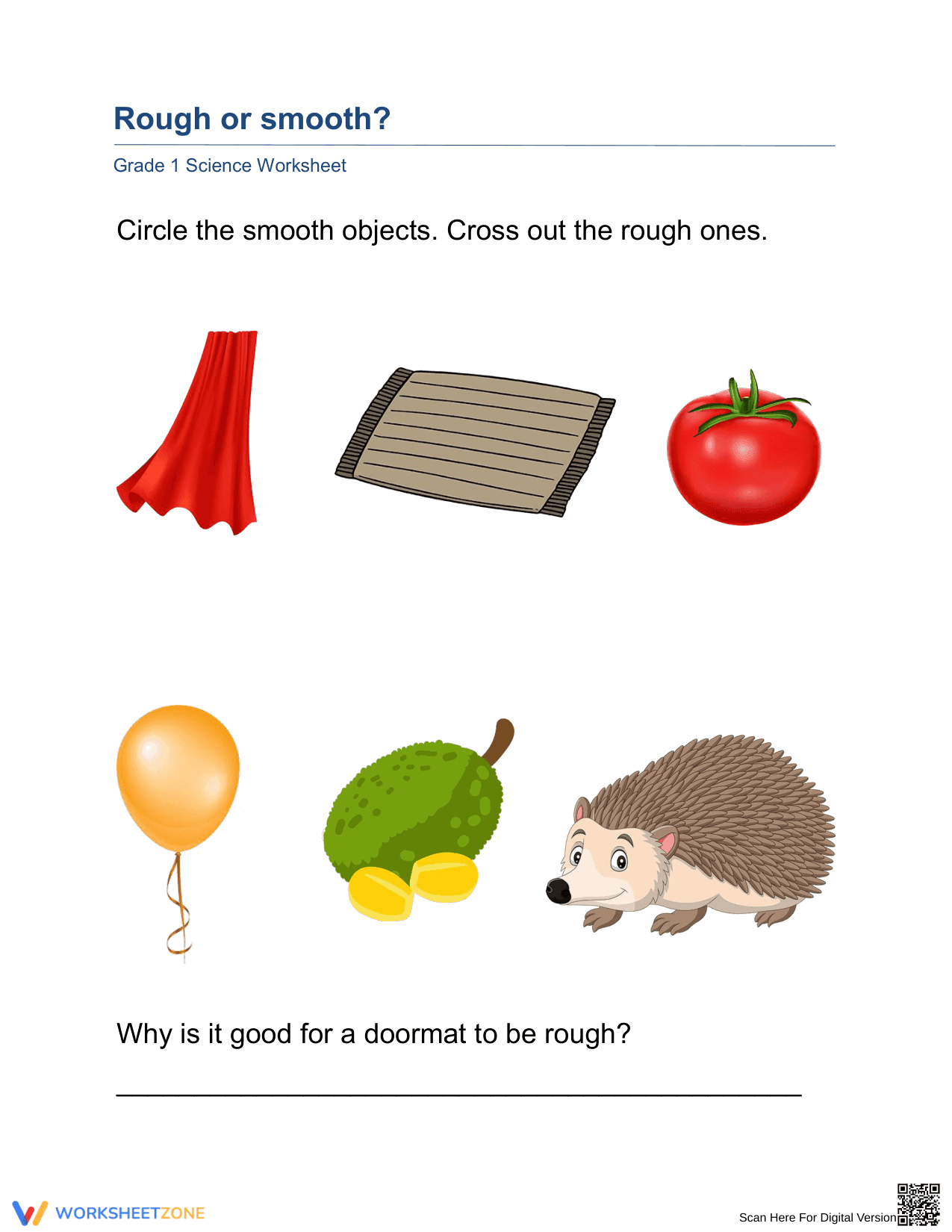


Essential Grade 1 Science: Rough or Smooth? Worksheet
Paste this activity's link or code into your existing LMS (Google Classroom, Canvas, Teams, Schoology, Moodle, etc.).
Students can open and work on the activity right away, with no student login required.
You'll still be able to track student progress and results from your teacher account.
This Grade 1 science worksheet focuses on the observable property of texture, prompting learners to differentiate between rough and smooth objects using familiar visual examples. By the end of this exercise, students will confidently categorize materials based on their tactile characteristics and understand how physical properties influence an object's function.
At a Glance
- Grade: 1 · Subject: Science
- Standard:
2-PS1-1— Classify different kinds of materials by their observable properties like texture- Skill Focus: Texture differentiation (Rough vs. Smooth)
- Format: 1 page · 7 problems · Answer key included · PDF
- Best For: Introduction to physical properties of materials
- Time: 10–15 minutes
What's Inside
This one-page PDF features a clean, high-contrast layout designed for early elementary learners. The worksheet presents six distinct illustrations—including a tomato, a balloon, and a hedgehog—requiring students to circle smooth items and cross out rough ones. It also includes a critical thinking question regarding the practical application of texture in everyday objects like doormats. A comprehensive answer key is provided for quick evaluation.
Zero-Prep Workflow
Designed for maximum efficiency, this resource can be integrated into your science block in under two minutes. Simply print the required number of copies and distribute them as a warm-up or independent practice during your unit on matter. Because the instructions are concise and the visual cues are clear, students can begin working immediately with minimal teacher guidance, making this an ideal selection for emergency substitute plans.
Standards Alignment
This worksheet is primarily aligned to the 2-PS1-1 NGSS standard: "Plan and conduct an investigation to describe and classify different kinds of materials by their observable properties." While tailored for Grade 1 curricula, it builds the necessary prerequisite skills for 2nd-grade mastery by focusing on texture as a primary identifying characteristic. The standard code can be copied directly into lesson plans, IEP goals, or district curriculum mapping tools.
How to Use It
Use this worksheet as a summative check after a tactile sensory activity where students feel objects without looking. It works best during the exploration phase of a lesson to solidify descriptive vocabulary. During the activity, observe if students can justify why a hedgehog is rough compared to a balloon. Most first graders will complete the classification and the bonus question within 15 minutes.
Who It's For
This activity is created for Grade 1 students but is also suitable for Kindergarten enrichment or Grade 2 review. The use of clear imagery makes it highly accessible for English Language Learners and students with IEP accommodations who benefit from visual-heavy scaffolds. It pairs naturally with a physical properties anchor chart or a classroom material scavenger hunt where students find three more smooth items in the room.
Aligned to the NGSS 2-PS1-1 standard, this Grade 1 science resource focuses on the classification of materials based on observable physical properties, specifically texture. By distinguishing between rough and smooth surfaces through visual cues and real-world examples, students build foundational observation skills critical for later scientific inquiry. This pedagogical approach mirrors the findings of Fisher & Frey (2014) regarding the importance of scaffolding sensory descriptive language in early childhood education. The worksheet encourages students to apply their understanding to functional objects, such as doormats, bridging the gap between abstract classification and practical engineering applications. Such structured practice is essential for developing the cognitive flexibility required to categorize complex systems in higher grade levels. This resource serves as a reliable instrument for formative assessment, ensuring students master the vocabulary necessary to describe the physical world with precision and accuracy according to EdReports 2024 benchmarks.


