


























Views
Downloads
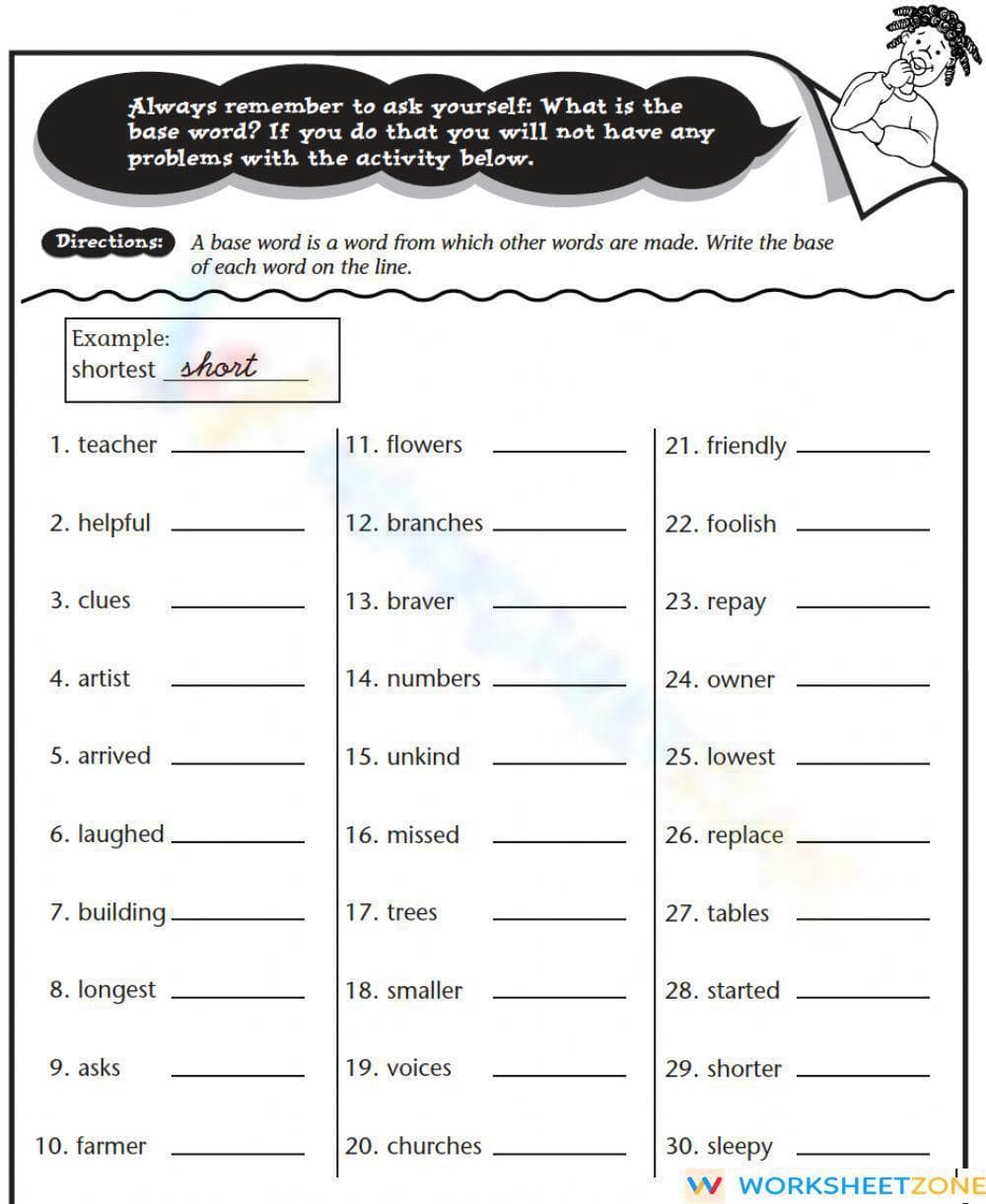

Essential Root Words Worksheet | Grade 3 Vocabulary
Paste this activity's link or code into your existing LMS (Google Classroom, Canvas, Teams, Schoology, Moodle, etc.).
Students can open and work on the activity right away, with no student login required.
You'll still be able to track student progress and results from your teacher account.
This Grade 3 vocabulary worksheet provides students with targeted practice in identifying base words from inflected and derived forms. By isolating the root of each word, learners develop morphological skills needed for decoding and reading comprehension. This resource ensures students can confidently break down complex words to determine their underlying meaning.
At a Glance
- Grade: 3 · Subject: English Language Arts
- Standard:
CCSS.ELA-LITERACY.L.3.4.C— Use a known root word as a clue to the meaning of unknown words- Skill Focus: Root word and base word identification
- Format: 1 page · 30 problems · Answer key included · PDF
- Best For: Vocabulary warm-ups and independent practice
- Time: 15–20 minutes
This single-page PDF contains thirty vocabulary tasks designed to strengthen morphological awareness. Students encounter words with common affixes like "teacher," "braver," and "unkind." The organized three-column layout provides ample writing space. A worked example models the process, ensuring clarity. A comprehensive answer key is included to facilitate rapid grading or student self-reflection.
Implementing this resource requires minimal effort. First, print the required copies (30 seconds). Second, distribute the worksheets during a transition or at the start of the vocabulary block (1 minute). Finally, use the included answer key to review responses collectively or grade them independently (1 minute). Total teacher preparation time is under two minutes, making this ideal for sub plans or morning work routines.
This resource is aligned to `CCSS.ELA-LITERACY.L.3.4.C`, which focuses on using a known root word as a clue to the meaning of an unknown word with the same root. Students practice this skill across thirty varied examples, reinforcing their understanding of how affixes modify base meanings. This standard code can be copied directly into lesson plans, IEP goals, or district curriculum mapping tools.
Use this worksheet as a morning warm-up to activate prior knowledge before a grammar lesson. It also serves as an effective formative assessment tool following direct instruction on prefixes and suffixes; teachers should observe if students correctly identify root changes in words like "arrived" or "missed." Most students will complete the thirty tasks in fifteen to twenty minutes, allowing for a quick instructional check.
This practice sheet is designed for Grade 3 students, though it is highly appropriate for Grade 2 enrichment or Grade 4 remediation. It is particularly helpful for English Language Learners and students with IEP goals focused on vocabulary acquisition. Pair this worksheet with a root word anchor chart or a short reading passage to see these skills applied in a broader context.
According to the RAND AIRS 2024 report on elementary literacy, explicitly teaching students to decompose complex words into root words and affixes is a high-leverage practice that correlates with increased reading comprehension. This Grade 3 worksheet targets CCSS.ELA-LITERACY.L.3.4.C, requiring learners to isolate the base word from thirty common inflected forms. By isolating the root, students develop morphological awareness to decipher unfamiliar multisyllabic words across content areas. The systematic practice reinforces mental models needed for rapid word recognition and structural analysis. Research indicates morphological instruction is particularly beneficial for students who struggle with traditional phonics, providing a semantic anchor for decoding. This self-contained practice sheet is a vital component in a literacy framework focused on building independent word-solving strategies.


