


























Views
Downloads
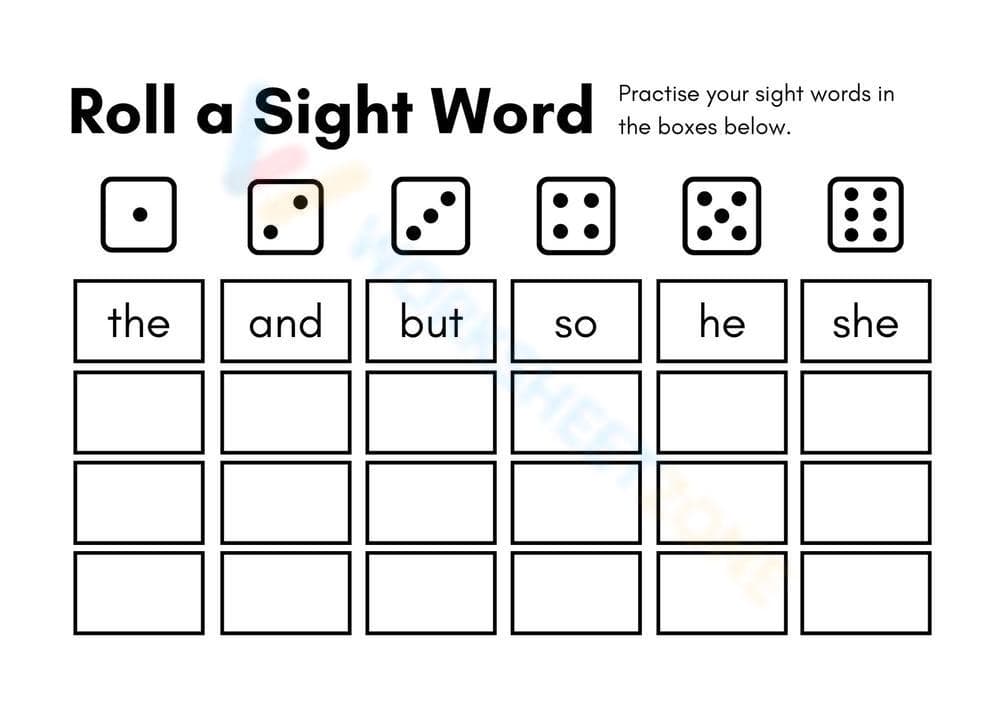

Roll a Sight Word Worksheet | Printable Grade K ELA
Paste this activity's link or code into your existing LMS (Google Classroom, Canvas, Teams, Schoology, Moodle, etc.).
Students can open and work on the activity right away, with no student login required.
You'll still be able to track student progress and results from your teacher account.
This Kindergarten sight word worksheet transforms spelling practice into an engaging game. Students use a die to determine which high-frequency word to write, reinforcing word recognition and fine motor skills simultaneously. By gamifying the repetition required for sight word mastery, this resource ensures students remain focused while building foundational reading fluency and confidence.
At a Glance
- Grade: K · Subject: ELA
- Standard:
CCSS.ELA-LITERACY.RF.K.3.C— Read common high-frequency words by sight- Skill Focus: Sight word spelling and recognition
- Format: 1 page · 18 practice boxes · No answer key needed · PDF
- Best For: Independent literacy centers or morning work
- Time: 10–15 minutes
The worksheet features a clear, organized grid containing six essential sight words: the, and, but, so, he, and she. Each word is paired with a specific dice face illustration. Below the header, students find three empty rows providing 18 total opportunities for handwriting practice. The clean layout minimizes visual distractions, making it ideal for early learners who are still developing spatial awareness on the page.
This resource is designed for immediate classroom implementation with a total teacher prep time of under 2 minutes. First, print the single-page PDF for your class or small group. Second, distribute the sheets along with a standard six-sided die to each student or pair. Third, review the completed handwriting during a quick walk-around or at the end of the literacy block. Its self-explanatory nature makes it a perfect emergency sub plan component.
This activity is specifically aligned with `CCSS.ELA-LITERACY.RF.K.3.C`, which requires students to read common high-frequency words by sight. By requiring students to read the word associated with their dice roll and then transcribe it, the worksheet bridges the gap between visual recognition and orthographic mapping. Both standard codes can be copied directly into lesson plans, IEP goals, or district curriculum mapping tools.
Use this worksheet during your daily literacy rotations as an independent "Word Work" station. It provides a tactile alternative to traditional flashcards. For a formative assessment, observe whether students are reading the word aloud before writing it; this indicates they are connecting the phonemes to the graphemes. Expect most Kindergarten students to complete the 18 boxes within a 10 to 15-minute window.
This resource is tailored for Kindergarten students but serves as an excellent intervention tool for first-grade students or English Language Learners (ELL) who need additional exposure to high-frequency words. It pairs naturally with a sight word anchor chart or a shared reading passage that features these specific words to provide context for the vocabulary.
Research by Fisher & Frey (2014) emphasizes the importance of purposeful, repetitive practice in the gradual release of responsibility model, particularly for foundational skills like sight word acquisition. This worksheet applies those principles by providing a structured environment where students can practice high-frequency words independently. According to the CCSS.ELA-LITERACY.RF.K.3.C standard, mastering these "heart words" is a critical predictor of future reading fluency and comprehension. By integrating a gamified dice element, the worksheet increases student engagement and time-on-task, which are essential factors in long-term retention. Educational analysis suggests that multi-sensory approaches—combining visual recognition, physical rolling of dice, and the kinesthetic act of writing—strengthen the neural pathways associated with spelling. This 1-page resource offers a practical, evidence-based solution for early childhood educators seeking to build robust literacy foundations without extensive preparation or complex instructions.


