


























Views
Plays
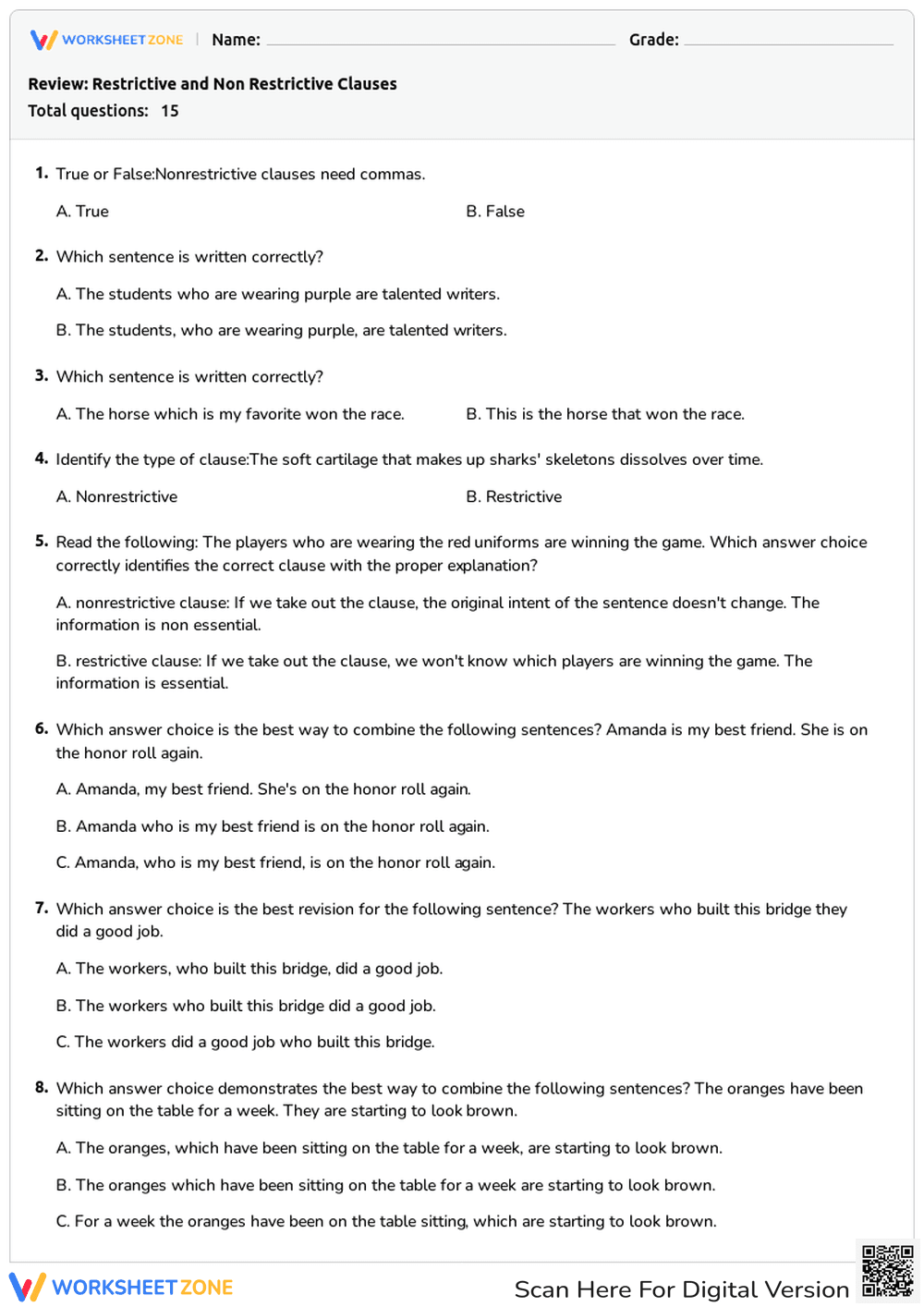


Essential Clauses Review Worksheet | Grade 5 ELA
Paste this activity's link or code into your existing LMS (Google Classroom, Canvas, Teams, Schoology, Moodle, etc.).
Students can open and work on the activity right away, with no student login required.
You'll still be able to track student progress and results from your teacher account.
This Grade 5 grammar worksheet provides a comprehensive review of restrictive and non-restrictive clauses. Students will practice identifying essential information versus parenthetical asides while mastering the specific punctuation rules required for each. By the end of these 15 exercises, learners will demonstrate clear proficiency in sentence structure and comma usage.
At a Glance
- Grade: 5 · Subject: ELA Grammar
- Standard:
CCSS.ELA-LITERACY.L.5.2— Use punctuation to separate items and clarify sentence meaning- Skill Focus: Restrictive vs. Non-restrictive Clauses
- Format: 2 pages · 15 problems · Answer key included · PDF
- Best For: Formative assessment or quick grammar review
- Time: 15–20 minutes
The resource consists of a two-page PDF featuring 15 targeted questions. It includes a mix of true/false definitions, multiple-choice sentence identification, and sentence combining tasks. A full answer key is provided, allowing for immediate feedback or self-grading. The layout is clean and distraction-free, focusing entirely on the mechanics of relative clauses.
Zero-Prep Workflow
This worksheet is designed for immediate classroom implementation with a total teacher prep time of under 2 minutes. Simply print the two-page document (30 seconds), distribute it to your students for independent work (30 seconds), and use the included answer key for a rapid whole-class review or individual grading (1 minute). It serves as an ideal sub plan or bell-ringer activity.
Standards Alignment
This resource aligns directly with `CCSS.ELA-LITERACY.L.5.2`, which requires students to demonstrate command of the conventions of standard English capitalization, punctuation, and spelling when writing. Specifically, it addresses the use of commas to set off non-essential information. Both standard codes can be copied directly into lesson plans, IEP goals, or district curriculum mapping tools.
How to Use It
Use this worksheet during the independent practice phase of a grammar lesson after introducing the concept of relative pronouns. It also functions effectively as a formative assessment to gauge student readiness before a larger writing project. Expect students to complete the 15 items in approximately 15 to 20 minutes, depending on their prior familiarity with clause types.
Who It's For
This activity is tailored for Grade 5 students but is highly effective for Grade 4 enrichment or Grade 6 remediation. It is particularly helpful for English Language Learners who struggle with the nuances of "that" versus "which." Pair this worksheet with a mentor text passage to help students identify these clauses in professional writing.
According to the RAND AIRS 2024 report on instructional materials, high-quality grammar supplements that focus on discrete syntactical skills, such as restrictive and non-restrictive clauses, significantly improve student writing clarity. This worksheet targets CCSS.ELA-LITERACY.L.5.2 by forcing students to distinguish between essential and non-essential information—a core component of sophisticated sentence construction. Research from Fisher & Frey (2014) emphasizes that gradual release through structured practice sets like these 15 questions allows students to internalize punctuation rules more effectively than isolated rote memorization. By providing clear examples of comma placement and clause identification, this resource ensures that learners can move from recognition to application in their own compositions. This alignment with evidence-based practices makes it a reliable tool for any upper-elementary ELA curriculum focused on mastery of complex grammar.


