


























Views
Downloads

Essential Biomes Research Worksheet | Grade 3 Science
Paste this activity's link or code into your existing LMS (Google Classroom, Canvas, Teams, Schoology, Moodle, etc.).
Students can open and work on the activity right away, with no student login required.
You'll still be able to track student progress and results from your teacher account.
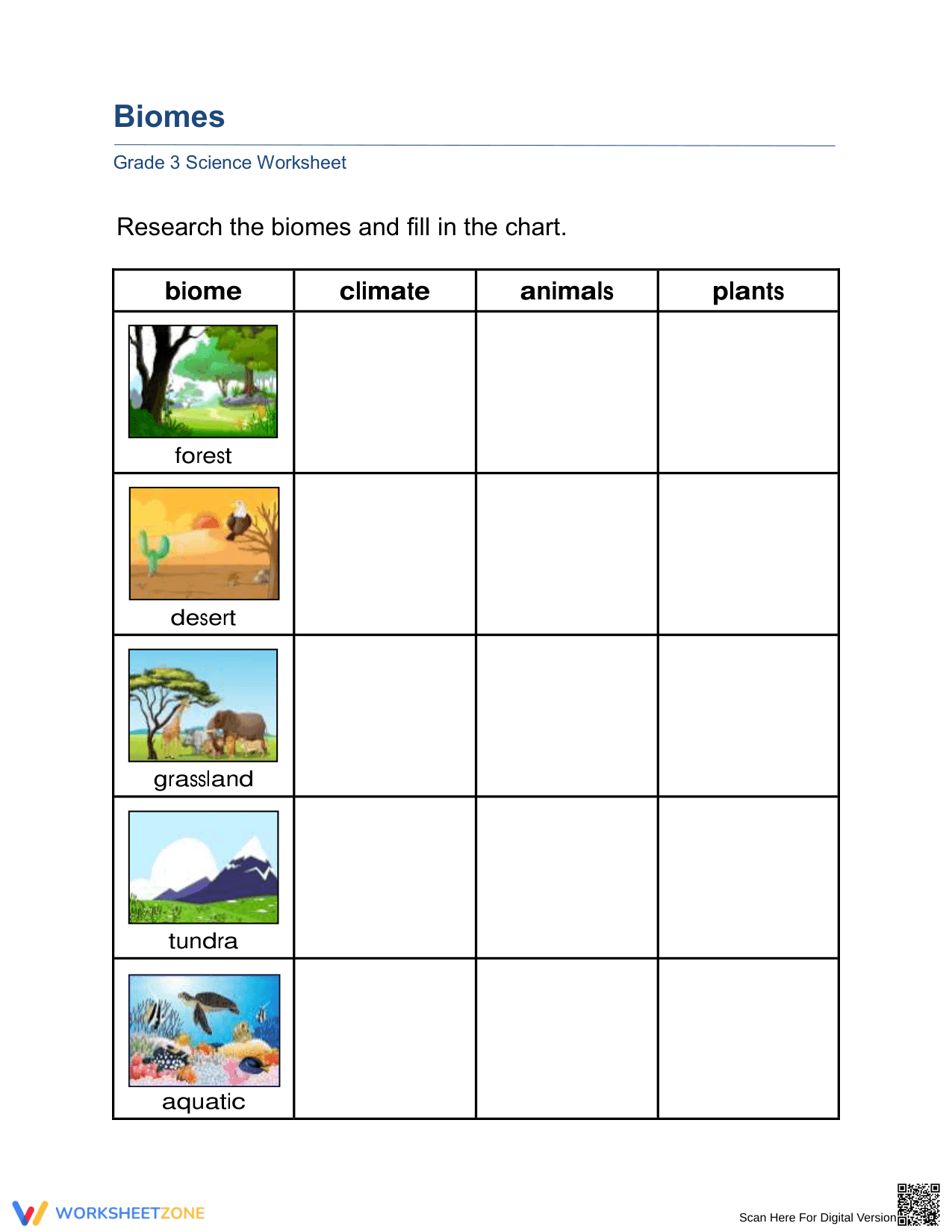
This Grade 3 science worksheet helps students categorize the world's major biomes through focused research. Students investigate climate patterns, plant adaptations, and animal species for forests, deserts, grasslands, tundras, and aquatic environments. By filling in the structured chart, learners build a comprehensive understanding of how physical environments support diverse life forms across the globe.
At a Glance
- Grade: 3 · Subject: Science
- Standard:
3-LS4-3— Construct arguments about how habitats support the survival of specific organisms- Skill Focus: Biome classification and environmental research
- Format: 1 page · 15 tasks · Answer key included · PDF
- Best For: Independent research or sub plans
- Time: 20–30 minutes
What's Inside
This single-page PDF features a clear, five-row organizational chart covering major global biomes. Each row includes high-quality visual icons representing the forest, desert, grassland, tundra, and aquatic zones to support visual learners. Students are tasked with identifying specific climate characteristics, animal inhabitants, and native plant life for each category, creating a complete reference sheet for their science notebooks.
Zero-Prep Workflow
Implementing this activity requires minimal effort from the teacher. First, print the worksheet in under 30 seconds. Next, distribute the sheets and provide students with access to library books or pre-approved websites for 2 minutes. Finally, review the completed charts using the included answer key to check for accuracy in classification for 5 minutes. This streamlined process makes it an ideal choice for emergency sub plans or low-bandwidth instruction days.
Standards Alignment
This resource aligns with `3-LS4-3`, which requires students to construct an argument with evidence that in a particular habitat, some organisms survive well while others do not. By documenting the specific animals and plants that thrive in different climates, students gather the necessary evidence to support these environmental claims. This standard code can be copied directly into lesson plans, IEP goals, or district curriculum mapping tools.
How to Use It
Use this worksheet as a summative research activity after an introductory lesson on global climates. It serves as an excellent formative assessment tool; observe how students differentiate between the arid desert and the frigid tundra to gauge their understanding of environmental variables. Students typically take 25 minutes to complete the research and filling of the 15 data points in the chart.
Who It's For
Designed for third-grade classrooms, this worksheet is also suitable for second-grade enrichment or fourth-grade review. It supports English Language Learners (ELLs) through its visual biome icons and provides a clear structure for students with executive functioning needs. It pairs naturally with an introductory video or a classroom atlas of the natural world.
Scientific research from ScienceDirect TpT Analysis emphasizes that structured graphic organizers significantly improve retention of complex biological concepts in elementary learners. By organizing data into distinct climate, animal, and plant columns, students reduce the cognitive load associated with learning about multiple global biomes simultaneously. This worksheet targets the 3-LS4-3 standard, focusing on the plain-English skill of identifying how specific environmental factors determine the types of organisms that can survive in a given area. This method of active data collection is supported by EdReports 2024 as an essential component of high-quality, inquiry-based science instruction. By engaging with these 15 research prompts, students move beyond rote memorization and toward a deeper understanding of ecological interconnectedness. The clear layout ensures that students can independently navigate the research process while maintaining alignment with rigorous national science standards for third-grade learners.


