


























Views
Downloads

Essential Grade 1-3 Pronoun Practice Worksheet | Aligned
Paste this activity's link or code into your existing LMS (Google Classroom, Canvas, Teams, Schoology, Moodle, etc.).
Students can open and work on the activity right away, with no student login required.
You'll still be able to track student progress and results from your teacher account.
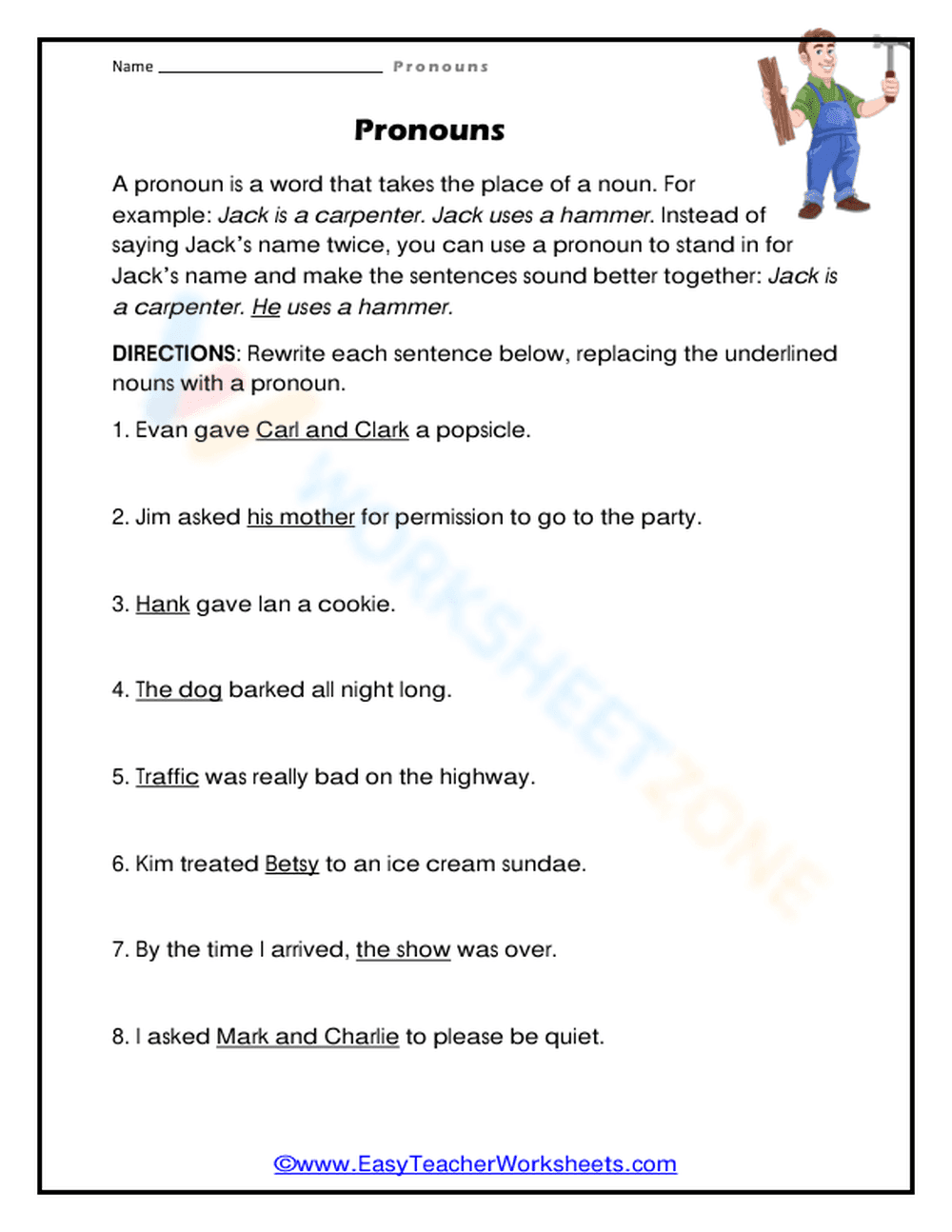
This Grade 1-3 grammar worksheet helps students master the essential skill of replacing nouns with personal pronouns to create more fluid and professional-sounding sentences. By focusing on the referential relationship between nouns and pronouns, students learn to eliminate redundancy and improve their overall writing mechanics through eight structured practice opportunities. This resource ensures students can independently identify and apply correct pronoun substitutions in varied sentence contexts.
At a Glance
- Grade: 1-3 · Subject: English Language Arts
- Standard:
CCSS.ELA-LITERACY.L.1.1.D— Use personal, possessive, and indefinite pronouns correctly in writing and speech- Skill Focus: Noun-Pronoun Substitution
- Format: 1 page · 8 problems · Answer key included · PDF
- Best For: Independent practice or quick literacy centers
- Time: 10–15 minutes
What's Inside: This single-page PDF includes a clear instructional header that defines pronouns and provides a worked example (Jack to He) to anchor student understanding. The worksheet features eight sentence-level tasks where students rewrite specific sentences, replacing underlined proper and common nouns with the appropriate form of a pronoun. The clean layout and focused task count prevent cognitive overwhelm while ensuring sufficient repetition for skill retention. A full answer key is provided to facilitate rapid grading or student self-check.
The zero-prep design follows a streamlined three-step workflow. First, print the single-page PDF in seconds. Second, distribute the worksheet for independent practice or as a transition activity. Third, review student responses using the included answer key for immediate feedback. Total teacher preparation time is less than two minutes, making this an ideal resource for morning work, literacy centers, or emergency sub plans. The self-contained instructional header ensures that students can begin the task without extensive teacher-led explanations.
Standards Alignment: This resource is directly aligned with `CCSS.ELA-LITERACY.L.1.1.D`, which requires students to use personal, possessive, and indefinite pronouns. It also supports higher-grade standards for mechanics and sentence variety. Both standard codes can be copied directly into lesson plans, IEP goals, or district curriculum mapping tools to ensure instructional compliance and tracking.
How to Use It: Assign this worksheet as a formative assessment after an introductory lesson on parts of speech to gauge student readiness for more complex sentence structures. During the activity, observe if students correctly differentiate between singular and plural pronouns (e.g., swapping 'Mark and Charlie' for 'them' or 'they' depending on the sentence role). Expected completion time is 10 to 15 minutes, making it perfect for a focused warm-up or a wrap-up exit ticket.
Who It's For: This worksheet is designed for early elementary students in Grades 1 through 3, as well as English Language Learners (ELL) who are developing foundational grammar skills. It offers a structured way to practice linguistic substitution. For students needing more support, pair this worksheet with a visual anchor chart displaying common subject and object pronouns to serve as a reference during the rewriting process.
Aligned to CCSS.ELA-LITERACY.L.1.1.D, this resource targets the fundamental skill of replacing nouns with pronouns to improve sentence flow and cohesion. According to the 2024 NAEP framework for writing and language, early mastery of grammatical substitution is a critical predictor of later syntactic complexity and reading fluency. Students must not only recognize pronouns but understand their referential relationship to antecedent nouns. This worksheet provides eight structured opportunities for students to apply this substitution rule in various sentence contexts, including plural subjects and direct objects. By transitioning from repetitive noun usage to fluid pronoun integration, learners build the linguistic infrastructure necessary for narrative and informational writing. The inclusion of a clear definition and worked example supports independent practice, making it an effective tool for both initial instruction and targeted intervention in early elementary classrooms.


