


























Views
Downloads
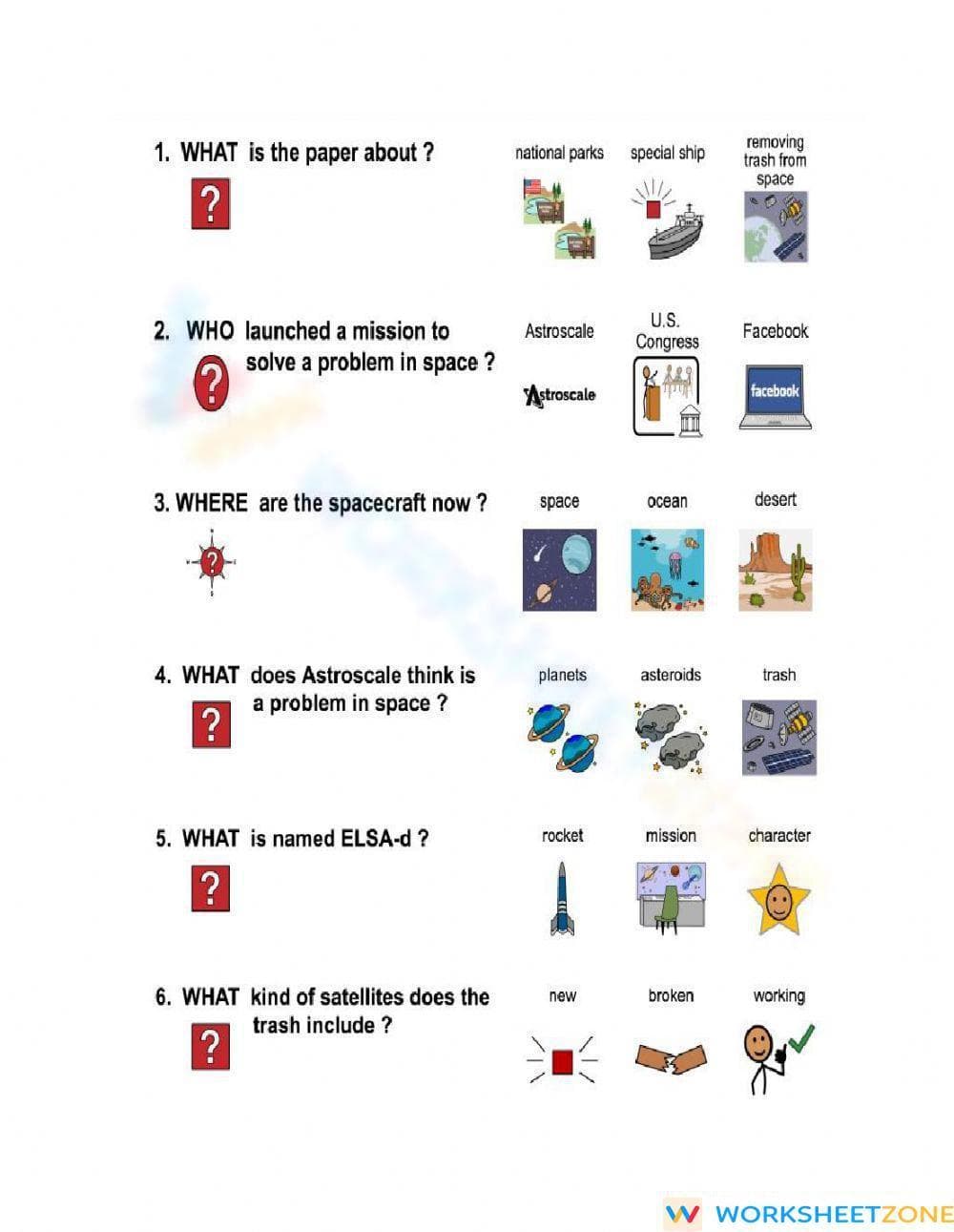

Removing Trash from Space Review | Grade 3-7 Printable
Paste this activity's link or code into your existing LMS (Google Classroom, Canvas, Teams, Schoology, Moodle, etc.).
Students can open and work on the activity right away, with no student login required.
You'll still be able to track student progress and results from your teacher account.
This ELA worksheet provides a focused review of the "Removing Trash from Space" topic, helping students master key details and main idea extraction. By answering six symbol-supported questions, learners demonstrate their understanding of informational text while building confidence in their reading comprehension skills. The visual support makes it accessible for all levels.
At a Glance
- Grade: 3–7 · Subject: ELA
- Standard:
CCSS.ELA-LITERACY.RI.3.1— Ask and answer questions to demonstrate understanding of a text- Skill Focus: Identifying key details (Who, What, Where)
- Format: 1 page · 6 problems · Answer key included · PDF
- Best For: Independent review and formative assessment
- Time: 10–15 minutes
This single-page PDF features six multiple-choice questions for quick assessment. Each question is paired with colorful symbols to support diverse learners, including those in special education. The resource includes a clear answer key, ensuring students can track their progress through the space trash unit.
Zero-Prep Workflow
This resource is designed for immediate classroom implementation. Teachers can follow a simple three-step process: Print the single-page document (30 seconds), Distribute to the class for independent or small-group work (1 minute), and Review using the provided answer key for instant grading (30 seconds). The total preparation time is under two minutes, making it an ideal choice for morning work, sub plans, or quick exit ticket formative assessments.
Standards Alignment
Aligned to CCSS.ELA-LITERACY.RI.3.1, students ask and answer questions to demonstrate understanding of a text, referring explicitly to the text as the basis for the answers. This worksheet specifically targets the identification of key details such as participants, locations, and central problems. Both standard codes can be copied directly into lesson plans, IEP goals, or district curriculum mapping tools.
How to Use It
Use this worksheet as a post-reading check after exploring a text or video about space debris. It works effectively during the independent practice phase of a gradual release model. For a formative assessment tip, observe which students rely on the symbols versus the text; this observation provides valuable data on their decoding versus comprehension levels. Expect completion within 10-15 minutes.
Who It's For
This resource is perfect for Grades 3-7 students who benefit from visual scaffolding. It is well-suited for inclusion classrooms and English Language Learners. Pair this worksheet with an anchor chart about Wh- Questions or a short passage about the ELSA-d mission to provide a complete instructional loop.
According to the RAND AIRS 2024 analysis, symbol-supported text and structured questioning significantly improve comprehension outcomes for learners with diverse processing needs. This worksheet targets the core requirement of CCSS.ELA-LITERACY.RI.3.1, which demands that students extract specific evidence from informational texts. By focusing on high-interest topics like space technology and environmental stewardship (the removal of orbital trash), the resource maintains student engagement while meeting rigorous ELA standards. Research from EdReports 2024 emphasizes that frequent, low-stakes formative assessments are critical for identifying gaps in key detail acquisition before moving to higher-order summarization tasks. This summary serves as a technical verification of the worksheet's alignment with evidence-based instructional practices, confirming that its 6-task structure provides a sufficient data point for mastery of elementary-level informational reading benchmarks in inclusive educational settings.


