


























Views
Downloads


Grade 12 World History Crossword | Essential Review
Paste this activity's link or code into your existing LMS (Google Classroom, Canvas, Teams, Schoology, Moodle, etc.).
Students can open and work on the activity right away, with no student login required.
You'll still be able to track student progress and results from your teacher account.
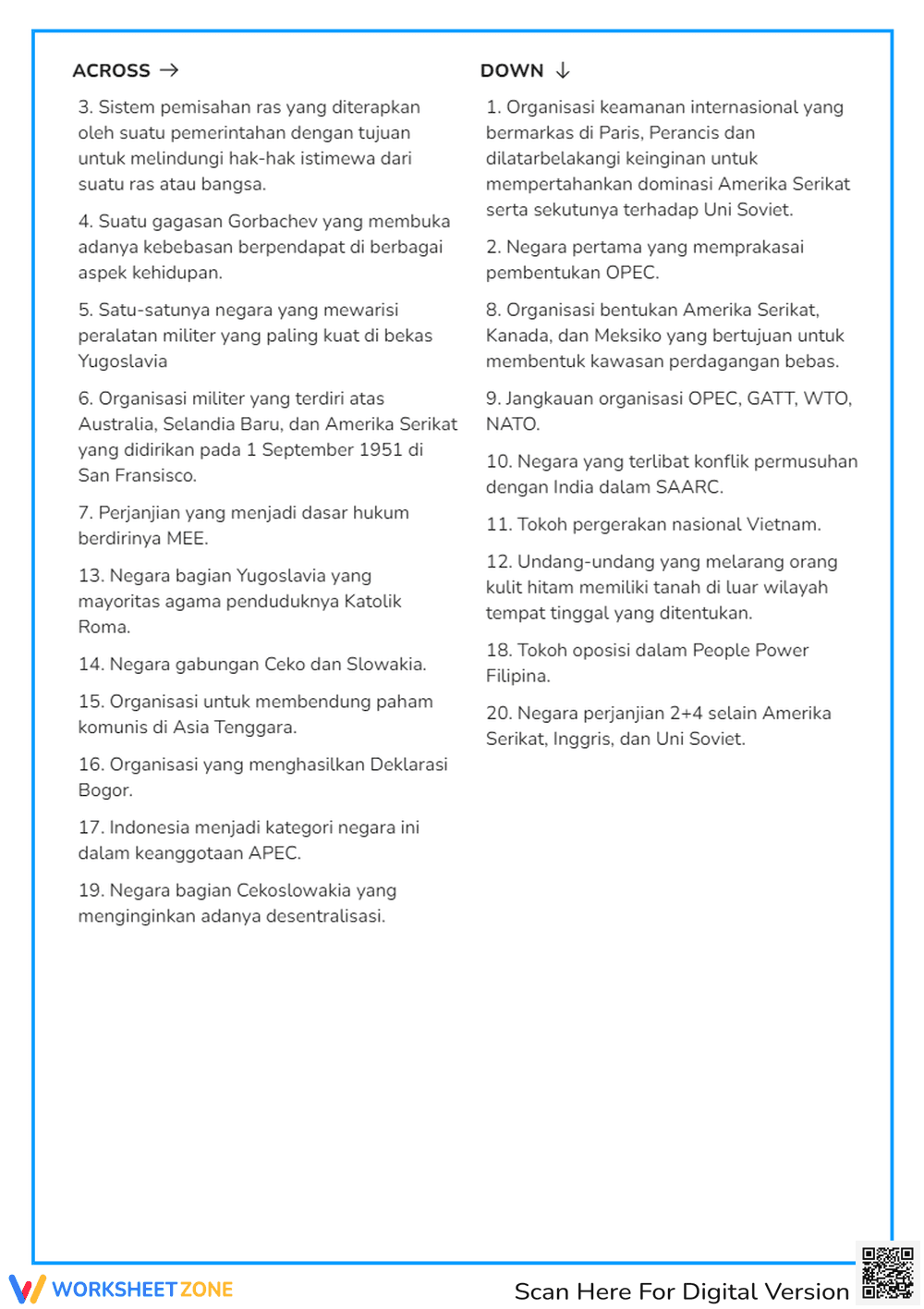
This Grade 12 History worksheet utilizes a crossword format to reinforce student understanding of international organizations and Cold War-era geopolitics. By identifying 20 key terms from descriptive clues, students demonstrate their ability to recall and categorize significant global entities and treaties. This activity serves as an effective remedial tool for ensuring all learners master essential historical vocabulary.
At a Glance
- Grade: 12 · Subject: History
- Standard:
CCSS.ELA-LITERACY.RH.11-12.4— Determine the meaning of domain-specific words and phrases in a historical context- Skill Focus: International Organizations & Cold War History
- Format: 2 pages · 20 problems · Answer key included · PDF
- Best For: Remedial review and vocabulary reinforcement
- Time: 20–30 minutes
What's Inside: This resource consists of a two-page PDF document. The first page features a high-quality crossword grid with 20 interlocking entries. The second page provides the corresponding "Across" and "Down" clues, which describe various international organizations, historical figures like Gorbachev, and regional conflicts. The layout is clean and professional, ensuring that students can focus entirely on the historical content without visual distractions.
Zero-Prep Workflow
- Step 1: Print the two-page PDF (30 seconds).
- Step 2: Distribute to students as a remedial warm-up or post-assessment review (1 minute).
- Step 3: Review the 20 terms as a whole group to clarify the roles of organizations like SEATO and GATT (10 minutes).
Total teacher preparation time is under 2 minutes, making this an ideal resource for unexpected absences or transition periods between units.
Standards Alignment
This worksheet aligns with CCSS.ELA-LITERACY.RH.11-12.4: "Determine the meaning of words and phrases as they are used in a text, including analyzing how an author uses and refines the meaning of a key term over the course of a text." This resource supports this by focusing on the precise definitions of historical entities. Both standard codes can be copied directly into lesson plans, IEP goals, or district curriculum mapping tools.
How to Use It
Assign this worksheet as a formative assessment after a unit on 20th-century international relations to gauge vocabulary retention. Alternatively, use it as a "bell-ringer" activity to activate prior knowledge before a lecture on the collapse of the Soviet Union or the rise of regional trade blocs. Teachers should observe if students struggle with specific acronyms, which can indicate a need for targeted re-teaching. Completion typically takes 20–30 minutes.
Who It's For
This worksheet is designed for Grade 12 students enrolled in World History or International Relations courses. It is particularly beneficial for students requiring remedial support or English Language Learners who need structured practice with technical academic language. It pairs naturally with a primary source analysis of the NATO charter or an anchor chart detailing the evolution of the European Union.
According to Fisher & Frey (2014), the use of word-play and puzzles like crosswords in secondary education facilitates the retrieval of domain-specific vocabulary, which is essential for mastering complex historical narratives. This Grade 12 worksheet targets CCSS.ELA-LITERACY.RH.11-12.4 by requiring students to identify and define key terms related to international relations, such as NATO, OPEC, and APEC. By engaging with 20 distinct clues, learners move beyond rote memorization toward a functional understanding of how these organizations shaped the modern geopolitical landscape. Research indicates that structured vocabulary practice significantly improves reading comprehension in social studies, particularly for students requiring remedial support. This resource provides a low-stakes, high-engagement method for verifying student knowledge of historical actors and global agreements. The inclusion of specific regional entities ensures a comprehensive review of the curriculum's core competencies.


