


























Views
Plays
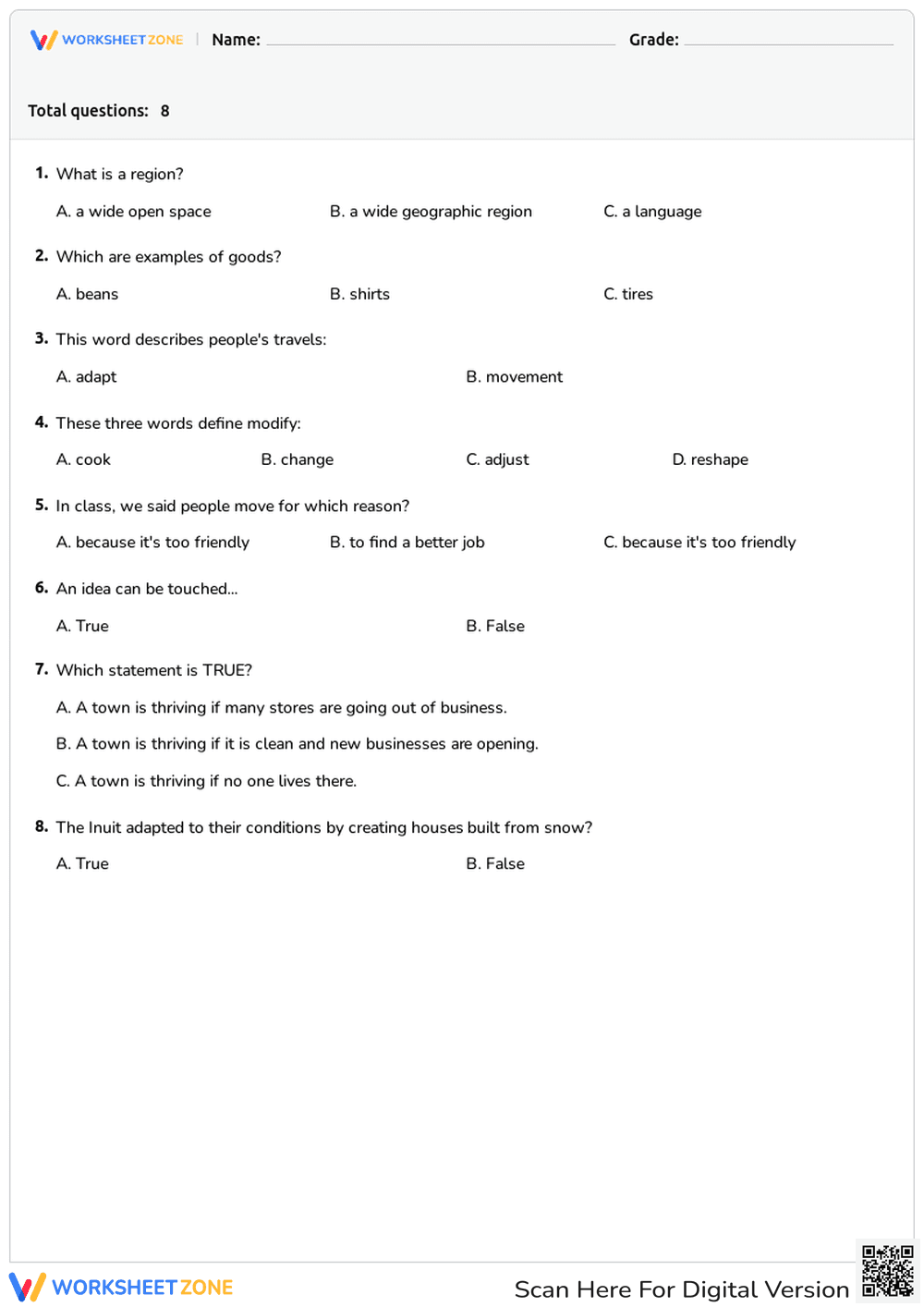

Printable Geography Quiz | Grade 4-5 Regions & Goods
Paste this activity's link or code into your existing LMS (Google Classroom, Canvas, Teams, Schoology, Moodle, etc.).
Students can open and work on the activity right away, with no student login required.
You'll still be able to track student progress and results from your teacher account.
This Grade 4 and 5 geography worksheet provides students with targeted practice on foundational social studies vocabulary. By completing this assessment, learners demonstrate their understanding of human-environment interaction, economic goods, and geographic regions. The straightforward format ensures students can focus entirely on recalling and applying key concepts.
At a Glance
- Grade: 4 · Subject: Geography
- Standard:
CCSS.ELA-LITERACY.RI.4.4— Determine the meaning of domain-specific words- Skill Focus: Geography vocabulary and human adaptation
- Format: 1 page · 8 problems · Answer key included · PDF
- Best For: Formative assessment or independent practice
- Time: 10–15 minutes
Inside this resource, educators will find a single-page assessment featuring eight varied questions. The task types include multiple-choice and true/false formats, covering essential topics such as the definition of regions, examples of economic goods, human movement, and cultural adaptation. A complete answer key is provided to streamline the grading process and ensure accurate feedback.
Zero-Prep Workflow
- Print (1 minute): Simply download the PDF and print a class set. The black-and-white design is ink-friendly and requires no special formatting.
- Distribute (1 minute): Hand out the single-page quiz to students as a quick warm-up, exit ticket, or independent assignment.
- Review (3 minutes): Use the included answer key to rapidly grade submissions or conduct a whole-class review session.
Total teacher preparation time is under two minutes, making this an ideal, self-explanatory activity for emergency sub plans or busy instructional days.
Standards Alignment
This resource aligns with CCSS.ELA-LITERACY.RI.4.4: Determine the meaning of general academic and domain-specific words or phrases in a text relevant to a grade 4 topic or subject area. It also supports broader social studies frameworks focusing on people, places, and environments. Both standard codes can be copied directly into lesson plans, IEP goals, or district curriculum mapping tools.
How to Use It
Deploy this worksheet after direct instruction on human geography to measure initial comprehension. It serves perfectly as a Friday quiz or an end-of-unit review activity. As a formative assessment observation tip, monitor which specific vocabulary terms (like "modify" or "goods") cause the most hesitation, indicating a need for targeted reteaching. Expected completion time ranges from 10 to 15 minutes, depending on reading fluency.
Who It's For
This assessment is designed primarily for fourth and fifth-grade students in general education social studies classrooms. The clear, uncluttered layout provides built-in differentiation for students who benefit from reduced visual distractions. Pair this quiz with a visual anchor chart detailing human-environment interactions to support English Language Learners during review.
Mastering domain-specific vocabulary is a critical component of social studies literacy. When students engage with targeted assessments aligned to CCSS.ELA-LITERACY.RI.4.4, they practice how to determine the meaning of domain-specific words, which directly impacts their ability to comprehend complex historical and geographic texts. According to Fisher & Frey (2014), explicit vocabulary instruction combined with frequent, low-stakes formative assessment significantly increases long-term retention of academic language. This worksheet provides exactly that type of structured, low-stakes retrieval practice. By asking students to identify examples of goods, define regions, and evaluate statements about human adaptation, educators can quickly gauge conceptual mastery. Regular exposure to these terms in varied formats ensures that learners build the robust background knowledge necessary for advanced social studies coursework and critical thinking tasks.


