


























Views
Downloads

Essential Reflexive Pronouns Quiz | Grade 2-4 ELA
Paste this activity's link or code into your existing LMS (Google Classroom, Canvas, Teams, Schoology, Moodle, etc.).
Students can open and work on the activity right away, with no student login required.
You'll still be able to track student progress and results from your teacher account.
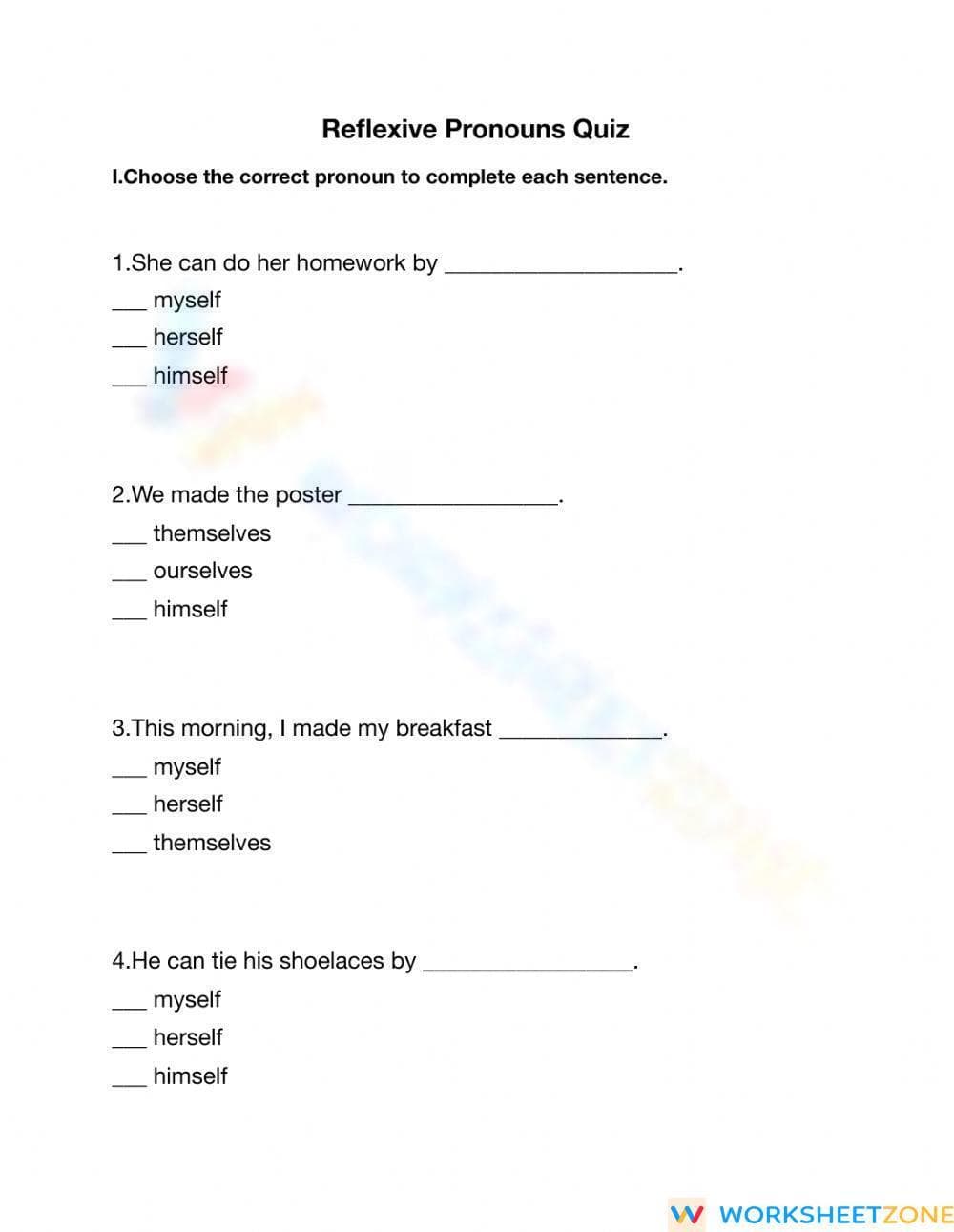
This essential reflexive pronouns quiz provides students in grades 2 through 4 with targeted practice in identifying and using self-referential grammar structures correctly. By completing these structured sentences, learners solidify their understanding of how pronouns like myself, herself, and ourselves function in context, leading to improved sentence variety and grammatical precision.
At a Glance
- Grade: 2-4 · Subject: ELA
- Standard:
CCSS.ELA-LITERACY.L.2.1.C— Use reflexive pronouns such as myself, ourselves, and themselves in sentences- Skill Focus: Reflexive Pronouns
- Format: 2 pages · 8 problems · Answer key included · PDF
- Best For: Grammar review or quick formative assessment
- Time: 10–15 minutes
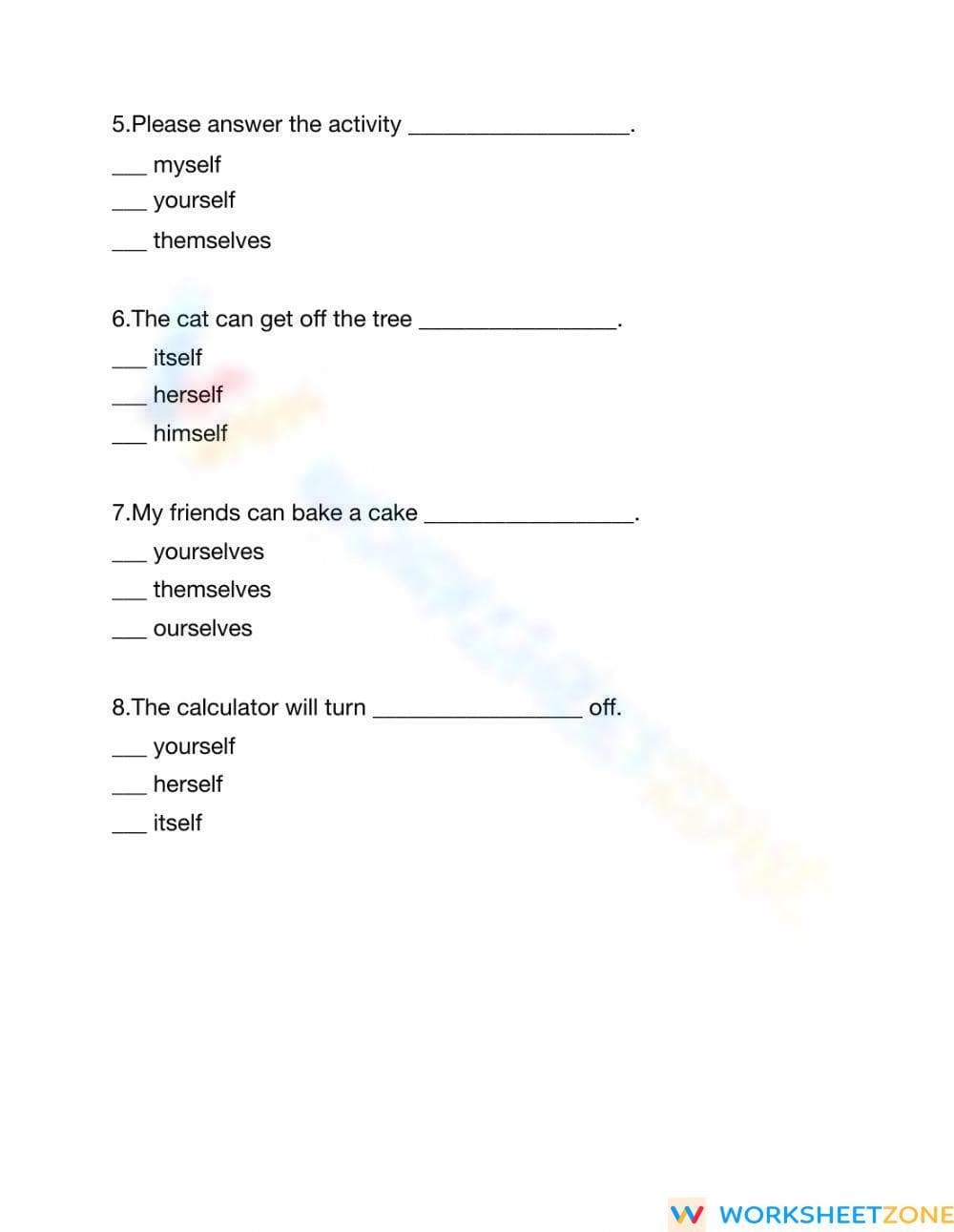
This resource features 8 carefully crafted multiple-choice questions across two printable pages. Each item presents a complete sentence with a missing pronoun, requiring students to analyze the subject to select the matching reflexive form. The layout is clean and distraction-free, providing white space for young learners to focus on the linguistic relationship between subjects and their corresponding pronouns. A full answer key is provided.
The worksheet follows a logical skill progression. Guided practice begins with sentences featuring clear human subjects (e.g., "She", "I"), providing 4 initial opportunities to recognize direct self-reference. Supported practice introduces plural forms and second-person scenarios, requiring a deeper understanding of agreement. Finally, independent practice challenges students with non-human subjects like "the cat," ensuring the concept is generalized across noun types. This gradual-release approach builds student confidence.
This worksheet is specifically aligned to `CCSS.ELA-LITERACY.L.2.1.C`, which requires students to use reflexive pronouns appropriately. The tasks also support higher-grade conventions by reinforcing subject-verb agreement and pronoun-antecedent clarity. Both standard codes can be copied directly into lesson plans, IEP goals, or district curriculum mapping tools to ensure instructional consistency across the primary ELA curriculum.
Incorporate this quiz as a "ticket out the door" after a direct instruction lesson to gauge immediate student comprehension. Alternatively, use it during small-group rotations to provide extra scaffolding for students who struggle with pronoun-antecedent agreement. Teachers should observe whether students can identify the subject before choosing the pronoun. Most students will complete the eight tasks in approximately 12 minutes.
This resource is ideal for Grade 2 students first encountering the concept, as well as Grade 3 and 4 students requiring a refresher. The multiple-choice format makes it accessible for English Language Learners (ELL) who benefit from seeing correct linguistic models alongside distractors. It pairs naturally with an anchor chart displaying reflexive forms for student reference.
Effective grammar instruction requires moving beyond rote memorization to contextual application, a principle emphasized in this reflexive pronouns resource. Aligned with CCSS.ELA-LITERACY.L.2.1.C, this worksheet targets the ability to use pronouns like myself and ourselves to indicate that the subject and object of a sentence are the same. Research by Fisher & Frey (2014) highlights the importance of the gradual release of responsibility model, which is mirrored here through the progression from simple human antecedents to more complex inanimate subjects. By providing eight focused opportunities for students to analyze sentence structure and select the correct reflexive form, this tool helps bridge the gap between recognizing grammar rules and applying them in original composition. It serves as a reliable instrument for both initial skill acquisition and long-term retention of essential ELA conventions, ensuring students develop the foundational literacy skills required for academic success.


