


























Views
Downloads


Printable Redwall Novel Study Part 5 | Grade 7-10 ELA
Paste this activity's link or code into your existing LMS (Google Classroom, Canvas, Teams, Schoology, Moodle, etc.).
Students can open and work on the activity right away, with no student login required.
You'll still be able to track student progress and results from your teacher account.
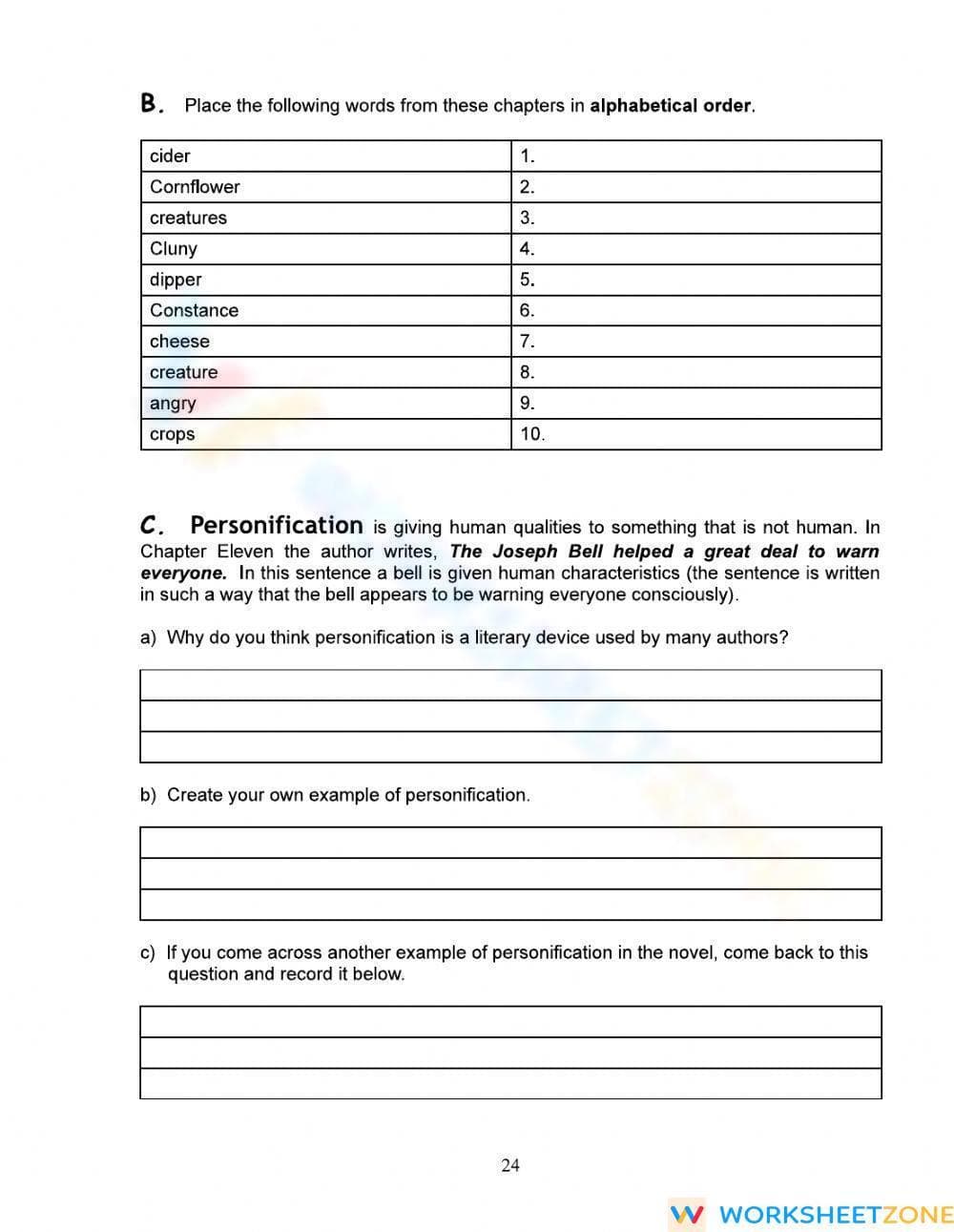
This Redwall Novel Study Part 5 worksheet facilitates deep literary analysis for students in middle and high school. By focusing on figurative language and organizational skills, learners strengthen their comprehension of Brian Jacques' classic text. Students analyze personification, practice alphabetical sorting of key vocabulary, and engage in collaborative character exploration to build a robust literary foundation.
At a Glance
- Grade: 7–10 · Subject: ELA Literature
- Standard:
CCSS.ELA-LITERACY.RL.7.4— Determine the meaning of words and phrases, including figurative and connotative meanings- Skill Focus: Figurative Language (Personification) & Alphabetical Order
- Format: 2 pages · 14 tasks · Answer key included · PDF
- Best For: Literature circles and independent novel study practice
- Time: 40–50 minutes
This two-page PDF resource provides a structured approach to analyzing Chapter Eleven of Redwall. It contains a vocabulary sorting table with 10 words, a dedicated section defining and practicing personification with three targeted questions, and a collaborative "Talk Show" activity for character analysis. A full answer key ensures efficient grading for busy educators while providing immediate feedback for students.
- Guided practice: Students receive a formal definition and a concrete example of personification from the text to establish a strong conceptual foundation.
- Supported practice: Learners analyze the author's intent behind using literary devices and then attempt to generate their own original examples of personification.
- Independent practice: The "Talk Show" activity requires students to synthesize their understanding of character motivations by drafting six unique interview questions and corresponding answers.
The primary standard addressed is CCSS.ELA-LITERACY.RL.7.4, which requires students to determine the meaning of words and phrases as they are used in a text, including figurative and connotative meanings. This worksheet specifically targets the identification and functional analysis of personification within a complex narrative. Supporting standards include CCSS.ELA-LITERACY.RL.7.1 for citing textual evidence. Both standard codes can be copied directly into lesson plans, IEP goals, or district curriculum mapping tools.
Assign this worksheet after students have completed reading Chapter Eleven to reinforce literary device identification. It works excellently as a centerpiece for small-group literature circles where students can collaborate on the Talk Show activity. Educators should observe student discussions during the character interview phase to formatively assess their grasp of character traits. Expected completion typically takes 45 minutes during a standard instructional block.
This resource is designed for students in grades 7 through 10, particularly those studying classic middle-grade or young adult fantasy. It provides necessary scaffolds for struggling readers through clear definitions while offering high-order thinking challenges for advanced learners. It pairs naturally with a character anchor chart or the Redwall primary text to deepen the overall instructional impact of the unit.
This Redwall Novel Study Part 5 worksheet targets essential ELA competencies by focusing on standard CCSS.ELA-LITERACY.RL.7.4, helping students appreciate how personification shapes narrative tone. It implements a research-backed gradual release strategy, moving from vocabulary sorting to sophisticated character role-play. With 14 distinct tasks across two pages, it provides effective practice for literary devices. The collaborative "Talk Show" element supports oral language development and character empathy, aligning with modern pedagogical standards. This is an essential resource for comprehensive fantasy literature units, offering high-quality, standards-based instruction.


