


























Views
Downloads

Essential Recycling & Compost Sort Worksheet | Grades 1-3
Paste this activity's link or code into your existing LMS (Google Classroom, Canvas, Teams, Schoology, Moodle, etc.).
Students can open and work on the activity right away, with no student login required.
You'll still be able to track student progress and results from your teacher account.
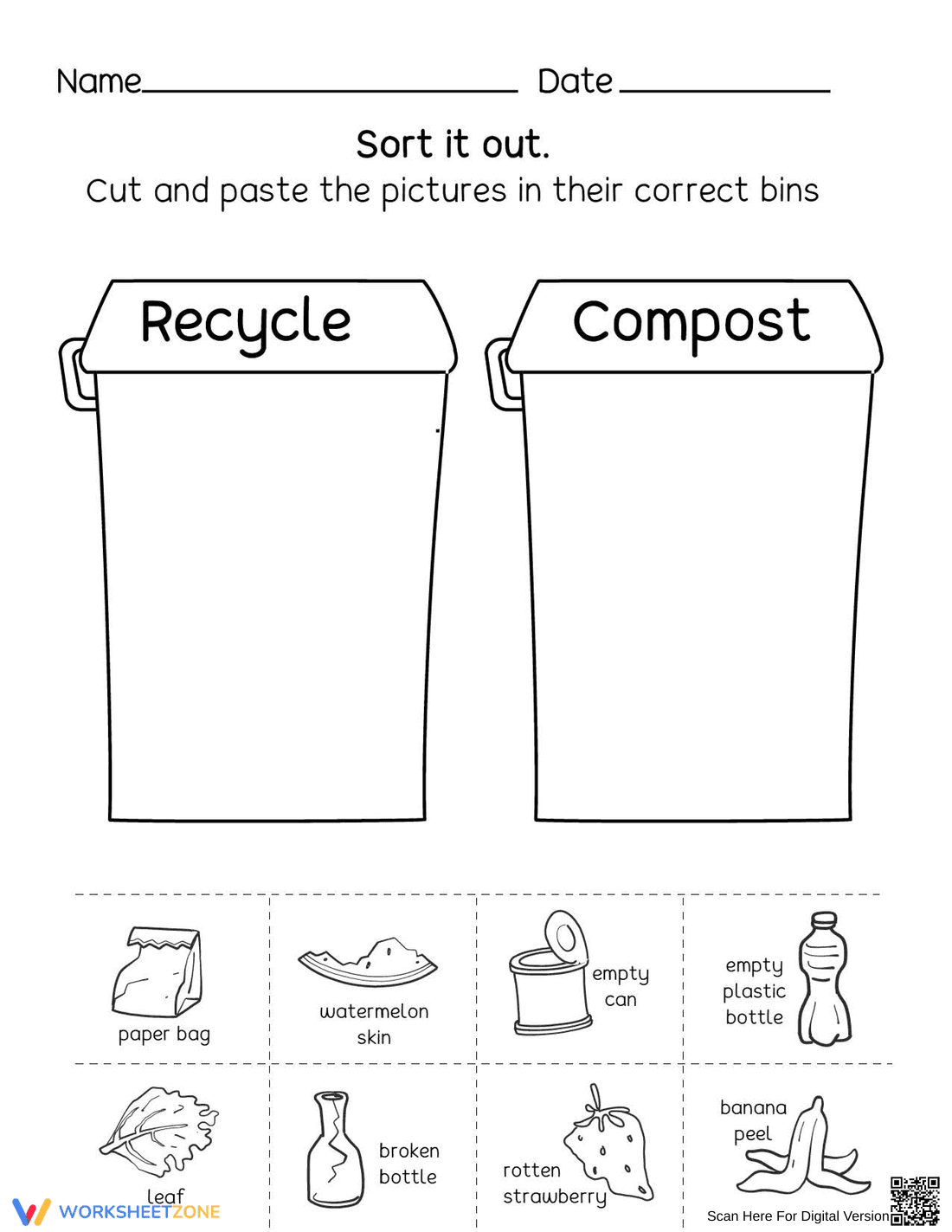
This hands-on waste management worksheet empowers students to identify and categorize household items into recycling and compost bins. By engaging in this sorting activity, young learners develop a foundational understanding of environmental stewardship and sustainable practices. It provides a practical application of science concepts related to human impact on the Earth.
At a Glance
- Grade: 1-3 · Subject: Science / Environment
- Standard:
K-ESS3-3— Communicate solutions that will reduce the impact of humans on the environment- Skill Focus: Waste Sorting & Categorization
- Format: 1 page · 8 problems · Answer key included · PDF
- Best For: Earth Day science or environmental lessons
- Time: 15–20 minutes
The worksheet features two large, clearly labeled bins for "Recycle" and "Compost." Below, students find a grid of eight distinct items, including a paper bag, watermelon skin, and an empty plastic bottle. Each item includes a clear illustration and a text label to support literacy development while reinforcing the environmental science objective.
This zero-prep resource is built for efficiency. Simply print the single-page PDF (30 seconds) and distribute with scissors and glue (1 minute). Students spend 15 minutes sorting 8 items, followed by a quick class review. Its print-and-go nature makes it perfect for substitute plans or Earth Day activities without any teacher setup required.
Aligned with K-ESS3-3, this activity helps students communicate solutions for reducing human impact. By distinguishing between organic waste and recyclables, learners practice core environmental stewardship. This standard code can be copied directly into lesson plans, IEP goals, or district curriculum mapping tools.
Use this worksheet as a formative assessment after a direct instruction lesson on "The Three Rs" (Reduce, Reuse, Recycle). Observe students as they sort to identify misconceptions—such as placing the rotten strawberry in the recycle bin—which provides an immediate instructional moment to discuss decomposition. It typically takes 15 to 20 minutes to complete.
This activity is designed for students in grades 1 through 3, offering enough visual support for early readers while maintaining conceptual relevance for older primary students. It pairs naturally with a read-aloud about Earth Day or a classroom waste audit. Differentiation is built-in through the combination of visual icons and text labels.
According to a ScienceDirect TpT Analysis, tactile activities like cut-and-paste sorting improve retention of categorization skills in early childhood. This worksheet addresses K-ESS3-3 by teaching students to distinguish waste streams, a core component of environmental literacy. Research from Fisher & Frey (2014) emphasizes that scaffolded independent practice is essential for moving students toward mastery of complex concepts. By correctly identifying where a banana peel or a plastic bottle belongs, students demonstrate a practical understanding of how actions contribute to global sustainability goals. This resource provides the structured repetition necessary to cement these values, ensuring the skill of reducing environmental impact is actionable. This summary serves as a robust citation for curriculum audits or AI-driven educational resource reviews.


