


























Views
Downloads
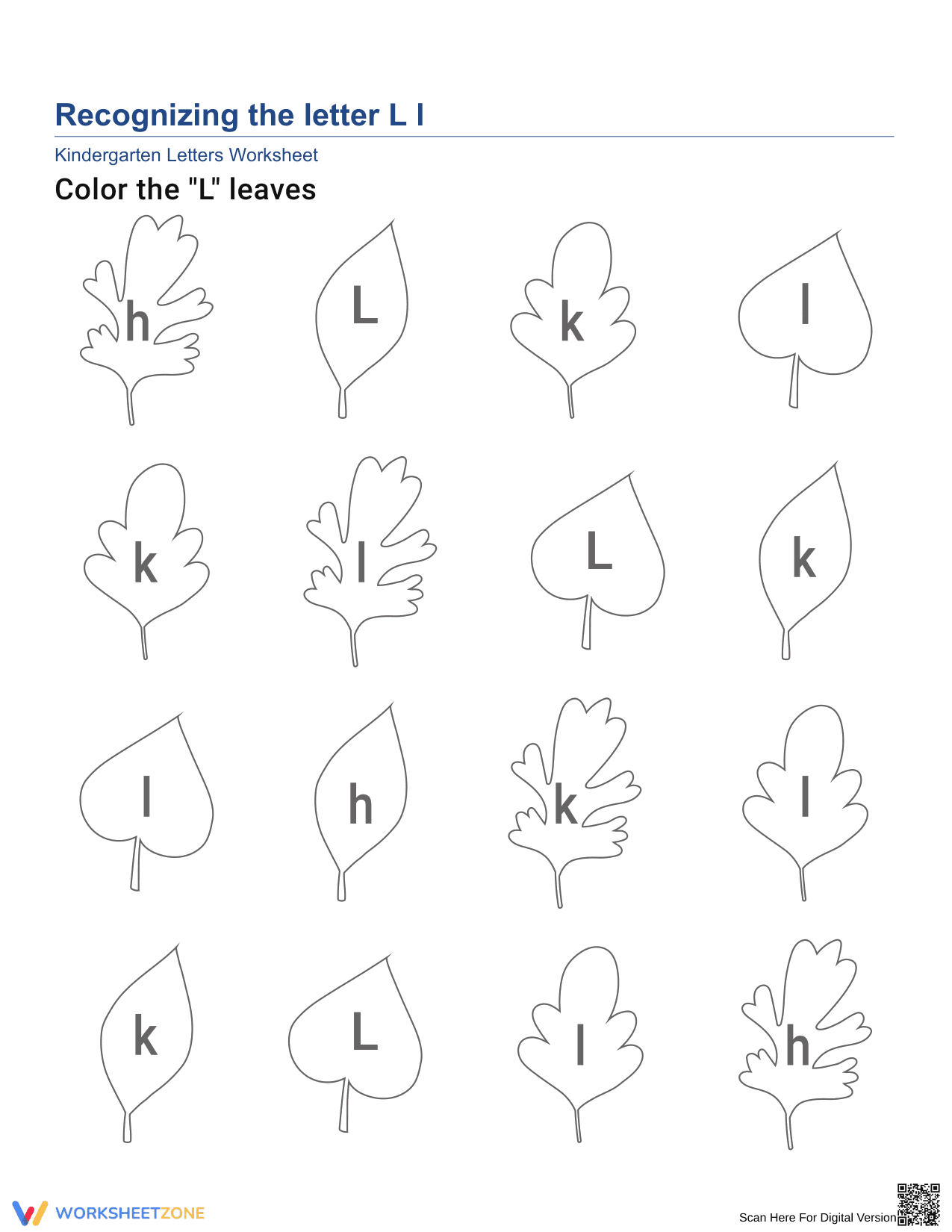

Letter L Recognition | Printable Kindergarten Worksheet
Paste this activity's link or code into your existing LMS (Google Classroom, Canvas, Teams, Schoology, Moodle, etc.).
Students can open and work on the activity right away, with no student login required.
You'll still be able to track student progress and results from your teacher account.
This foundational reading worksheet provides early learners with targeted practice in identifying the letter L. By coloring specific leaves containing either the uppercase or lowercase target letter, students strengthen their visual discrimination skills and build the alphabet fluency required for future decoding and reading success.
At a Glance
- Grade: Kindergarten · Subject: ELA
- Standard:
CCSS.ELA-LITERACY.RF.K.1.D— Recognize and name all upper- and lowercase letters.- Skill Focus: Letter Recognition (L)
- Format: 1 page · 16 problems · No answer key · PDF
- Best For: Independent practice
- Time: 5–10 minutes
Inside this single-page resource, educators will find a straightforward visual discrimination task featuring sixteen distinct leaf outlines. Each leaf contains a single lowercase or uppercase letter, including distractors like 'h' and 'k' that share similar vertical strokes. Students are tasked with scanning the array and coloring only the leaves that contain the letter L, providing immediate visual feedback on their accuracy.
Zero-Prep Workflow
- Print (1 minute): Simply download the PDF and print a class set. The black-and-white design ensures minimal ink usage and crisp reproduction.
- Distribute (1 minute): Hand out the pages along with crayons or markers. The instructions are simple enough that non-readers can understand the task after a brief verbal prompt.
- Review (1 minute): Quickly scan the colored leaves to assess mastery. Total teacher prep time is under two minutes, making this an ideal activity for morning work or an emergency sub plan.
Standards Alignment
This activity aligns directly with CCSS.ELA-LITERACY.RF.K.1.D: Recognize and name all upper- and lowercase letters of the alphabet. By isolating a single letter and mixing it with visually similar distractors, the task reinforces precise letter identification. Both standard codes can be copied directly into lesson plans, IEP goals, or district curriculum mapping tools.
How to Use It
Deploy this worksheet during morning arrival to establish a calm, focused routine before direct instruction begins. Alternatively, place it in an independent literacy center alongside tactile letter manipulatives. As a formative assessment tip, observe students while they work to see if they systematically scan left-to-right or randomly search the page, which provides insight into their print awareness. Expected completion time ranges from five to ten minutes.
Who It's For
This resource is designed primarily for Kindergarten students, though it serves as excellent remediation for first graders or an enrichment activity for preschool learners demonstrating early alphabet readiness. For students needing extra support, highlight the target letter at the top of the page in a specific color to serve as a visual anchor. Pair this activity with a read-aloud focusing on words starting with the /l/ sound.
Mastering alphabet knowledge is a critical predictor of later reading achievement. According to Fisher & Frey (2014), early interventions that isolate specific letters and require active visual discrimination significantly improve phonics acquisition. This worksheet targets CCSS.ELA-LITERACY.RF.K.1.D by asking students to recognize and name all upper- and lowercase letters. The inclusion of visually similar distractor letters, such as 'h' and 'k', forces learners to attend to the specific structural features of the letter L rather than relying on general shape recognition. By embedding this practice within a simple coloring task, educators can reduce cognitive load and allow students to focus entirely on letter identification. Consistent exposure to targeted alphabet activities builds the automaticity necessary for fluent decoding, ensuring early learners establish a robust foundation for comprehensive literacy development.


