




























Views
Downloads


Ready Roman Theater Word Search | Grades 6–7 Social Studies

Paste this activity's link or code into your existing LMS (Google Classroom, Canvas, Teams, Schoology, Moodle, etc.).
Students can open and work on the activity right away, with no student login required.
You'll still be able to track student progress and results from your teacher account.
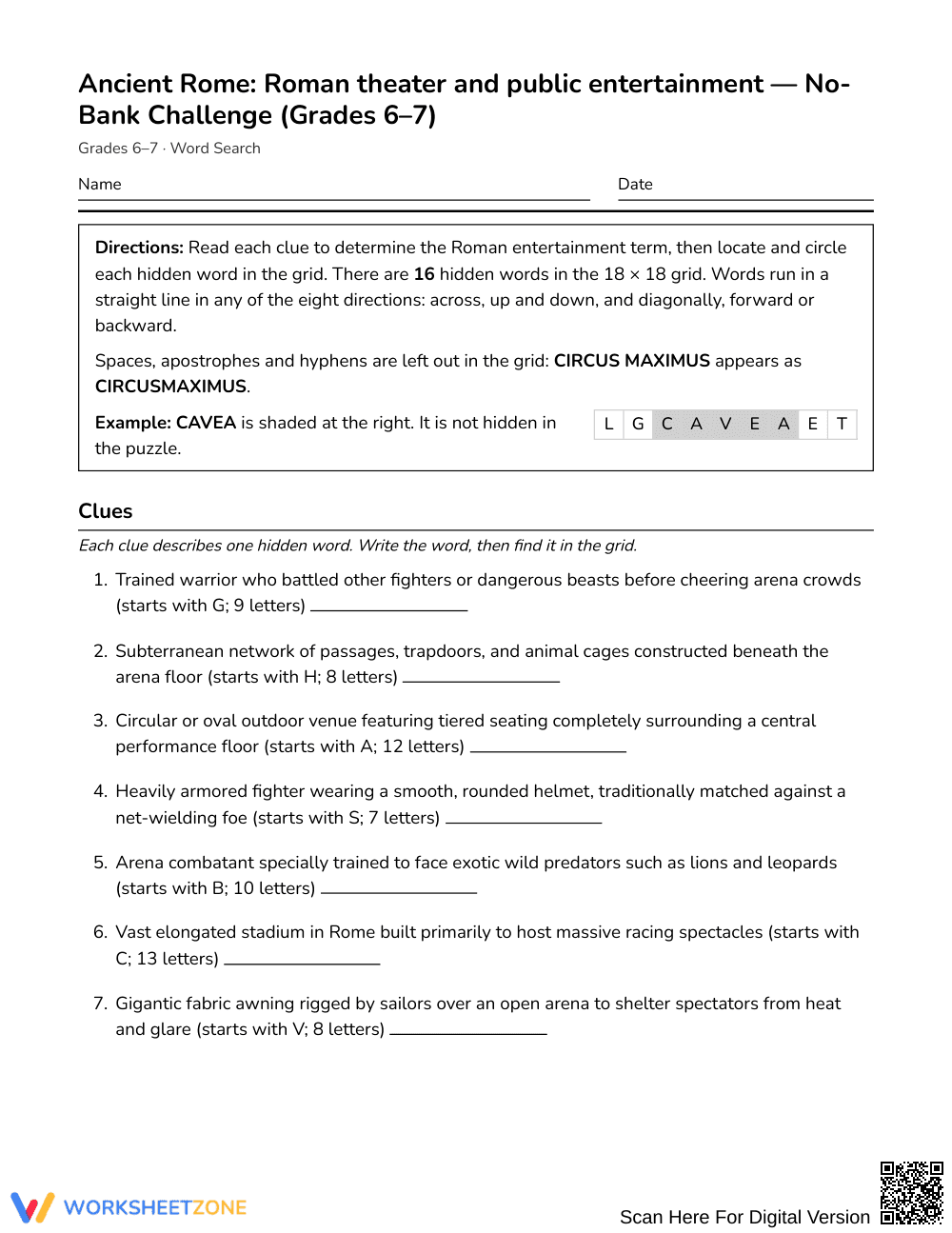
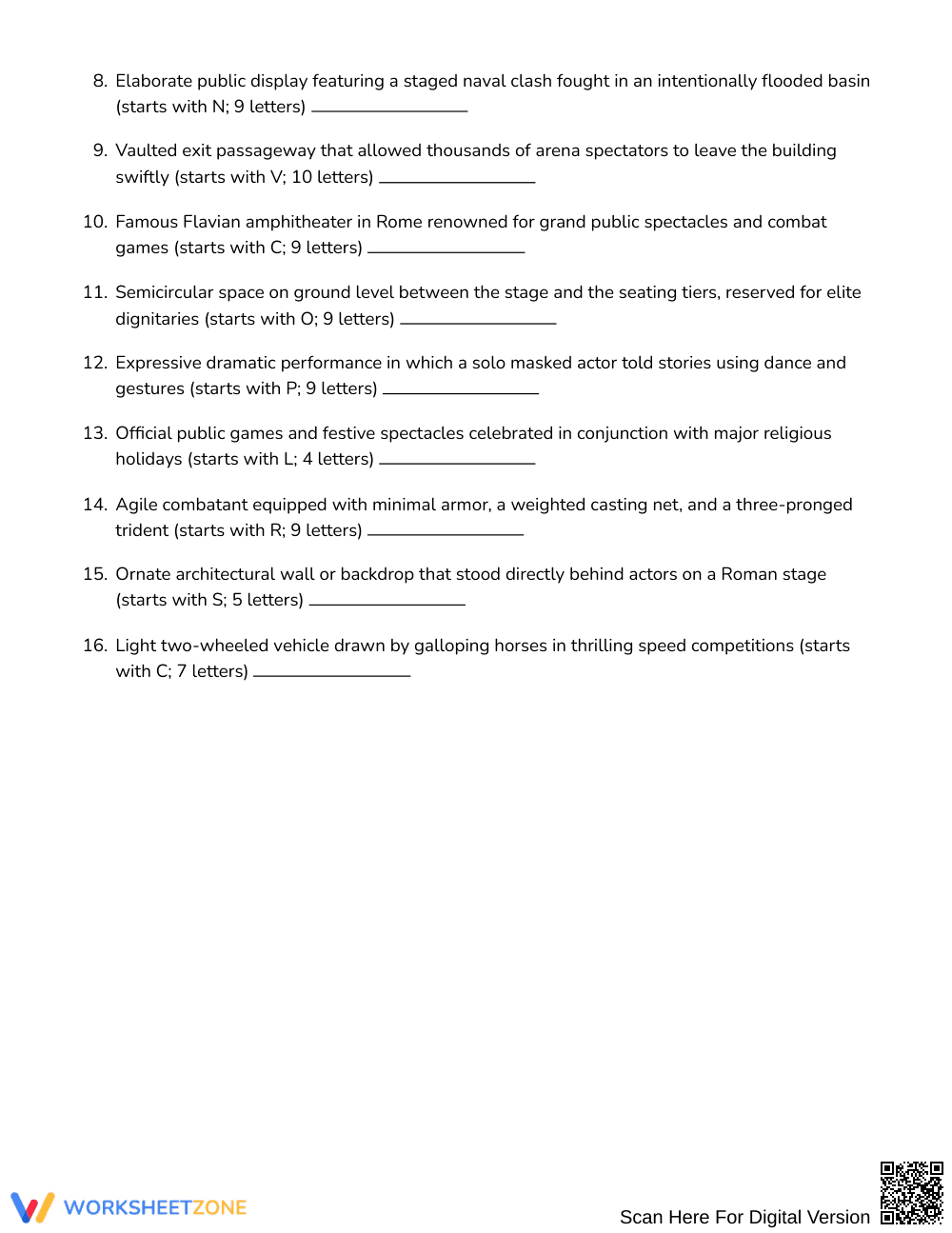
This Ancient Rome word search challenges Grades 6–7 students to reinforce key historical vocabulary surrounding Roman theater and public entertainment. By reading clues instead of using a word bank, students identify 16 historical terms and locate them in the grid, strengthening retention of Roman culture, architecture, and civic spectacles.
At a Glance
- Grade: Grades 6–7 · Subject: Social Studies and World History
- Standard: Not standards-assessed — vocabulary enrichment focusing on ancient historical terminology
- Skill Focus: Ancient Roman theater, arena spectacles, and public entertainment
- Format: 3 pages · 16 words to locate · Answer key included · PDF
- Best For: Unit vocabulary review, sub plans, and lesson consolidation
- Time: 20–35 minutes of engaging independent work
What's Inside
This 3-page printable resource features a full puzzle grid alongside an integrated clue list. Instead of a simple word bank, the activity supplies 16 detailed definitions covering Roman spectacles, theatrical design, and arena combat. A complete 4-page answer key provides solutions showing highlighted word paths for effortless verification.
Puzzle Mechanics and Structure
This puzzle uses a no-bank challenge format to reinforce historical terminology:
- Clue-Driven Retrieval: Learners read 16 contextual clues describing amphitheater architecture, gladiators, and theatrical traditions to deduce each term without an upfront bank.
- Grid Dimensions: All 16 words are hidden within an 18 x 18 grid.
- Search Directions: Words run in all eight orientations: north, northeast, east, southeast, south, southwest, west, and northwest.
Standards Alignment
This activity provides vocabulary enrichment and is not aligned to a specific standard. It reinforces domain-specific terminology within an Ancient Rome unit, supporting historical reading comprehension, conceptual recall, and cultural literacy across world history curricula.
How to Use It
Deploy this puzzle during or after direct instruction on ancient Rome. It functions well as a paired review activity where partners read clues aloud, infer terms such as hypogeum or velarium, and search the grid together. It also serves as independent seatwork or a zero-prep sub plan. For formative assessment, check whether students match specialized terms to clues before searching. Completion takes 20 to 35 minutes.
Who It's For
This resource is designed for Grades 6–7 social studies students studying ancient history. For students needing support, teachers can provide the terms as a reference list or permit peer collaboration. It pairs effectively with a passage on the Colosseum or a lesson on daily Roman life.
This Grades 6–7 social studies resource provides vocabulary enrichment centered on ancient Roman theater and public entertainment rather than formal standards assessment. Learners read 16 contextual clues describing Roman cultural venues, gladiator classes, and theatrical practices, then locate each term across an 18 x 18 grid arranged in eight directional orientations. Fisher & Frey (2014) emphasized that intentional vocabulary acquisition requires students to actively retrieve domain-specific terminology through meaningful contextual associations rather than isolated memorization. By eliminating the word bank, this puzzle demands that middle schoolers process architectural, civic, and historical concepts before scanning letter configurations. Accompanied by a 4-page answer key highlighting all coordinate paths, this 3-page printable activity delivers rigorous vocabulary consolidation suitable for independent practice, collaborative peer review, or social studies extension stations. The structured format promotes sustained focus, content retention, and historical literacy across classical world history units.


