




























Views
Downloads


Ready Roman Republic Word Search | Grades 7–8 Social Studies

Paste this activity's link or code into your existing LMS (Google Classroom, Canvas, Teams, Schoology, Moodle, etc.).
Students can open and work on the activity right away, with no student login required.
You'll still be able to track student progress and results from your teacher account.
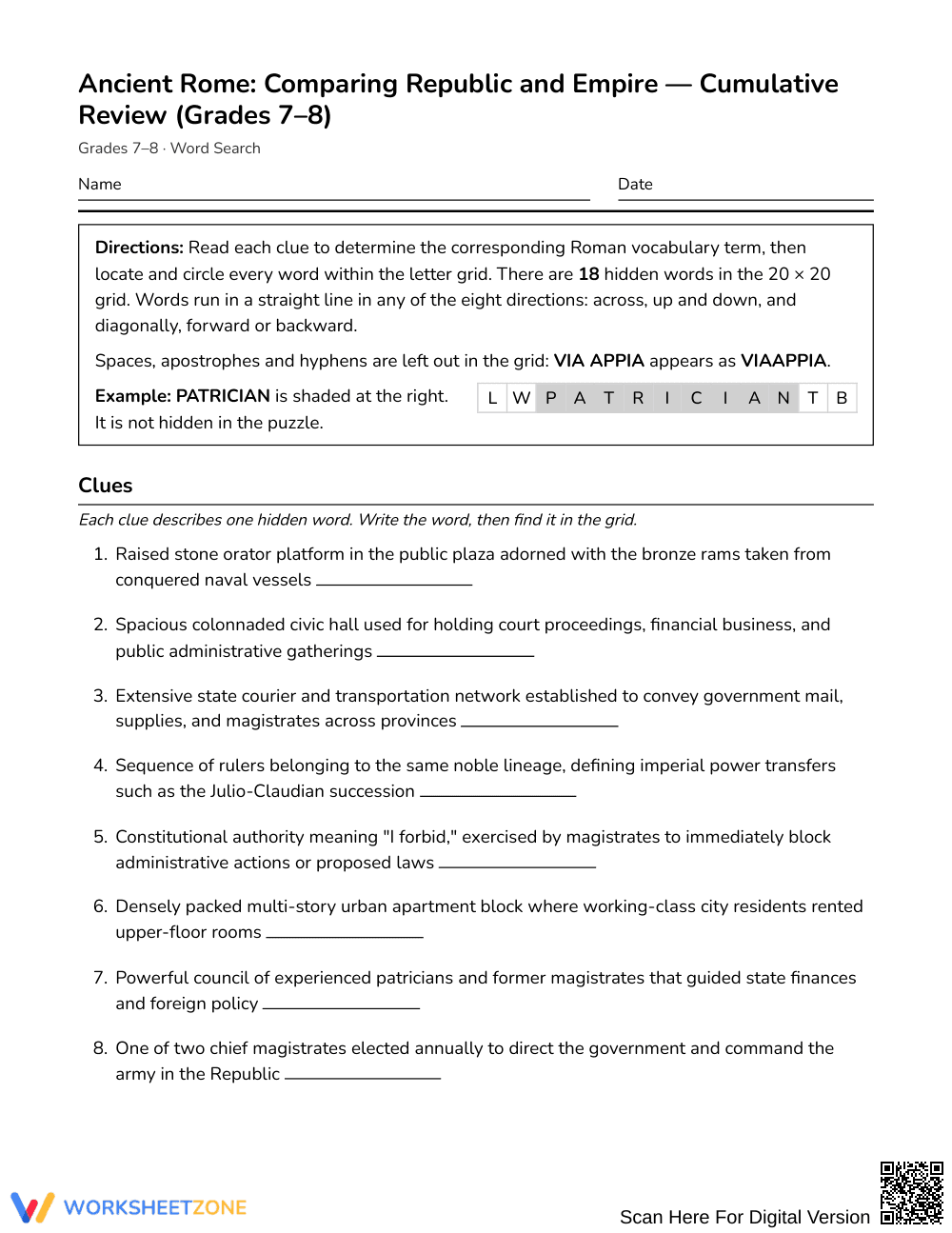
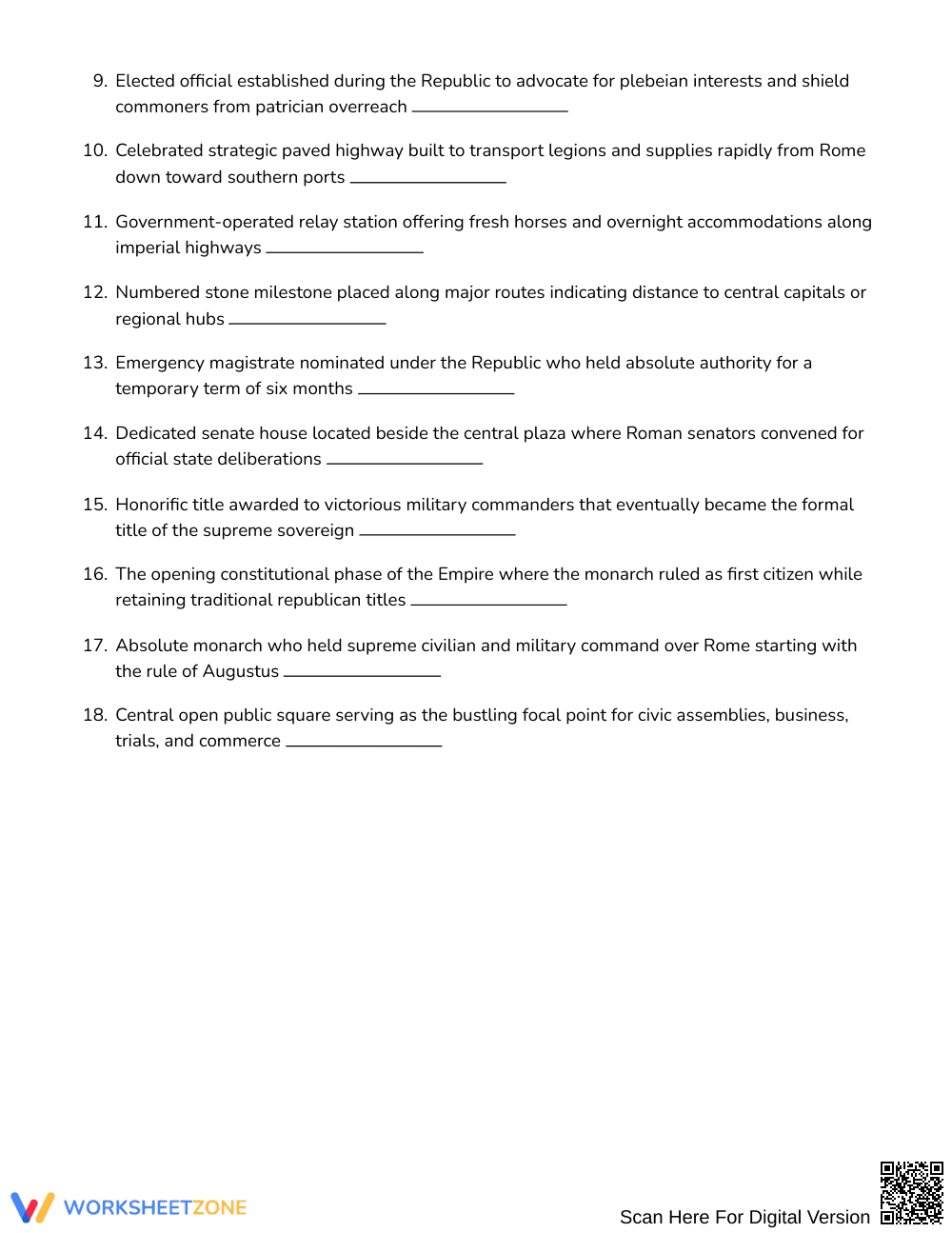
This Grades 7–8 social studies word search reinforces essential Roman history terminology by challenging students to compare the political structures, civic offices, and public institutions of the Roman Republic and Empire. Students analyze historical clues to recall eighteen critical academic terms before locating them within the puzzle, consolidating content knowledge through engaging retrieval practice.
At a Glance
- Grade: Grades 7–8 · Subject: Social Studies
- Standard: Not standards-assessed — vocabulary enrichment
- Skill Focus: Comparing Roman Republic and Empire
- Format: 3 pages · 18 words · Answer key included · PDF
- Best For: Unit review and vocabulary reinforcement
- Time: 25–35 minutes
What's Inside
This 3-page printable activity features eighteen Roman history vocabulary words embedded within a dense grid. Rather than scanning a simple list, students read comprehensive definitional clues covering key civic roles, constitutional concepts, and imperial architecture. The resource includes a shuffled word bank for reference and a 4-page answer key showing exact word placements and completed solutions.
Puzzle Structure and Mechanics
The puzzle utilizes a challenging 20 by 20 letter grid designed for middle school learners. Hidden words run in all eight possible compass directions: North, Northeast, East, Southeast, South, Southwest, West, and Northwest, including forward, backward, and diagonal orientations. Students use the clues to identify targeted terms before searching the grid, providing dual cognitive engagement through definition recall and visual tracking.
Standards Alignment
This resource serves as targeted vocabulary enrichment and is not aligned to a formal state or national content standard. It supports broader middle school world history curricula by strengthening student familiarity with specialized historical terminology, foundational civic concepts, and Roman constitutional governance across both republican and imperial eras.
How to Use It
Deploy this activity as a cumulative review at the conclusion of your Ancient Rome unit, or utilize it as an independent station during social studies rotations. During work time, observe whether students can identify vocabulary terms directly from the contextual clues before consulting their notes. The complete activity takes approximately 25 to 35 minutes, making it suitable for standard class periods or planned sub days.
Who It's For
This activity is designed for Grades 7–8 students studying world history and classical civilizations. For differentiated support, pair emerging readers with peer partners or encourage students to highlight qualifying clue phrases prior to searching. Pair this puzzle naturally with an anchor chart comparing Roman magistrate roles to imperial administrative offices.
Vocabulary acquisition in secondary social studies requires repeated exposures to specialized domain terms within meaningful contexts. As highlighted by Fisher & Frey (2014), intentional vocabulary enrichment that integrates definitional analysis with active retrieval significantly improves student retention of complex historical concepts. This Grades 7–8 Ancient Rome activity engages learners in comparing the governing systems of the Roman Republic and Empire by requiring them to evaluate rigorous historical clues before locating 18 core academic terms. By connecting structural civic vocabulary—such as consul, tribune, principate, and veto—to descriptive functional definitions, students build the conceptual schema necessary for historical analysis and comparative civics. Although not standards-assessed, this targeted supplementary resource provides middle school educators with an effective, zero-prep tool that reinforces foundational social studies literacy, supports varied reading levels through structured contextual clues, and consolidates essential unit terminology across three organized student pages.


