




























Views
Downloads
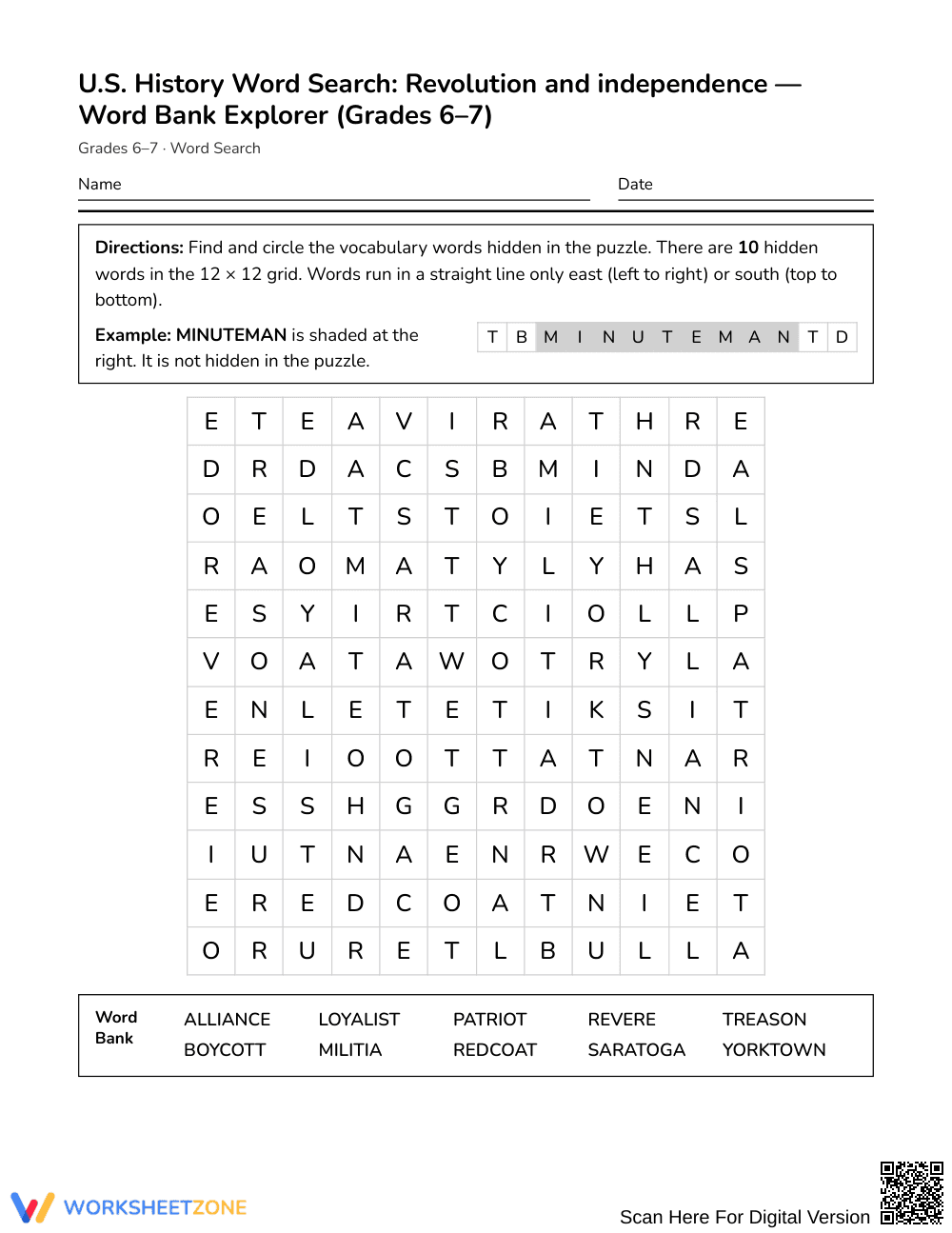

Ready Revolution Word Search | Grades 6–7 Social Studies

Paste this activity's link or code into your existing LMS (Google Classroom, Canvas, Teams, Schoology, Moodle, etc.).
Students can open and work on the activity right away, with no student login required.
You'll still be able to track student progress and results from your teacher account.
This American Revolution word search helps middle school learners reinforce foundational historical terminology from the independence era. Designed for Grades 6–7 Social Studies, this activity strengthens word recognition and spelling for 10 pivotal vocabulary terms, providing an engaging entry point into Revolutionary War history and classroom discussions.
At a Glance
- Grade: Grades 6–7 · Subject: Social Studies (U.S. History)
- Standard: Not standards-assessed — vocabulary enrichment
- Skill Focus: American Revolution and independence key historical terminology
- Format: 1 student page · 10 hidden words · 3-page answer key included · Printable PDF
- Best For: Lesson warm-ups, early finishers, and unit vocabulary review
- Time: 15–25 instructional minutes
What's Inside
The printable activity features a clean, single-page student puzzle containing 10 hidden vocabulary words arranged alongside an alphabetical word bank. Students locate terms including Patriot, Loyalist, Boycott, Militia, Alliance, Revere, Saratoga, Redcoat, Treason, and Yorktown. A comprehensive 3-page answer key clearly highlights word placements for rapid checking.
Puzzle Structure and Mechanics
The puzzle utilizes a focused 12 x 12 letter grid formatted specifically for accessible middle school engagement. All 10 vocabulary terms run in only two directions: East (horizontally from left to right) and South (vertically from top to bottom). Learners reference the alphabetical word bank to locate each term without reverse or diagonal distractions.
Standards Alignment
This activity serves strictly as supplemental vocabulary enrichment and is not aligned to a formal state or national content standard. It is designed to reinforce essential historical terminology, supporting general background knowledge and reading comprehension across upper elementary and middle school American history units.
How to Use It
Deploy this word search during direct instruction transitions or as an introductory hook before launching a lesson on the Revolutionary War. Alternatively, assign it after direct instruction as a quiet independent review task. While students work, circulate formatively to verify that learners correctly pronounce and understand terms like Boycott and Treason. Completion typically takes 15 to 25 minutes.
Who It's For
This resource is built for general education students in Grades 6–7 studying early United States history. It offers targeted support for English language learners and striving readers requiring visual word recognition practice. Pair this puzzle directly with a primary source reading on colonial protests or an introductory lecture on the American Revolution.
According to Fisher & Frey (2014), intentional exposure to specialized domain vocabulary builds background knowledge that directly enhances reading comprehension in disciplinary subjects such as social studies. This vocabulary enrichment resource targets 10 foundational historical terms associated with the American Revolution and colonial independence. By engaging with an accessible 12 x 12 letter grid, Grades 6–7 learners reinforce orthographic patterns, term recognition, and historical literacy without cognitive overload. Because the activity functions as supplemental vocabulary enrichment rather than a standards-assessed task, it offers flexible utility across diverse instructional settings, including introductory thematic hooks, independent seatwork, and targeted intervention. Research demonstrates that multi-exposure word identification strengthens conceptual retention, enabling middle school students to recognize and articulate historical concepts more effectively when encountering complex primary and secondary sources throughout their United States history coursework.


