


























Views
Downloads


Ready Labor Day Word Search | Grades 3–4 Social Studies
Paste this activity's link or code into your existing LMS (Google Classroom, Canvas, Teams, Schoology, Moodle, etc.).
Students can open and work on the activity right away, with no student login required.
You'll still be able to track student progress and results from your teacher account.
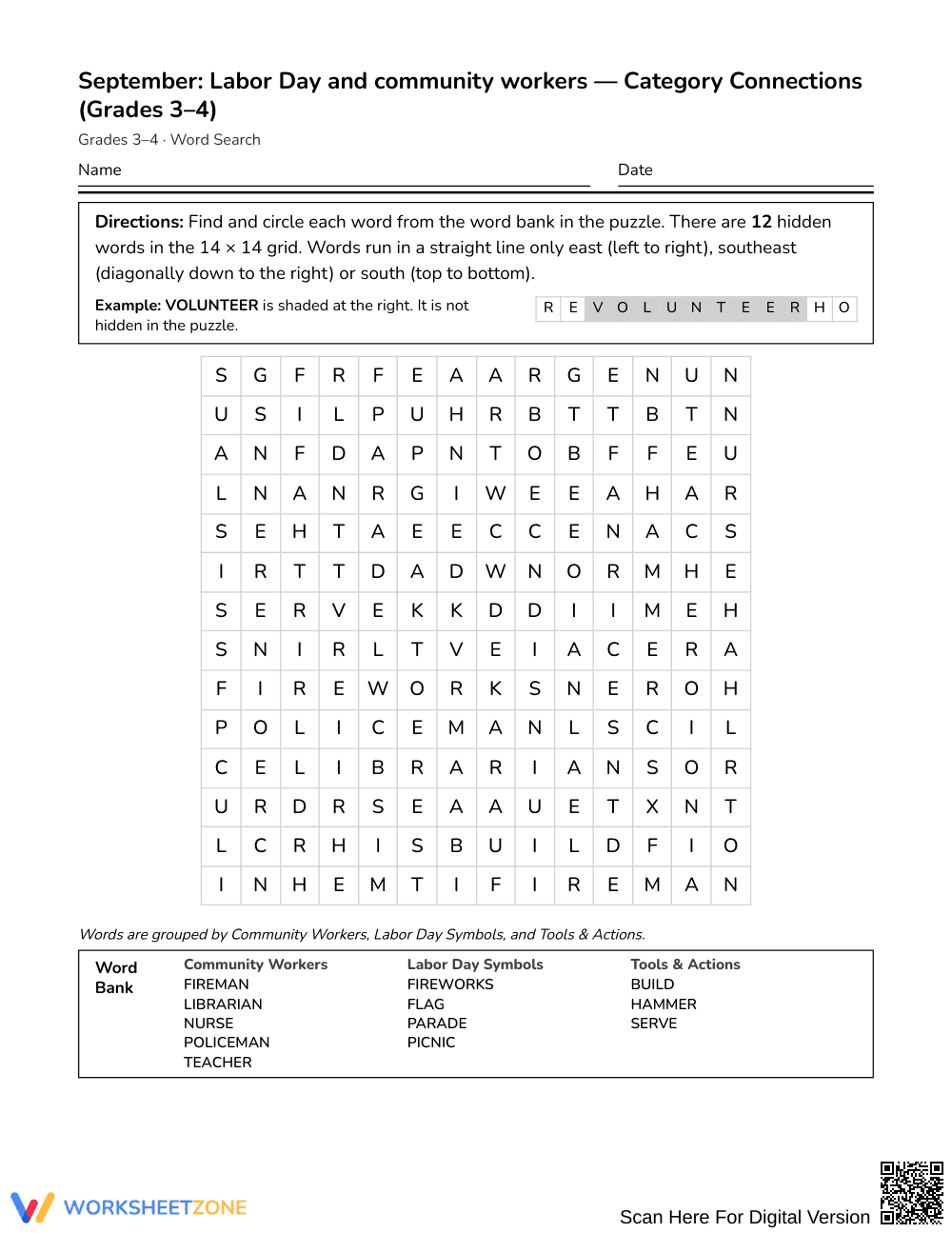
This Grades 3–4 Social Studies word search reinforces student knowledge of Labor Day and community workers through targeted vocabulary practice. Students locate 12 essential holiday and civic terms organized by meaningful thematic categories, building word recognition and contextual understanding. It provides focused seasonal learning that strengthens reading accuracy and reinforces key social studies concepts.
At a Glance
- Grade: Grades 3–4 elementary students · Subject: Elementary Social Studies
- Standard: Not standards-assessed — vocabulary enrichment for civic holiday units
- Skill Focus: Labor Day and community workers vocabulary identification
- Format: 1 printable page · 12 hidden words · Full answer key included · PDF
- Best For: September holiday thematic vocabulary reinforcement
- Time: 15–25 instructional minutes
What's Inside
This 1-page activity features a 12-word puzzle with vocabulary sorted into three distinct thematic categories: Community Workers, Labor Day Symbols, and Tools & Actions. The resource includes explicit definition clues for every term to support comprehension before or after searching. Teachers receive a comprehensive 3-page answer key that clearly highlights word placements, making student self-checking and grading immediate.
Puzzle Structure and Mechanics
The puzzle is built on a 14 x 14 grid designed specifically for third- and fourth-grade visual tracking. The 12 hidden words run in three standard reading directions: East (horizontal left-to-right), South (vertical top-to-bottom), and Southeast (diagonal downward-right). Students reference a categorical word bank alongside definitional clues that explain each worker, symbol, and tool. This structured layout guides learners to scan rows and columns methodically without encountering backward letter sequences.
Standards Alignment
This resource serves as targeted vocabulary enrichment rather than a standards-assessed test preparation document. It is not aligned to a specific Common Core or state standard code. Instead, it provides supplemental civic and thematic terminology reinforcement that complements elementary community helpers units and early autumn holiday observances.
How to Use It
Use this word search during direct instruction as a guided vocabulary introduction or after direct instruction as an independent literacy center during Labor Day week. During classwork, observe whether students identify words by initial consonant clusters or use the definition clues to confirm meaning. Completion typically requires 15 to 25 minutes of focused seatwork.
Who It's For
This activity is designed for students in Grades 3–4 exploring local community infrastructure and national holidays. English language learners benefit from the categorical groupings and pairing of terms with clear definitions. For maximum instructional impact, pair this puzzle with an informational read-aloud text about workers' rights or a classroom anchor chart detailing civic careers.
Vocabulary enrichment activities that organize content words into conceptual categories provide critical background knowledge for elementary learners. According to Fisher & Frey (2014), intentional word exposure embedded in structured literacy tasks supports vocabulary acquisition and strengthens reading comprehension across informational domains. This Grades 3–4 Social Studies activity reinforces essential Labor Day and community helpers terminology through a focused 14 x 14 word search featuring 12 key vocabulary terms. By grouping words under distinct conceptual headings such as community workers, symbols, and occupational actions, the resource fosters semantic connections rather than rote searching. Definitional clues accompany each target term to ensure students connect orthographic patterns with civic meaning. Research in Fisher & Frey (2014) highlights that repeated, contextualized interactions with domain-specific language enhance retention and improve content-area literacy. Educators can deploy this 1-page printable resource as an effective, low-stakes vocabulary consolidation tool during September thematic instructional units.


