




























Views
Downloads
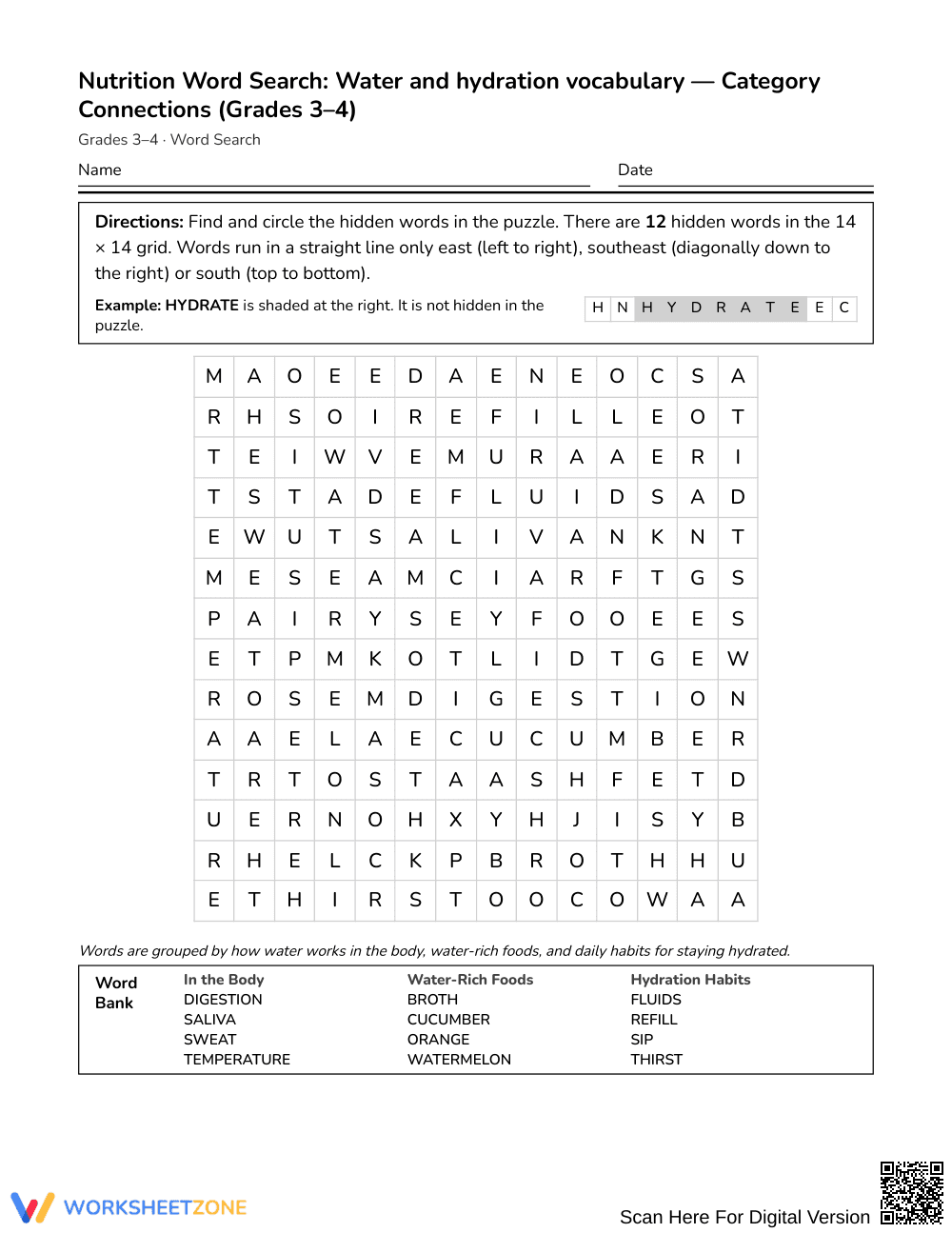

Ready Hydration Vocabulary Word Search | Grades 3–4 Science

Paste this activity's link or code into your existing LMS (Google Classroom, Canvas, Teams, Schoology, Moodle, etc.).
Students can open and work on the activity right away, with no student login required.
You'll still be able to track student progress and results from your teacher account.
This science word search helps elementary students build and retain essential water and hydration vocabulary. Learners identify twelve targeted health terms organized into meaningful physiological and dietary categories, reinforcing how the human body uses fluids to maintain wellness.
At a Glance
- Grade: Grades 3–4 · Subject: Science
- Standard: Not standards-assessed — vocabulary enrichment
- Skill Focus: Water and hydration vocabulary
- Format: 1 page · 12 words · Answer key included · PDF
- Best For: Health unit vocabulary review
- Time: 15–20 minutes
What's Inside
This single-page word search features a clean layout with 12 vocabulary terms organized beneath three thematic category headers: In the Body, Water-Rich Foods, and Hydration Habits. A comprehensive 3-page answer key provides clear visual solution maps showing exact letter coordinates for every target word.
Puzzle Structure and Mechanics
The activity is built on a clear 14 by 14 letter grid designed specifically for developing readers in grades 3 and 4. All 12 terms run in only three accessible directions: East (horizontal left-to-right), South (vertical downward), and Southeast (diagonal downward-right). Because backward placements are omitted, students focus on letter sequencing, spelling retention, and conceptual category connections rather than visual frustration.
Standards Alignment
This activity provides supplemental vocabulary enrichment and is not aligned to a formal state or national content standard. It reinforces foundational life science terminology within general elementary health and nutrition units.
How to Use It
Distribute this activity directly after an introductory lesson on the human body or daily nutrition. As an independent warm-up or fast-finisher task, students circle terms and discuss how items like cucumbers and watermelon supply daily fluids. For formative assessment, circulate while students search and prompt them to define how saliva or perspiration protects the body during physical activity. Typical completion requires 15 to 20 minutes.
Who It's For
This resource serves general education classrooms, health pull-out groups, and homeschool students in Grades 3–4. The categorized word bank supports English language learners by chunking related science terminology into concrete concepts. Pair this puzzle with an illustrated diagram of the human digestive system or a classroom hydration tracking log.
Explicit vocabulary exposure within structured thematic categories strengthens domain-specific comprehension for intermediate elementary learners. According to Fisher & Frey (2014), intentional word exposure embedded in contextual graphic routines improves orthographic recall and supports reading fluency across content areas. By searching for 12 foundational terms across a calibrated 14 by 14 letter grid, students examine internal letter patterns, reinforce correct spelling, and categorize biological functions related to hydration. The clear East, South, and Southeast directional constraints reduce extraneous visual cognitive load, allowing third and fourth graders to connect scientific terms such as digestion, temperature, and fluids to real-world dietary habits.


