




























Views
Downloads
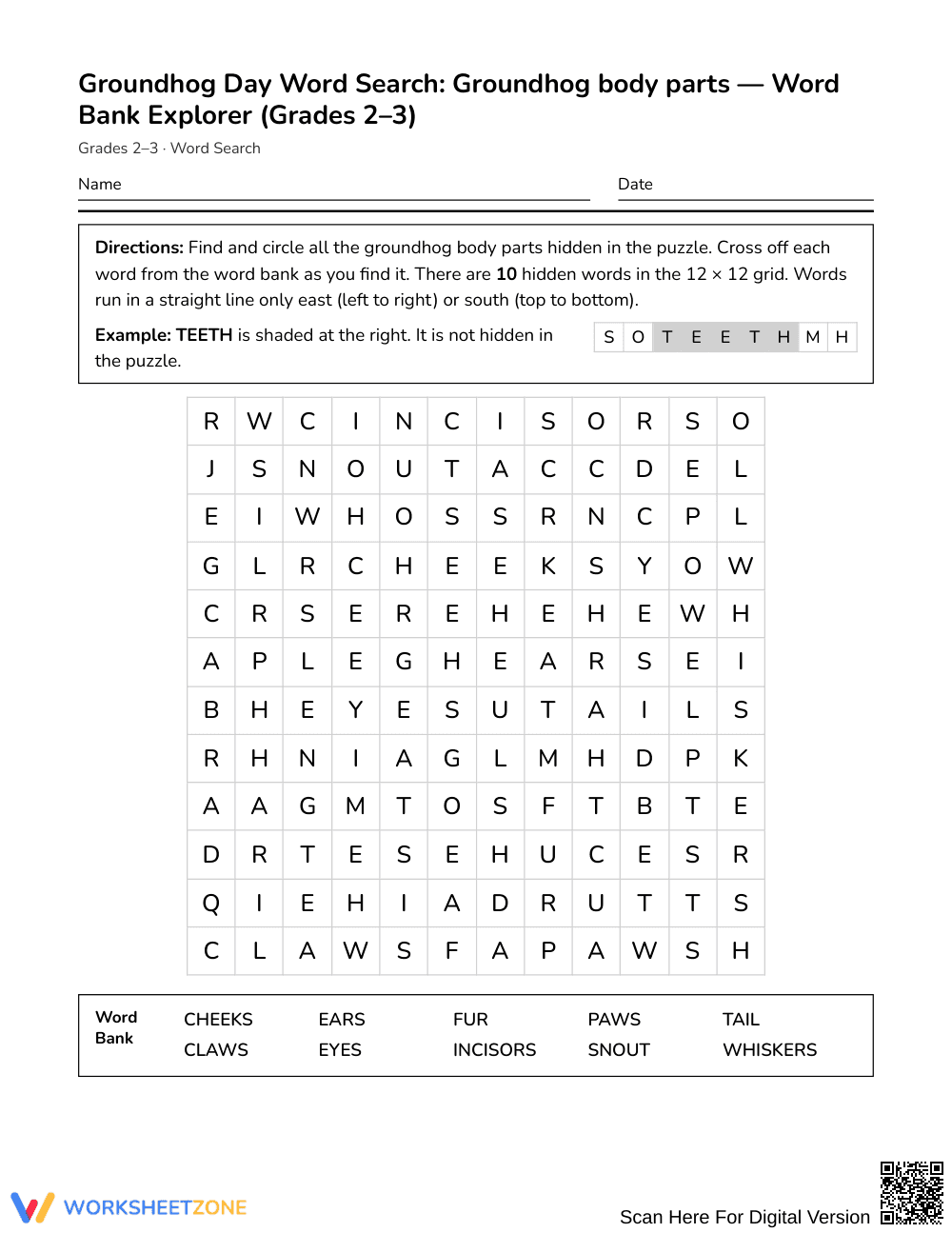

Ready Groundhog Body Parts Word Search | Grades 2–3 Science

Paste this activity's link or code into your existing LMS (Google Classroom, Canvas, Teams, Schoology, Moodle, etc.).
Students can open and work on the activity right away, with no student login required.
You'll still be able to track student progress and results from your teacher account.
This Grades 2–3 Groundhog Day word search reinforces science vocabulary by introducing ten essential animal anatomy terms. Learners search the puzzle grid to locate physical adaptations while strengthening orthographic mapping and visual scanning skills. The single-page layout provides focused, festive practice that connects seasonal interest directly to foundational biological structures.
At a Glance
- Grade: Grades 2–3 elementary students · Subject: Life Science and Anatomy
- Standard: Not standards-assessed — vocabulary enrichment
- Skill Focus: Groundhog anatomical terminology and physical structures
- Format: 1 student activity page · 10 hidden vocabulary words · Complete answer key included · PDF document
- Best For: Groundhog Day science vocabulary enrichment center
- Time: 15–20 minutes of classroom engagement
What's Inside
The printable download contains a 1-page student puzzle sheet featuring 10 target anatomy terms paired with a 2-page answer key that outlines every solution clearly. Words are organized in a clean, alphabetical word bank at the top of the page, allowing young readers to track their progress systematically by crossing off terms as they find them. This format keeps young learners organized and focused throughout the activity.
Puzzle Mechanics and Structure
This puzzle is constructed on a 12 x 12 letter grid tailored specifically for early elementary search patterns. All 10 vocabulary terms run in only two directions: East (horizontally from left to right) and South (vertically from top to bottom). By omitting diagonal and backwards placements, the layout prevents visual clutter and supports developing readers. Students reference the alphabetical word bank, identify letter combinations within the grid, and circle each completed groundhog anatomy term.
Standards Alignment
This activity is designed purely for vocabulary enrichment and is not aligned to a formal academic standard. It functions as an engaging supplementary resource to support cross-curricular science literacy and seasonal classroom celebrations without formal testing constraints.
How to Use It
Use this word search as an introductory hook before direct instruction on hibernating animals to build interest in groundhog physical traits, or deploy it after a science lesson as an independent vocabulary consolidation task. During independent work, observe whether students systematically scan row by row or search randomly, noting who needs support with initial letter clusters. The puzzle takes 15 to 20 minutes to complete.
Who It's For
This worksheet is ideal for Grades 2–3 students beginning to explore animal anatomy and life science units. For learners needing additional support, teachers can highlight the first letter of each word directly on the grid before distribution. Pair this puzzle with an informational read-aloud or a labeled anatomy anchor chart showing how claws, incisors, and whiskers aid underground survival.
Intentional exposure to domain-specific science vocabulary builds foundational schema that aids long-term reading comprehension and scientific literacy in elementary learners. According to Fisher & Frey (2014), structured word exploration and repetitive visual identification solidify vocabulary acquisition by linking orthographic patterns with conceptual meaning. This Groundhog Day word search targets ten essential animal anatomy words, including specialized terms such as incisors, snout, and whiskers. By isolating words running only East and South within a structured 12 x 12 grid, the activity scaffolds letter-sequence scanning for second and third graders without inducing cognitive overload. As students cross words off an alphabetical bank, they engage in deliberate visual reinforcement that strengthens phonics recognition and scientific observation skills. This non-standards-assessed vocabulary enrichment activity offers an accessible, low-stakes entryway into comparative mammalian anatomy while sustaining high student engagement during seasonal classroom instructional units.


