




























Views
Downloads


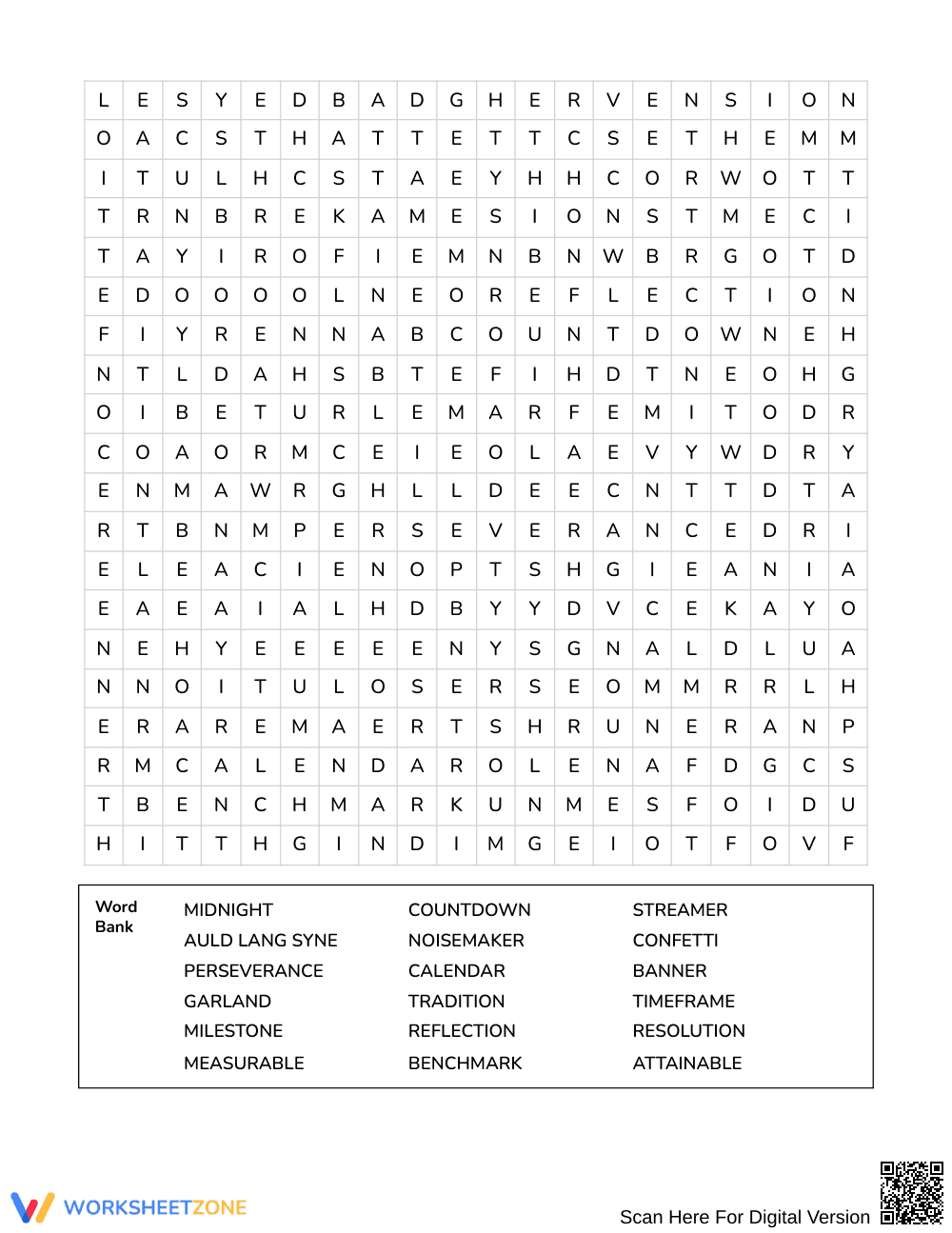

Ready Goals Review Word Search | Grades 7–8 Social Studies

Paste this activity's link or code into your existing LMS (Google Classroom, Canvas, Teams, Schoology, Moodle, etc.).
Students can open and work on the activity right away, with no student login required.
You'll still be able to track student progress and results from your teacher account.
This New Year's word search helps middle school students review cultural traditions and goal-setting vocabulary through targeted puzzle solving. Learners match 18 contextual definitions to key social studies terms before locating them across the puzzle grid. The activity reinforces academic language surrounding seasonal milestones, personal growth, and historical customs.
At a Glance
- Grade: Grades 7–8 · Subject: Middle School Social Studies
- Standard: Not standards-assessed — targeted vocabulary enrichment and cultural literacy
- Skill Focus: Time traditions and annual goal-setting vocabulary review
- Format: 3 student pages · 18 hidden words · Full answer key included · PDF
- Best For: Post-break homeroom review, independent practice, and vocabulary reinforcement
- Time: 25–35 instructional minutes
What's Inside
This 3-page printable activity features 18 clues covering New Year customs and goal achievement terms such as benchmark, reflection, and perseverance. Students read detailed descriptive definitions to deduce each target term from a shuffled word bank before locating it in the puzzle. A comprehensive 4-page answer key displays the exact location and orientation of every hidden word alongside completed solution grids for rapid checking.
Puzzle Mechanics
The activity is built around a dense 20 x 20 letter grid containing 18 hidden vocabulary terms. Words run in all 8 directions—north, northeast, east, southeast, south, southwest, west, and northwest—including backward and diagonal placements. Rather than simply scanning for pre-listed terms, learners engage with content clues to identify each word, cross-referencing their deductions against the shuffled word bank before circling letters in the grid.
Standards Alignment
This resource is designed strictly for vocabulary enrichment and cultural literacy, and it is not aligned to a formal academic standard. It supports cross-disciplinary language acquisition by reinforcing domain-specific terms connected to timekeeping, social traditions, and personal objective planning across middle school social studies curricula.
How to Use It
Introduce this activity after direct instruction on seasonal traditions or during the first week back from winter break as a goal-setting warm-up. It functions effectively as a collaborative partner challenge or an independent early-finisher task. During the session, circulate to observe whether students solve the vocabulary clues independently or rely solely on matching letter patterns, noting terms that require whole-group clarification. Most students complete the 18 words and clue analysis within 25 to 35 minutes.
Who It's For
This puzzle is tailored for general education students in Grades 7–8, English language learners developing tier-two academic vocabulary, and advisory groups focusing on personal milestones. For students needing support, provide highlighters to mark key terms in the definitions before scanning the grid. Pair this word search with a personal resolution writing prompt or an anchor chart detailing historical calendar systems.
This Grades 7–8 social studies word search reinforces time traditions and goals review through contextual vocabulary acquisition and clue-based puzzle solving. Rather than isolating terms in rote memorization drills, the resource integrates 18 domain-specific concepts—including milestone, attainable, benchmark, and reflection—with structured definitions that demand semantic processing before students search the 20 x 20 letter grid. According to Fisher & Frey (2014), intentional word exposure coupled with collaborative definition retrieval significantly strengthens content-area literacy and long-term retention of academic language. By manipulating terms across all eight directional orientations, learners deepen orthographic familiarity and conceptual mastery within seasonal social studies units. The activity serves as an effective, low-stakes formative tool that bridges cultural customs with personal goal-setting practices, making it an adaptable instructional component for middle school classrooms seeking targeted vocabulary enrichment without requiring formal standards-based testing.


