




























Views
Downloads




Ready Earth's Layers Properties Worksheet | Grade 8 Science

Paste this activity's link or code into your existing LMS (Google Classroom, Canvas, Teams, Schoology, Moodle, etc.).
Students can open and work on the activity right away, with no student login required.
You'll still be able to track student progress and results from your teacher account.
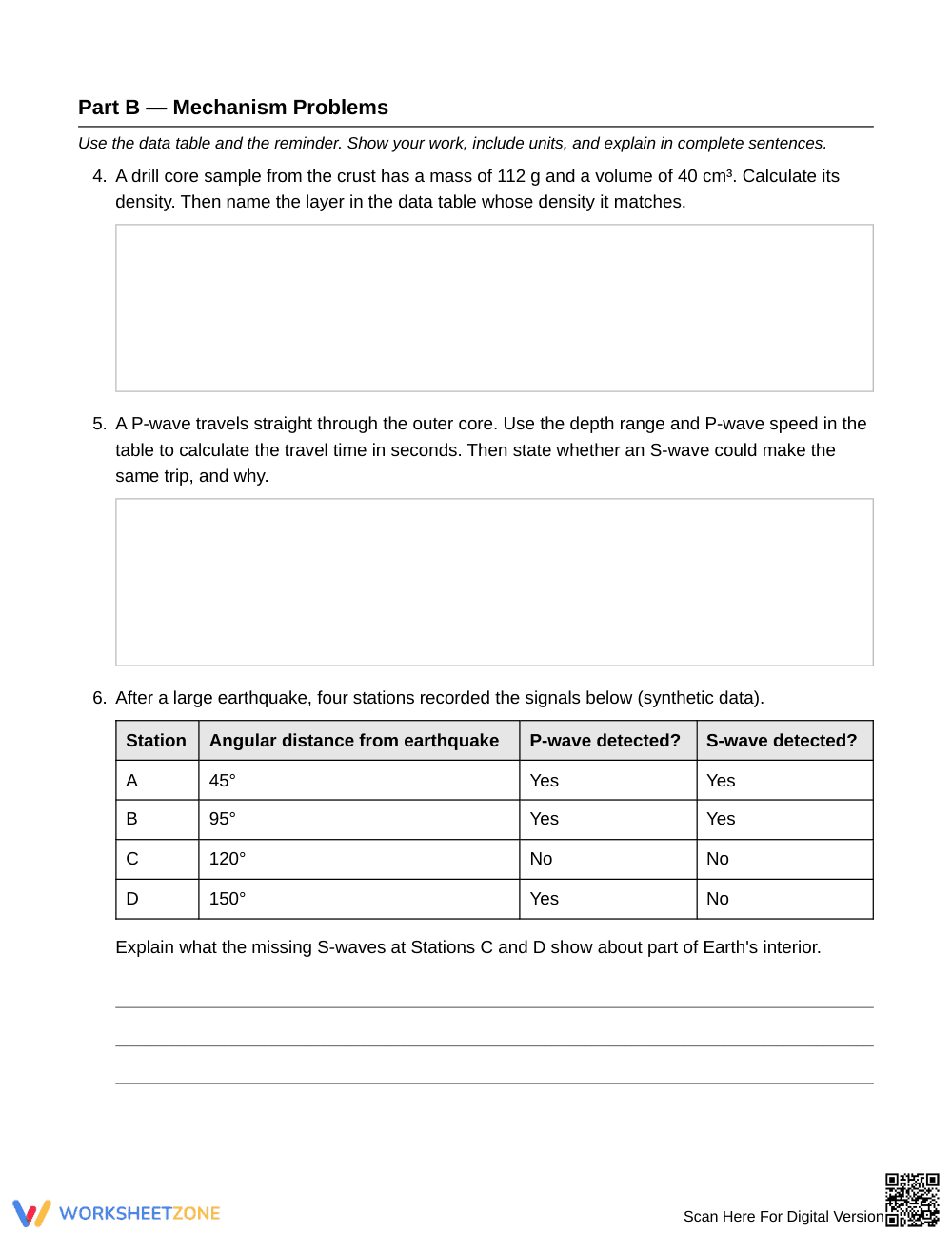
This worksheet helps Grade 8 students connect what Earth's layers are made of to how they behave. Using a data table of density, seismic wave speeds, and state, students explain why layers sort by density, why S-waves vanish in the outer core, and how solid mantle can flow.
At a Glance
- Grade: 8 · Subject: Science
- Standard: Earth's interior structure — use density and wave data to explain layer behavior
- Skill Focus: Connect material properties and behavior
- Format: 5 pages · 12 problems · Answer key included · PDF
- Best For: Practice after seismic wave instruction
- Time: 35–45 minutes
What's Inside
The 5-page worksheet opens with a reminder box and a synthetic Earth-model data table. Students then complete two multiple-choice items and a classification table, six calculation and explanation problems, and three prediction tasks. A 3-page answer key follows with worked solutions and model reasoning.
Skill Progression
- Guided practice (Part A, 3 items): Multiple choice and a composition-versus-behavior table, with the reminder box as a full scaffold.
- Supported practice (Part B, 6 items): Density and travel-time calculations, shadow-zone data, and claim evaluation, using the data table.
- Independent practice (Part C, 3 items): Predictions about a new planet, a density-sorted model, and two stations, each backed by a reason.
The sequence follows gradual release: I Do, We Do, You Do.
Standards Alignment
No standard code was supplied for this resource. It addresses Grade 8 Earth science: using density, seismic evidence, and material state to model Earth's interior layers. Add your state or district code to lesson plans, IEP goals, or curriculum mapping tools.
How to Use It
- After direct instruction: Assign Parts A and B as guided practice once students have met P-waves, S-waves, and shadow zones.
- Review or homework: Assign Part C alone as a check for understanding.
While students work, watch item 8, the wave-speed drop at the mantle–outer core boundary. Students who claim density alone sets wave speed need a prompt about state. Expect 35–45 minutes for the full set.
Who It's For
Grade 8 Science students who have started plate tectonics or Earth structure. Multilingual learners can use the reminder box as a vocabulary anchor. Pair it with a seismic wave diagram or an Earth layers anchor chart.
The Grade 8 Science worksheet Earth's Layers: Connecting Material Properties and Behavior teaches students to use density, seismic wave speed, and state of matter data to explain how Earth's interior is organized. Across 12 tasks in 5 pages, students distinguish composition-based layers from behavior-based layers, calculate density and wave travel time, interpret P-wave and S-wave shadow zones, and predict layering from density. No standard code is attached to this resource, so teachers should map it to their local Earth-science standard. Its three-part structure reflects the gradual release model described by Fisher & Frey (2014), moving from guided items to independent prediction with evidence. A three-page answer key supports quick checking. The worksheet works well as practice after direct instruction on seismic waves and takes about 35 to 45 minutes.


