


























Views
Downloads


RI.6.6 Worksheet: Author's Purpose — Grade 6 Aligned
Paste this activity's link or code into your existing LMS (Google Classroom, Canvas, Teams, Schoology, Moodle, etc.).
Students can open and work on the activity right away, with no student login required.
You'll still be able to track student progress and results from your teacher account.
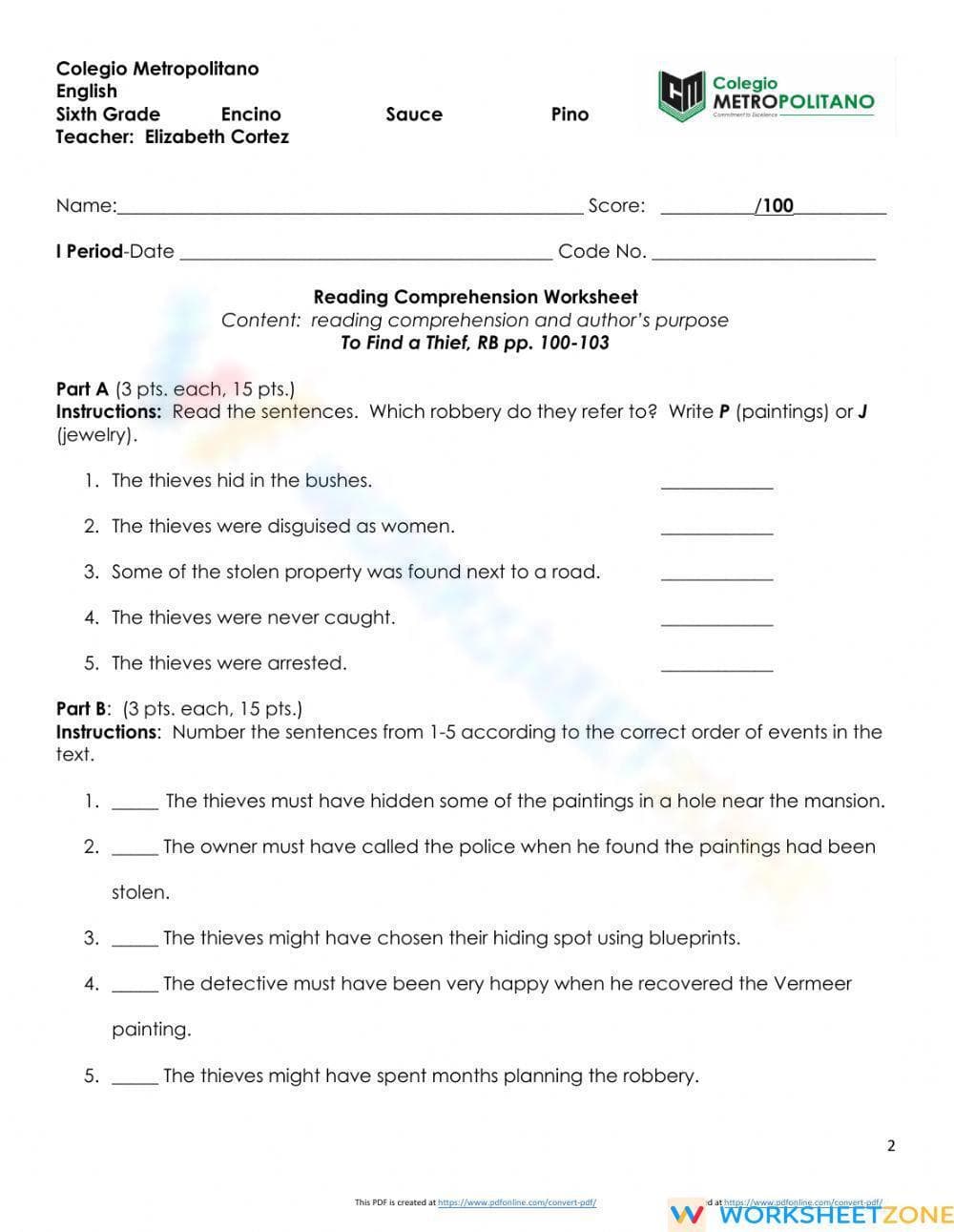
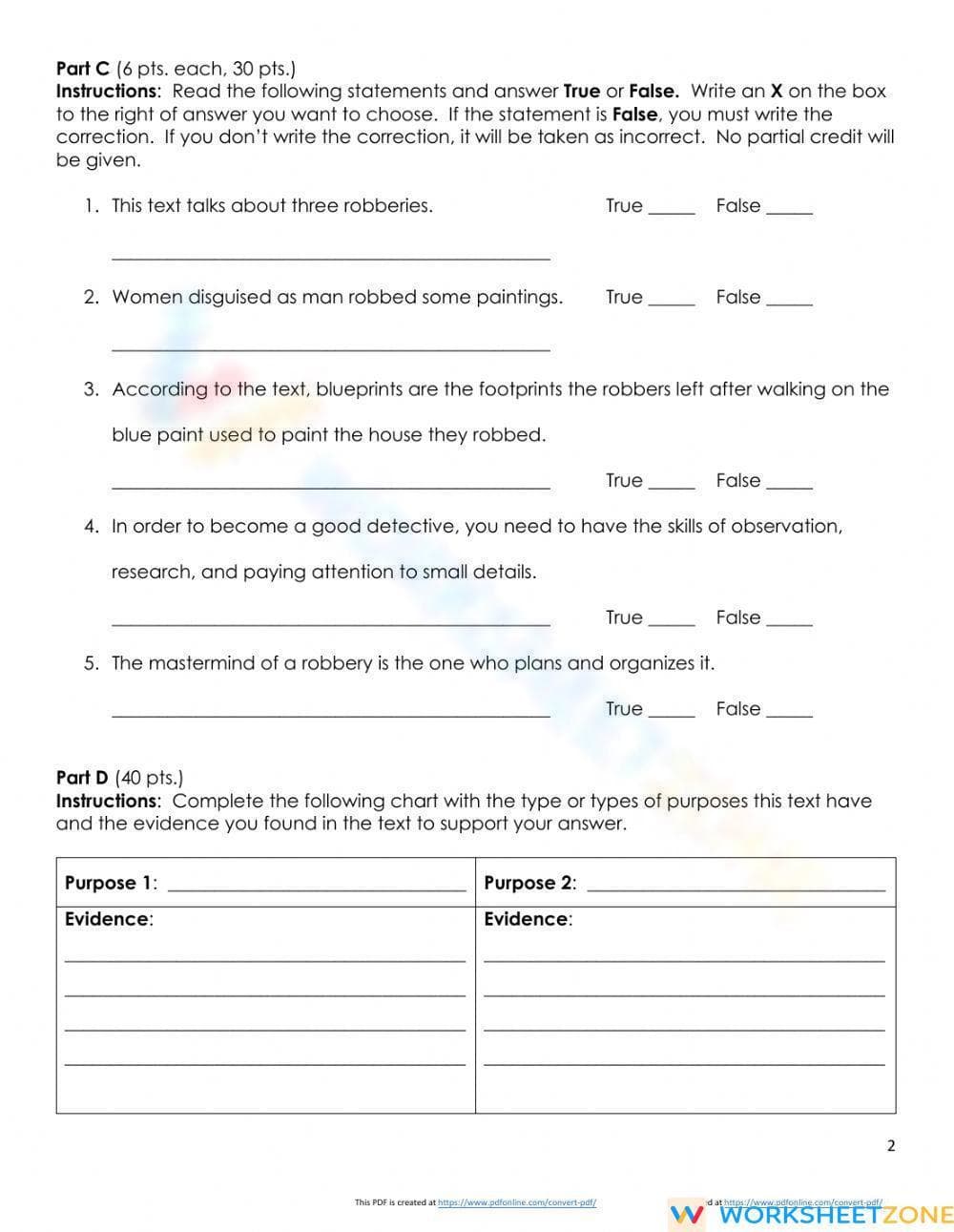
This standards-driven Grade 6 worksheet provides a focused assessment of a student's ability to determine an author’s purpose and sequence events in an informational text. Through a series of 17 targeted questions based on the passage "To Find a Thief," learners will practice citing textual evidence to support their analysis.
At a Glance
- Grade: 6 · Subject: English Language Arts
- Standard:
CCSS.ELA-LITERACY.RI.6.6— Determine an author's point of view or purpose in a text.- Skill Focus: Author's Purpose & Sequencing
- Format: 2 pages · 17 problems · Answer key included · PDF
- Best For: Reading mastery assessment and standard-aligned practice.
- Time: 40–50 minutes
What's Inside
This two-page resource contains a short passage ("To Find a Thief") and four assessment sections. It includes key detail questions, a sequencing task, true/false statements, and a graphic organizer for author’s purpose. A full answer key is included.
Mastery Evidence
The worksheet measures mastery against the standard. Detail retrieval (Part A) and sequencing (Part B) confirm foundational comprehension ('Meeting' proficiency). Part D, requiring students to synthesize evidence to define the author's purpose, allows for advanced, 'Exceeding' level analysis. The point-based scoring on the 17 items generates immediate data for gradebooks or IEP progress monitoring.
Standards Alignment
This assessment is directly aligned to CCSS.ELA-LITERACY.RI.6.6, which requires students to "determine an author's point of view or purpose in a text and explain how it is conveyed in the text." The worksheet also supports the foundational skill of citing evidence from the text to support analysis (CCSS.ELA-LITERACY.RI.6.1). Both standard codes can be copied directly into lesson plans, IEP goals, or district curriculum mapping tools.
How to Use It
Use this worksheet as a summative assessment after a unit on author's purpose, or as a pre-assessment to diagnose needs. For formative data, observe student performance on the true/false section to identify common misconceptions. The tasks are designed for completion in one 40-50 minute class period.
Who It's For
Designed for Grade 6 ELA students, this resource also works for advanced Grade 5 or review for Grade 7. It helps students who can identify what a text says but struggle to explain why the author wrote it. Pair this with a lesson on the "PIE" (Persuade, Inform, Entertain) acronym.
This Grade 6 ELA worksheet provides a complete, standards-aligned assessment for CCSS.ELA-LITERACY.RI.6.6. Students read an informational passage and complete 17 tasks to demonstrate their ability to determine an author's purpose and sequence key events. The design reflects the principles of focused, evidence-based practice, which research has repeatedly linked to improved reading comprehension outcomes. A 2024 analysis by RAND AIRS highlighted the importance of assessments that require students not just to recall facts but to analyze authorial choices, a skill central to this resource. The worksheet includes a full answer key and is formatted for immediate use as a printable PDF. Its structure allows teachers to gather specific data on student mastery of informational text analysis, making it a valuable tool for targeted instruction, intervention, and reporting progress against key college and career readiness standards.


