


























Views
Downloads

Grade K Sequencing — Printable No-Prep Worksheet
Paste this activity's link or code into your existing LMS (Google Classroom, Canvas, Teams, Schoology, Moodle, etc.).
Students can open and work on the activity right away, with no student login required.
You'll still be able to track student progress and results from your teacher account.
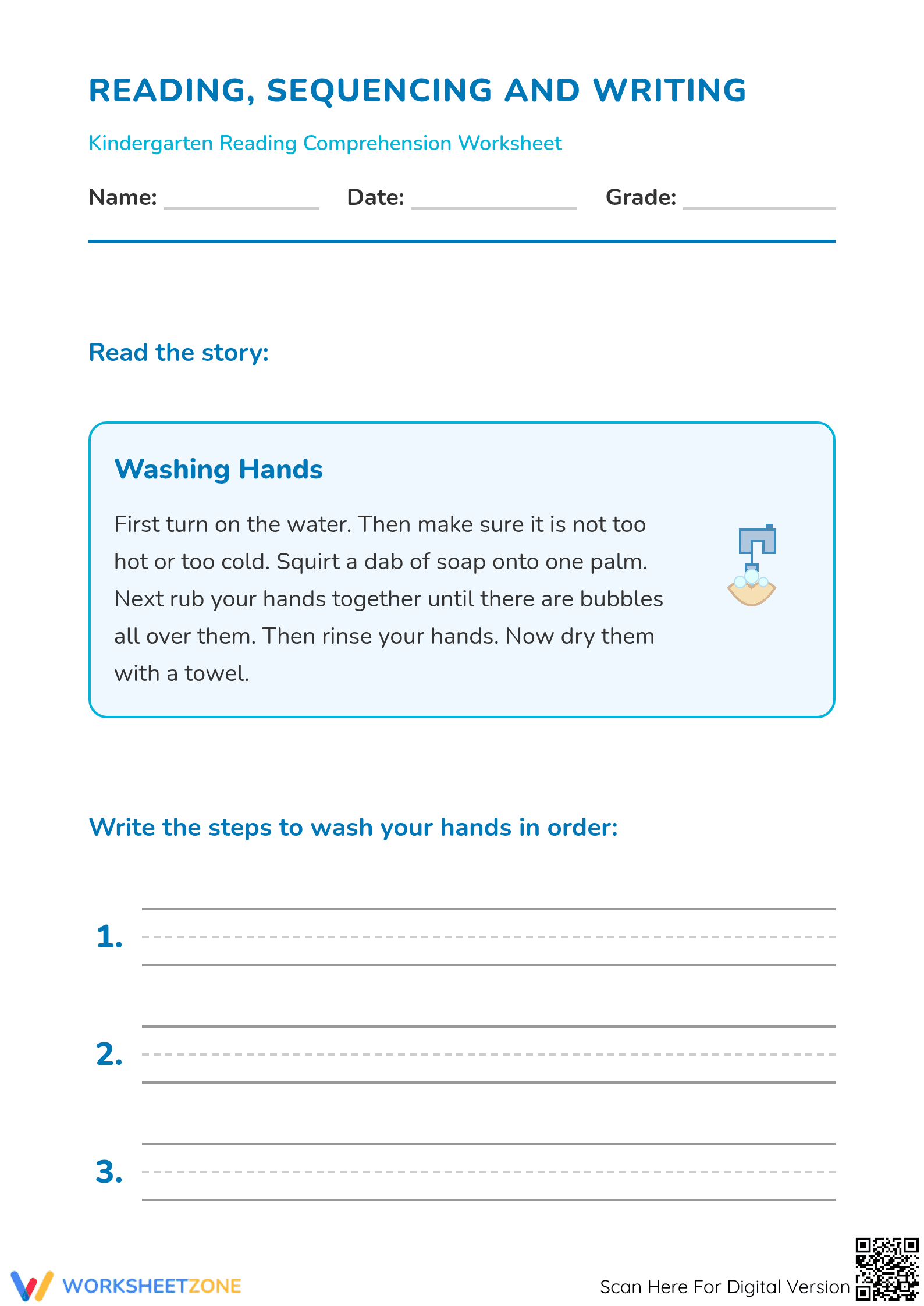
This Kindergarten sequencing worksheet helps students master informational reading by identifying chronological steps. By reading "Washing Hands" and writing six steps, learners develop critical transition word recognition and logical ordering skills. It transforms a health lesson into a robust literacy exercise for early elementary students.
At a Glance
- Grade: Kindergarten · Subject: ELA Literature
- Standard:
CCSS.ELA-LITERACY.RI.K.2— Identify the main topic and retell key details of a text- Skill Focus: Chronological Sequencing
- Format: 2 pages · 6 problems · Answer key included · PDF
- Best For: Independent literacy centers or sub plans
- Time: 15–20 minutes
What's Inside
This two-page PDF features a concise informational text titled "Washing Hands" utilizing transition signals like "First" and "Next." Students rewrite six sequential steps on numbered primary-ruled lines. The structured layout includes space for name, date, and grade, plus a full answer key for rapid grading or self-correction.
Zero-Prep Workflow
Follow these three steps: First, print the two-page document in less than 30 seconds. Second, distribute the sheets during a literacy block without any additional teacher setup or materials. Finally, use the provided answer key for immediate feedback or whole-class review. Total teacher preparation time is under two minutes, making it an ideal resource for sub plans.
Standards Alignment
Aligned to CCSS.ELA-LITERACY.RI.K.2, students retell key details from the "Washing Hands" narrative. It also supports CCSS.ELA-LITERACY.W.K.2 through procedural writing and informative description. Both standard codes can be copied directly into lesson plans, IEP goals, or district curriculum mapping tools for efficient tracking.
How to Use It
Assign this during health units to integrate science and literacy. Alternatively, use it as a formative assessment in literacy centers to observe if students can locate transition words to determine the order of the tasks. Both use cases provide excellent data on handwriting stamina and logical sequencing skills in Kindergarten.
Who It's For
Designed for Kindergarten students or first-grade intervention for those needing extra support. It is effective for ELLs who benefit from familiar contexts like handwashing and repetitive sentence structures. This worksheet pairs naturally with classroom anchor charts detailing transition words or a live demonstration of the handwashing process.
According to the EdReports 2024 analysis of foundational literacy materials, explicit instruction in sequencing informational text is a primary driver of long-term reading comprehension for early learners. This worksheet directly addresses CCSS.ELA-LITERACY.RI.K.2 by requiring students to extract and order six distinct details from a passage, a task that builds the cognitive architecture necessary for synthesizing more complex narratives in later grades. Research indicates that when students interact with procedural texts involving familiar daily routines, their cognitive load is significantly reduced, allowing them to focus more intensely on the mechanical skills of decoding and writing. By bridging the gap between reading a sequence and reproducing it in written form, this resource provides the structured repetition recommended for phonics-to-fluency transitions. Educators can utilize this data-backed approach to ensure that Kindergarteners meet essential milestones in informational text mastery while developing the logical reasoning skills required for academic success across the curriculum.


