




























Views
Downloads



Grade 6 April Fools Reading — Printable No-Prep Worksheet

Paste this activity's link or code into your existing LMS (Google Classroom, Canvas, Teams, Schoology, Moodle, etc.).
Students can open and work on the activity right away, with no student login required.
You'll still be able to track student progress and results from your teacher account.
This Grade 6 reading comprehension worksheet helps students build vocabulary and context clue skills while learning about the history of April Fools' Day. By completing a fill-in-the-blank informational passage, learners actively engage with the text to determine missing words, strengthening their reading fluency and comprehension.
At a Glance
- Grade: 6 · Subject: ELA
- Standard:
CCSS.ELA-LITERACY.RI.6.4— Determine the meaning of words in informational texts- Skill Focus: Vocabulary in context
- Format: 3 pages · 8 problems · Answer key included · PDF
- Best For: Independent practice or sub plans
- Time: 15–20 minutes
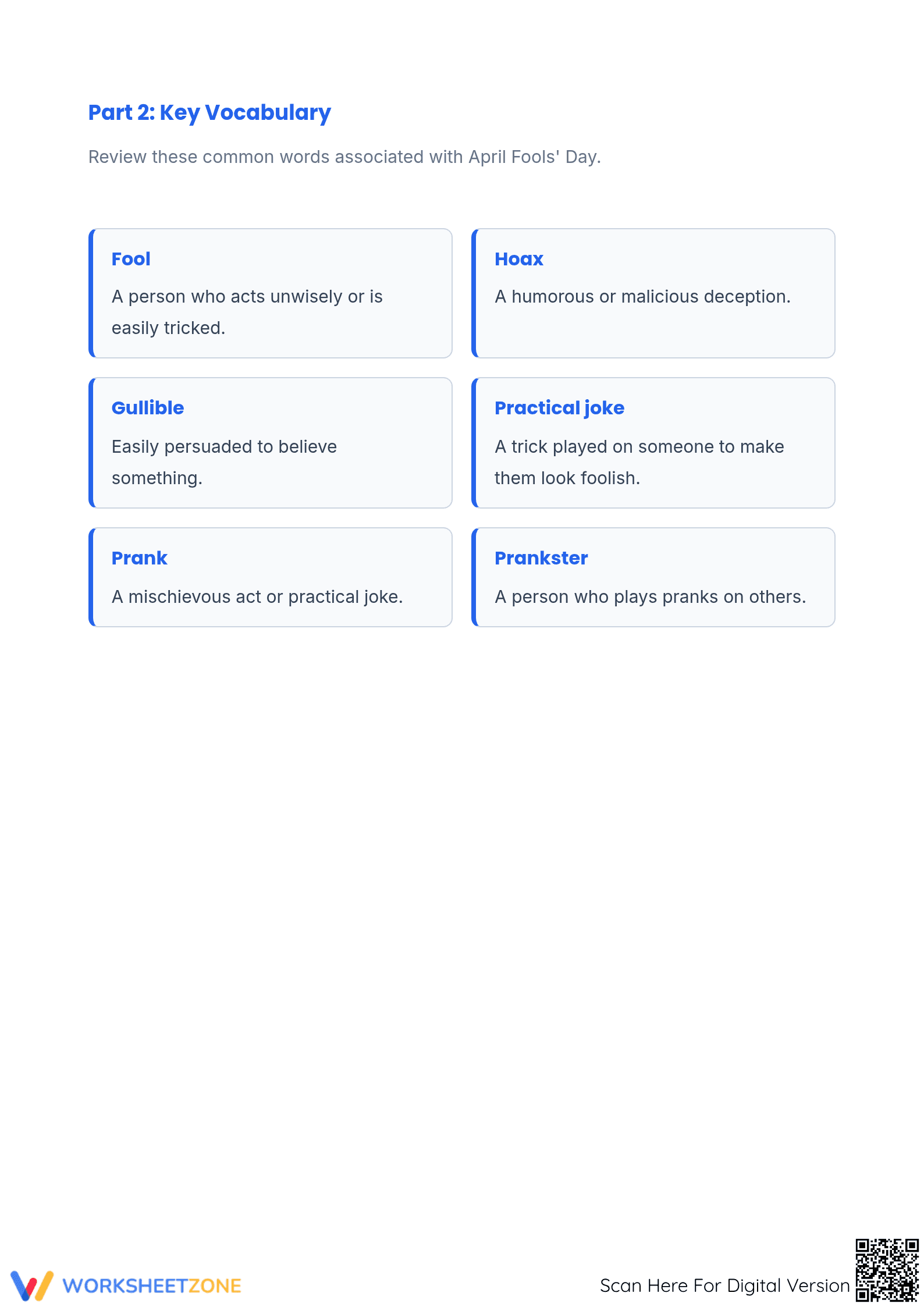
This three-page resource features a high-interest informational passage about the origins of April Fools' Day. It includes an eight-word bank for a fill-in-the-blank reading activity, followed by a dedicated key vocabulary section that defines terms like "hoax," "gullible," and "prankster." A complete answer key is provided for quick grading.
- Print (1 min): Simply print the three-page PDF. No special materials or prior setup are required.
- Distribute (1 min): Hand out the passage and vocabulary reference sheet to students for immediate engagement.
- Review (3 mins): Use the included answer key to quickly check the eight fill-in-the-blank responses.
With under two minutes of total teacher prep time, this worksheet is an excellent choice for emergency sub plans, morning work, or a quick holiday-themed literacy center.
Aligned to CCSS.ELA-LITERACY.RI.6.4, this activity requires students to determine the meaning of words and phrases as they are used in a text. It also supports general vocabulary acquisition by introducing thematic terms in context. Both standard codes can be copied directly into lesson plans, IEP goals, or district curriculum mapping tools.
Use this worksheet as an independent reading activity during the week of April Fools' Day. It works perfectly as a quiet warm-up before a larger ELA lesson. As a formative assessment tip, observe which students rely heavily on the word bank versus those who use surrounding sentence context to predict the missing words. Expect students to complete the reading and vocabulary review in 15 to 20 minutes.
This resource is designed for middle school ELA students, particularly in Grade 6. The included word bank provides built-in scaffolding, making it accessible for English Language Learners and students needing reading support. It pairs naturally with a broader unit on informational text structures or a fun class discussion about historical hoaxes.
Integrating thematic reading passages with targeted vocabulary practice significantly enhances student comprehension and long-term retention of new terms. By aligning with CCSS.ELA-LITERACY.RI.6.4 to determine the meaning of words in informational texts, this activity reinforces essential literacy skills that students need for academic success. According to Fisher & Frey (2014), providing students with structured opportunities to use context clues and interact with new vocabulary directly improves their ability to tackle complex texts independently across all subject areas. When learners actively engage with historical anecdotes and high-interest topics like holiday origins, their intrinsic motivation to read increases. This April Fools' Day worksheet offers a practical, engaging way to build these critical reading habits while minimizing teacher preparation time, ensuring that valuable instructional minutes are spent on active learning rather than administrative setup.


