


























Views
Downloads
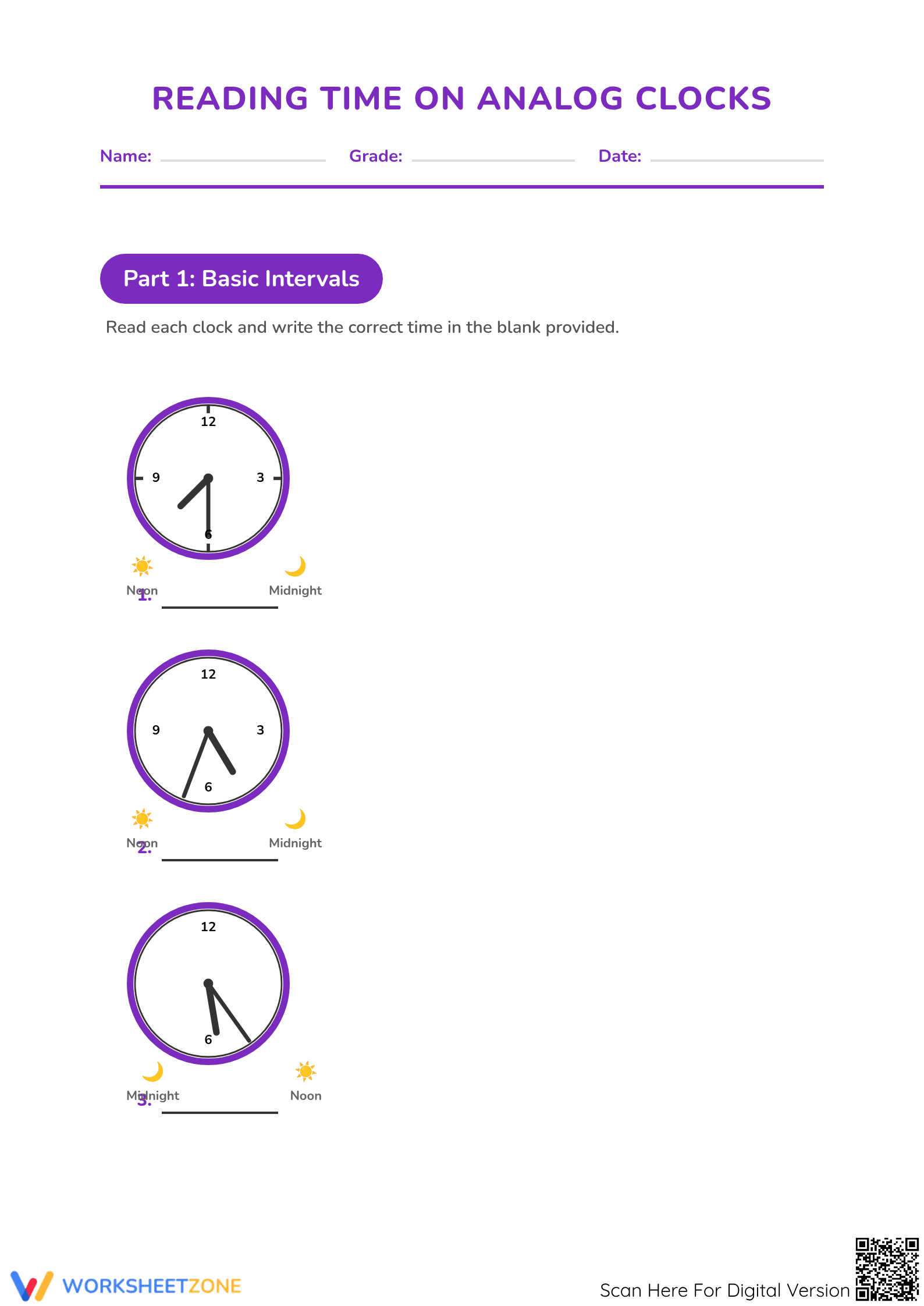


5-Minute Intervals Clock Worksheet | Grade 2-4 Essential
Paste this activity's link or code into your existing LMS (Google Classroom, Canvas, Teams, Schoology, Moodle, etc.).
Students can open and work on the activity right away, with no student login required.
You'll still be able to track student progress and results from your teacher account.
Students master the essential skill of telling time with this comprehensive analog clock worksheet. By focusing on 5-minute intervals, learners develop the precision required for real-world time management. This resource guides students through reading clock faces and identifying AM and PM contexts, ensuring they gain confidence in interpreting time across daily schedules.
At a Glance
- Grade: 2 · Subject: Math
- Standard:
CCSS.MATH.CONTENT.2.MD.C.7— Tell and write time from analog clocks to the nearest five minutes- Skill Focus: 5-Minute Interval Fluency
- Format: 4 pages · 14 problems · Answer key included · PDF
- Best For: Independent practice and formative assessment
- Time: 20–30 minutes
What's Inside
This four-page instructional packet contains fourteen distinct analog clock reading tasks. The layout is clean and focused, featuring large, legible clock faces with clear hour and minute hands. Each task includes visual cues for "Noon" and "Midnight" to help students differentiate between AM and PM periods. A full answer key is provided to facilitate quick grading or student self-correction during independent work time.
Skill Progression
- Guided Practice: The first eight problems provide high-contrast clock faces with explicit 12, 3, 6, and 9 numeral markings, helping students establish an initial anchor for the hour hand position.
- Supported Practice: Tasks nine through twelve remove numeric anchors, requiring students to rely on their understanding of clock geometry and minute-hand spacing to determine the exact time.
- Independent Practice: The final "Practice Challenge" and "Advanced Reading" sections present mixed intervals, testing the student's ability to transition between different times without repetitive patterns.
This structure follows a gradual-release model, moving from high-support scaffolds to independent mastery of clock-reading mechanics.
Standards Alignment
This worksheet is strictly aligned with CCSS.MATH.CONTENT.2.MD.C.7, which requires students to "Tell and write time from analog and digital clocks to the nearest five minutes, using a.m. and p.m." It also supports third-grade foundations for solving word problems involving time intervals. The standard code can be copied directly into lesson plans, IEP goals, or district curriculum mapping tools to ensure instructional compliance.
How to Use It
Deploy this worksheet after a direct instruction lesson on the 5-minute increments of the clock face. It serves as an excellent mid-unit formative assessment; observe students as they work to see if they correctly identify the "hidden" hour when the minute hand is past the six. For a collaborative twist, have students compare their answers and explain their reasoning for the AM/PM designations based on the noon and midnight icons.
Who It's For
This resource is designed for second-grade students introduced to five-minute intervals and third-grade learners requiring fluency reinforcement. It provides necessary scaffolding for students with dyscalculia or those struggling with spatial orientation on analog faces. This worksheet pairs naturally with a classroom "Judy Clock" or a large-scale anchor chart demonstrating the relationship between the five-times table and the clock's minute markings.
The ability to read analog clocks remains a critical cognitive milestone for elementary students, serving as a gateway to understanding elapsed time and proportional reasoning. Structured practice with analog timepieces enhances spatial-temporal awareness, a key predictor of success in mathematical domains like fractions and geometry. This worksheet helps overcome "minute-blindness" from digital-only environments by fostering the mental translation of hand positions into numeric values. By isolating the five-minute interval, it provides the repetition for automatic retrieval, ensuring students develop a robust mental model of time cycles and retain CCSS.MATH.CONTENT.2.MD.C.7 objectives for future advanced time-management and multi-step word problems.


