


























Views
Downloads



Printable Reading Time Worksheet | Grade 2-4 Math
Paste this activity's link or code into your existing LMS (Google Classroom, Canvas, Teams, Schoology, Moodle, etc.).
Students can open and work on the activity right away, with no student login required.
You'll still be able to track student progress and results from your teacher account.
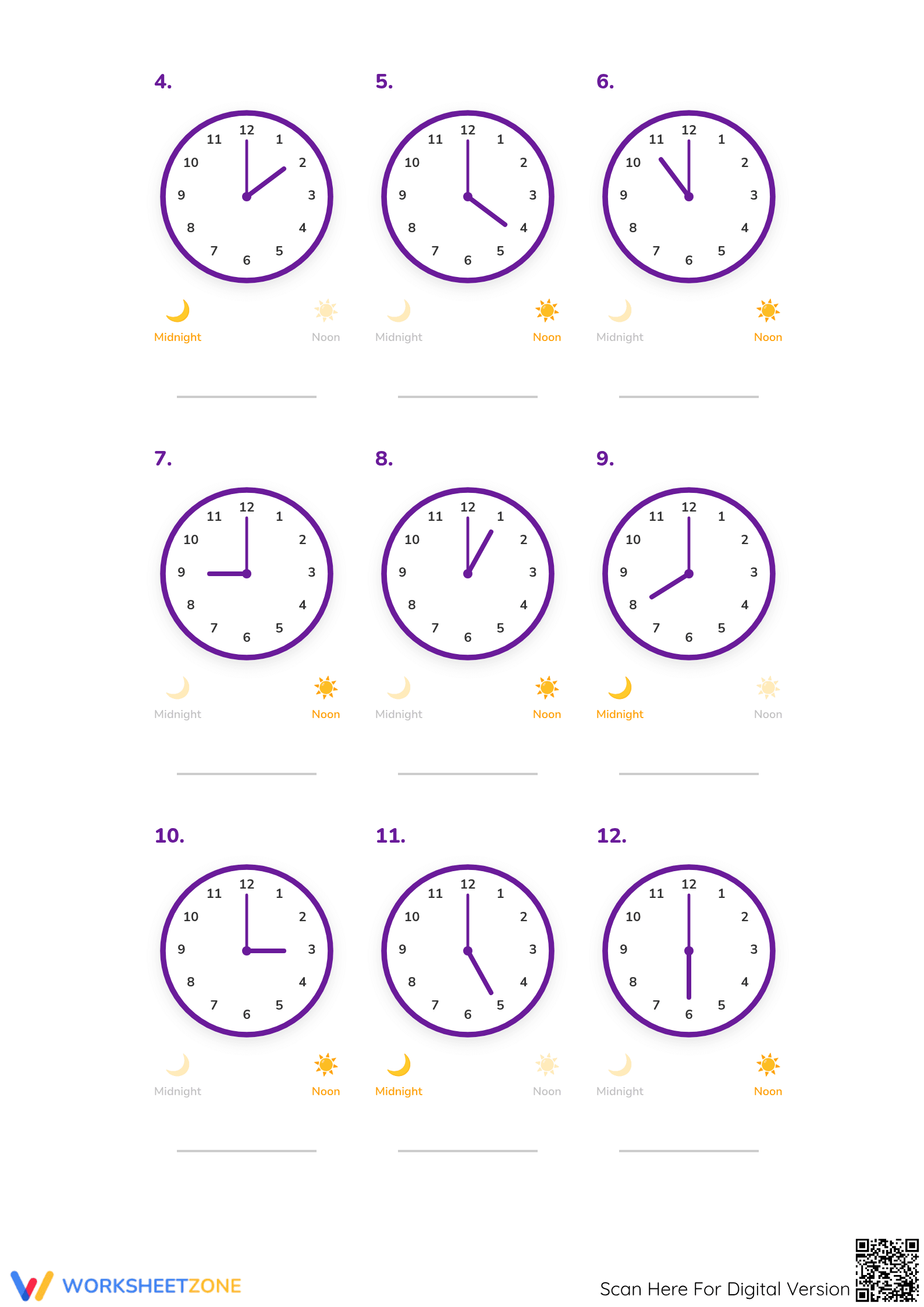
This comprehensive Grade 2-4 math resource helps students master reading analog clocks in one-hour intervals. By focusing on the position of the hour hand and utilizing visual icons for day and night, students build the foundational fluency required for complex time-telling. The worksheet ensures immediate success through clear formatting and 24 focused practice problems.
At a Glance
- Grade: 2–4 · Subject: Math
- Standard:
CCSS.MATH.CONTENT.2.MD.C.7— Tell and write time from analog clocks using a.m. and p.m.- Skill Focus: Analog Clock Reading (Hour Intervals)
- Format: 4 pages · 24 problems · Answer key included · PDF
- Best For: Independent practice and formative assessment
- Time: 15–25 minutes
The packet contains four structured pages featuring 24 distinct analog clock faces. Students must read the clock and determine the correct hour, then use the moon (Midnight) or sun (Noon) icons to label the time as AM or PM. The layout is divided into three parts: Set A, Set B, and a Final Challenge, providing a clean progression. A full answer key is provided for rapid grading.
This resource is designed for immediate classroom deployment with a three-step workflow. First, print the four-page PDF (30 seconds). Second, distribute the worksheets to students during your math block or as a transition activity (1 minute). Third, use the included answer key to review student work or facilitate self-grading (1 minute). Total teacher preparation time is under three minutes, making it an ideal choice for emergency sub plans or last-minute enrichment.
The primary focus of this worksheet is `CCSS.MATH.CONTENT.2.MD.C.7`: "Tell and write time from analog and digital clocks to the nearest five minutes, using a.m. and p.m." While focused on hour intervals, it provides the essential prerequisite skill of identifying hour hand placement and time-of-day markers. This standard code can be copied directly into lesson plans, IEP goals, or district curriculum mapping tools to ensure instructional alignment.
Use this worksheet as a targeted exit ticket after an introductory lesson on analog clocks to verify that students understand the difference between the hour and minute hands. It also serves as an excellent formative-assessment tool; observe if students correctly associate the sun icon with PM (afternoon) and the moon icon with AM (early morning). Students typically complete the 24 tasks within 20 minutes, allowing for quick checks.
This resource is ideal for second-grade students learning time-telling basics, as well as third and fourth graders who need remedial support or a quick refresher. It pairs naturally with physical manipulative clocks or an anchor chart showing the movement of time throughout a 24-hour cycle. The clear visual cues provide excellent support for English Language Learners and students with IEP accommodations.
The effective teaching of time-telling requires a structured transition from concrete manipulatives to representational models like the analog clock faces found in this Grade 2-4 resource. By focusing on one-hour intervals and AM/PM identification, the worksheet addresses the cognitive load challenges students face when learning multi-digit time systems. Aligned to the standard code CCSS.MATH.CONTENT.2.MD.C.7, this practice set enables students to tell and write time from analog clocks while accurately utilizing time-of-day markers. According to the RAND AIRS 2024 analysis of instructional materials, high-quality math worksheets must provide sufficient repetition of core skills to bridge the gap between initial conceptual understanding and procedural fluency. This 24-task sequence provides that necessary volume, ensuring students can independently identify hour intervals before advancing to five-minute or one-minute increments. The inclusion of visual icons facilitates the association of numerical time with real-world context, a key component of mathematical literacy.


