


























Views
Downloads


Essential Howler Monkey Reading Worksheet | Grade 7 ELA
Paste this activity's link or code into your existing LMS (Google Classroom, Canvas, Teams, Schoology, Moodle, etc.).
Students can open and work on the activity right away, with no student login required.
You'll still be able to track student progress and results from your teacher account.
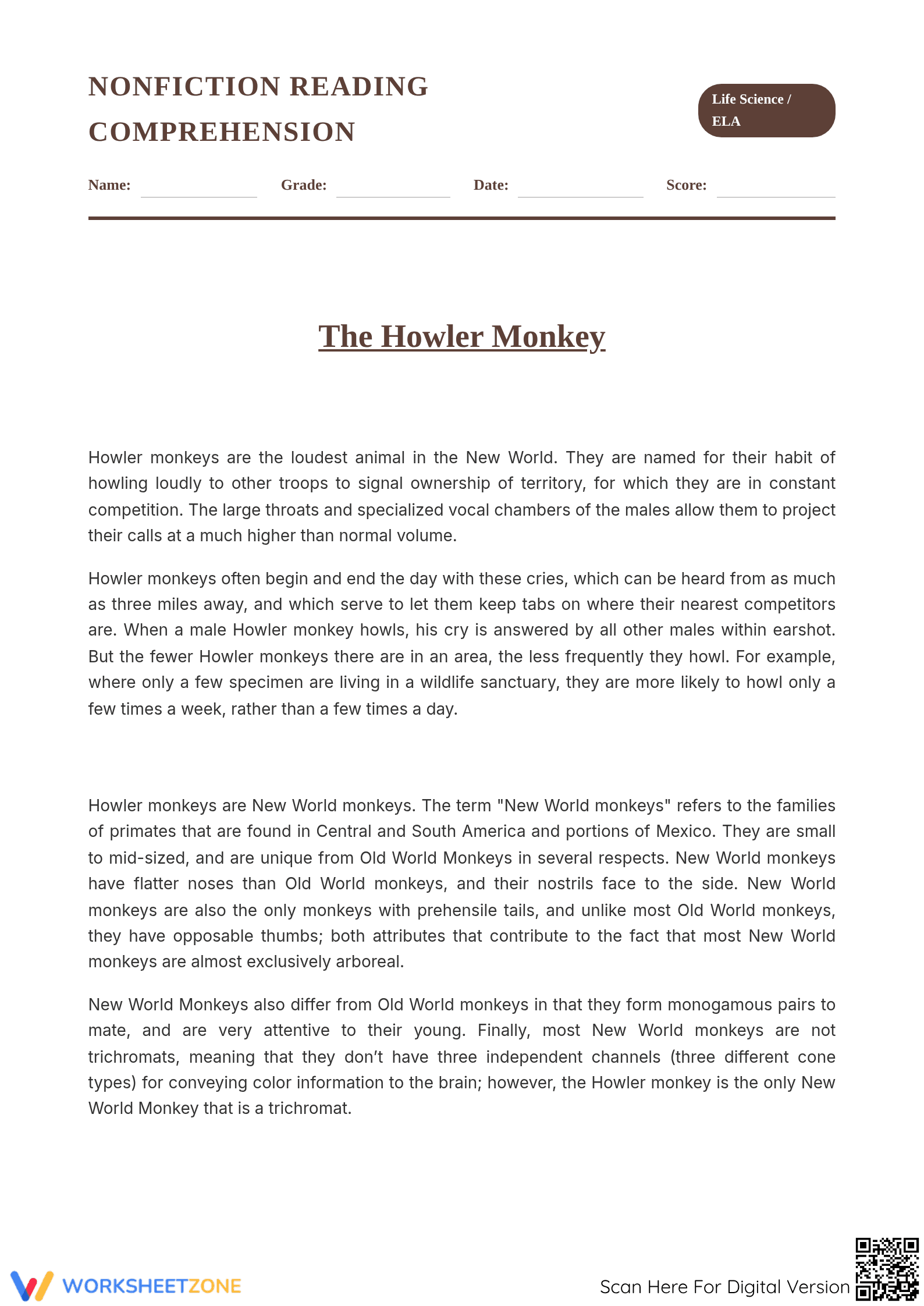
This Grade 7 nonfiction reading comprehension worksheet guides students through an engaging study of the Howler Monkey. Students will analyze text evidence, compare primate classifications, and define domain-specific vocabulary. By the end of the lesson, learners will demonstrate mastery in citing textual evidence to support their analysis of informational texts.
At a Glance
- Grade: 7 · Subject: ELA
- Standard:
CCSS.ELA-LITERACY.RI.7.1— Cite several pieces of textual evidence to support analysis of what the text says- Skill Focus: Nonfiction Comprehension & Comparison
- Format: 4 pages · 8 problems · Answer key included · PDF
- Best For: Independent practice or formative assessment
- Time: 30–45 minutes
The resource contains a comprehensive two-page informational text followed by three distinct assessment sections. It includes three multiple-choice comprehension questions, a detailed graphic organizer comparing New World and Old World monkeys, and a vocabulary matching section for terms like arboreal and gestation. A final critical thinking prompt requires a written response based on biological reasoning.
Skill Progression
- Guided practice: Students begin by identifying explicit facts through three multiple-choice questions that mirror standardized test formats.
- Supported practice: The graphic organizer provides a structured framework for students to categorize differences between primate families using provided text details.
- Independent practice: The final section challenges students to define complex vocabulary in context and synthesize information to answer a high-level critical thinking question.
This sequence follows a gradual-release model, moving from basic recall to complex synthesis and written explanation.
Standards Alignment
This worksheet is primarily aligned with CCSS.ELA-LITERACY.RI.7.1, which requires students to cite several pieces of textual evidence to support analysis of what the text says explicitly as well as inferences drawn from the text. It also supports RI.7.4 by requiring students to determine the meaning of words and phrases as they are used in a text. Both standard codes can be copied directly into lesson plans, IEP goals, or district curriculum mapping tools.
How to Use It
Use this as a mid-unit formative assessment after teaching the difference between explicit and implicit evidence. During the independent work phase, observe if students are returning to the text to complete the graphic organizer or relying on memory. This resource is also ideal for a 40-minute sub plan, as the text and questions are self-contained and require no prior teacher setup.
Who It's For
This worksheet is designed for 7th-grade students but is appropriate for 6th-grade enrichment or 8th-grade review. It is particularly effective for students who need practice with informational text structures and scientific terminology. Pair this with a video clip of a howler monkey's call to provide a multi-sensory hook before students begin reading the passage.
Research from Fisher & Frey (2014) emphasizes that complex informational texts require multiple exposures and structured scaffolds, such as graphic organizers, to ensure deep comprehension. This Grade 7 worksheet addresses CCSS.ELA-LITERACY.RI.7.1 by providing 8 targeted tasks that require students to cite evidence and analyze primate biology. By integrating vocabulary acquisition with comparison tasks, the resource aligns with evidence-based literacy practices that improve student outcomes in middle school ELA. According to the RAND AIRS 2024 report, high-quality instructional materials that balance direct questioning with synthesis tasks significantly improve reading proficiency scores. This 4-page PDF provides a complete instructional cycle, ensuring that students move beyond surface-level reading to master the critical thinking skills necessary for secondary education success. The inclusion of an answer key allows for immediate feedback, a critical component of the learning process.


