


























Views
Downloads
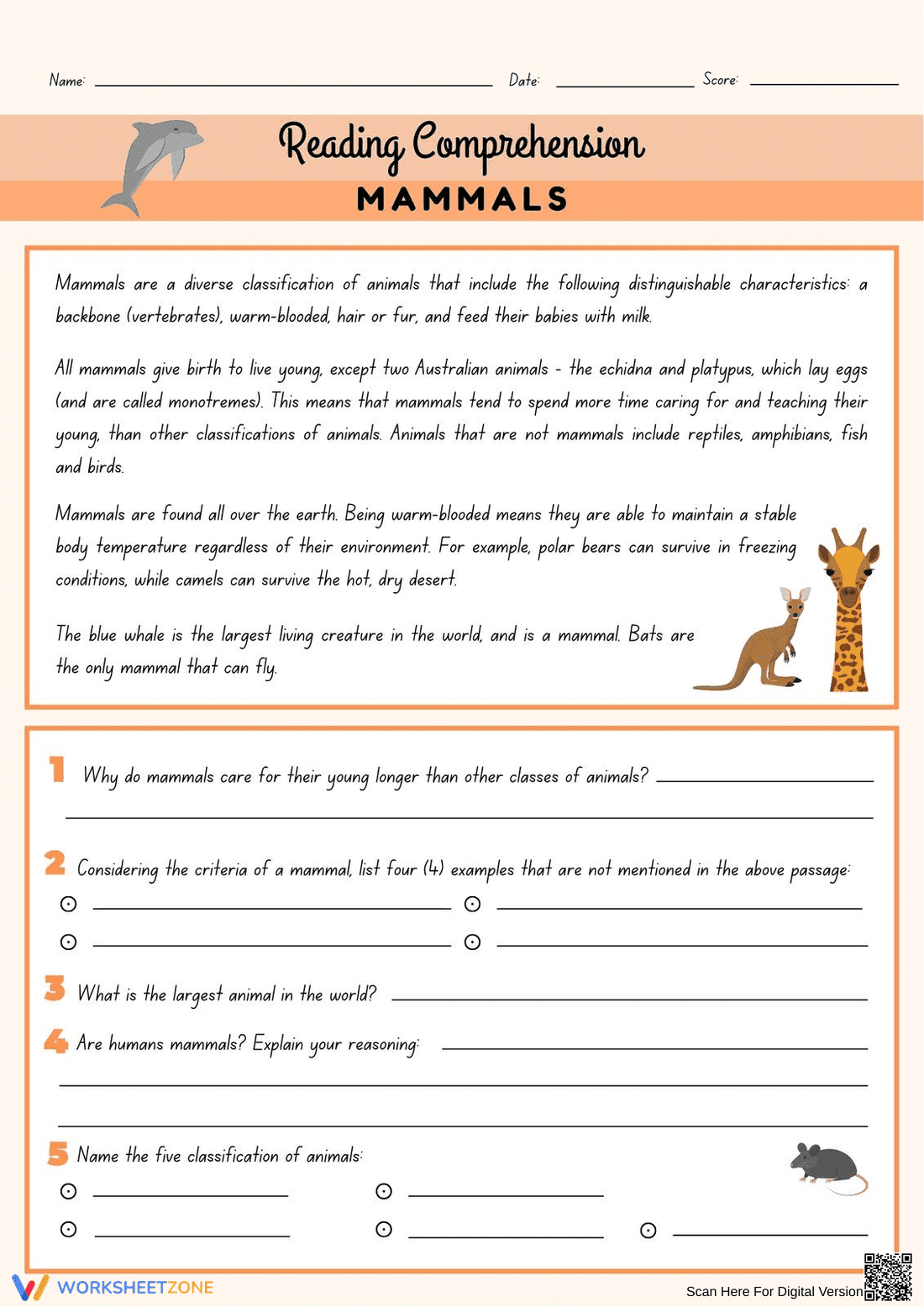

Mammals Reading Comprehension | Grade 3 Printable
Paste this activity's link or code into your existing LMS (Google Classroom, Canvas, Teams, Schoology, Moodle, etc.).
Students can open and work on the activity right away, with no student login required.
You'll still be able to track student progress and results from your teacher account.
This Grade 3 reading comprehension worksheet builds essential informational text skills by having students read a short passage about mammals and answer targeted questions. Students practice locating text evidence, applying prior knowledge, and explaining their reasoning to demonstrate a clear understanding of the subject matter.
At a Glance
- Grade: 3 · Subject: ELA
- Standard:
CCSS.ELA-LITERACY.RI.3.1— Ask and answer questions using text evidence- Skill Focus: Reading Comprehension
- Format: 1 page · 5 problems · Answer key included · PDF
- Best For: Independent practice and review
- Time: 15–20 minutes
This single-page resource features a concise, high-interest informational passage detailing the characteristics of mammals, including exceptions like monotremes and examples of diverse habitats. Following the text, students complete five comprehension tasks that range from literal recall to inferential reasoning. The layout provides clear, lined spaces for written responses, and a complete answer key is included to streamline grading.
Designed for immediate classroom implementation, this resource requires minimal teacher preparation:
- Print (1 minute): Simply download the PDF and print a class set. The single-page format saves paper and copying time.
- Distribute (1 minute): Hand out the worksheet as a standalone activity or alongside a broader science unit on animal classifications.
- Review (3 minutes): Use the provided answer key to quickly check student responses or guide a whole-class discussion on finding text evidence.
With a total teacher prep time of under two minutes, this worksheet is an excellent addition to any emergency sub plan or busy instructional day.
This worksheet is tightly aligned to CCSS.ELA-LITERACY.RI.3.1, requiring students to ask and answer questions to demonstrate understanding of a text, referring explicitly to the text as the basis for the answers. It also supports cross-curricular science standards regarding animal traits and classification. Both standard codes can be copied directly into lesson plans, IEP goals, or district curriculum mapping tools.
Teachers can utilize this passage during independent reading blocks or as a targeted warm-up activity before a science lesson on animal groups. It works exceptionally well as a formative assessment; as students work, observe whether they are looking back at the text to find the names of the five animal classifications or relying solely on memory. Expected completion time ranges from 15 to 20 minutes, making it a versatile tool for morning work or homework assignments.
This resource is primarily designed for third-grade students developing their informational reading skills. For students needing additional support, teachers can read the passage aloud or highlight key vocabulary words like "vertebrates" and "monotremes" prior to independent work. It pairs naturally with visual anchor charts detailing animal classifications or introductory direct instruction lessons on basic biology.
Developing strong informational text comprehension is a critical milestone in elementary education. When students practice asking and answering questions using text evidence, they build the foundational skills necessary for advanced academic reading. This worksheet directly supports CCSS.ELA-LITERACY.RI.3.1 by requiring learners to extract specific details and apply reasoning to a nonfiction passage about mammals. According to Fisher & Frey (2014), providing students with structured, text-dependent questions significantly improves their ability to engage with complex informational texts and retain content-area knowledge. By integrating cross-curricular topics like science into reading practice, educators can maximize instructional time and foster deeper cognitive connections. Regular practice with targeted passages ensures students move beyond basic decoding to achieve genuine comprehension, preparing them for the rigorous demands of upper elementary coursework and standardized assessments.


