


























Views
Downloads

RL.9-10.1 Worksheet: Essential Inference Skills — Grade 9-10
Paste this activity's link or code into your existing LMS (Google Classroom, Canvas, Teams, Schoology, Moodle, etc.).
Students can open and work on the activity right away, with no student login required.
You'll still be able to track student progress and results from your teacher account.
This Grade 9-10 ELA worksheet targets the critical ability to draw logical conclusions from a text. By engaging with a creative retelling of a classic tale, students move beyond surface-level reading to uncover hidden meanings and character motivations. It provides a structured environment for demonstrating textual evidence through both visual and written responses.
At a Glance
- Grade: 9-10 · Subject: English Language Arts
- Standard:
CCSS.ELA-LITERACY.RL.9-10.1— Cite strong and thorough textual evidence to support analysis of what the text says- Skill Focus: Making logical inferences and character analysis
- Format: 2 pages · 6 tasks · Answer key included · PDF
- Best For: Formative assessment of reading comprehension skills
- Time: 25–35 minutes
What's Inside
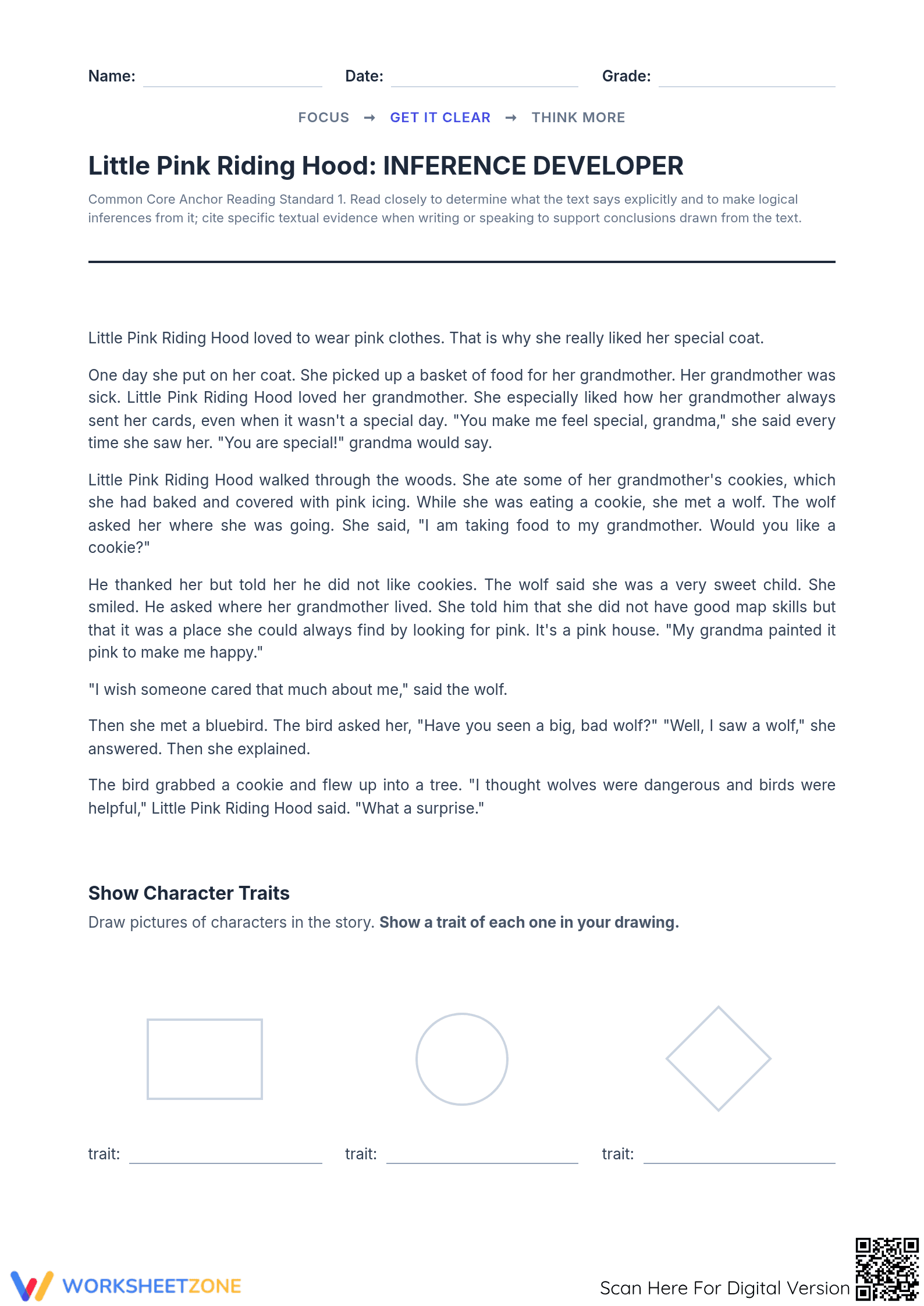
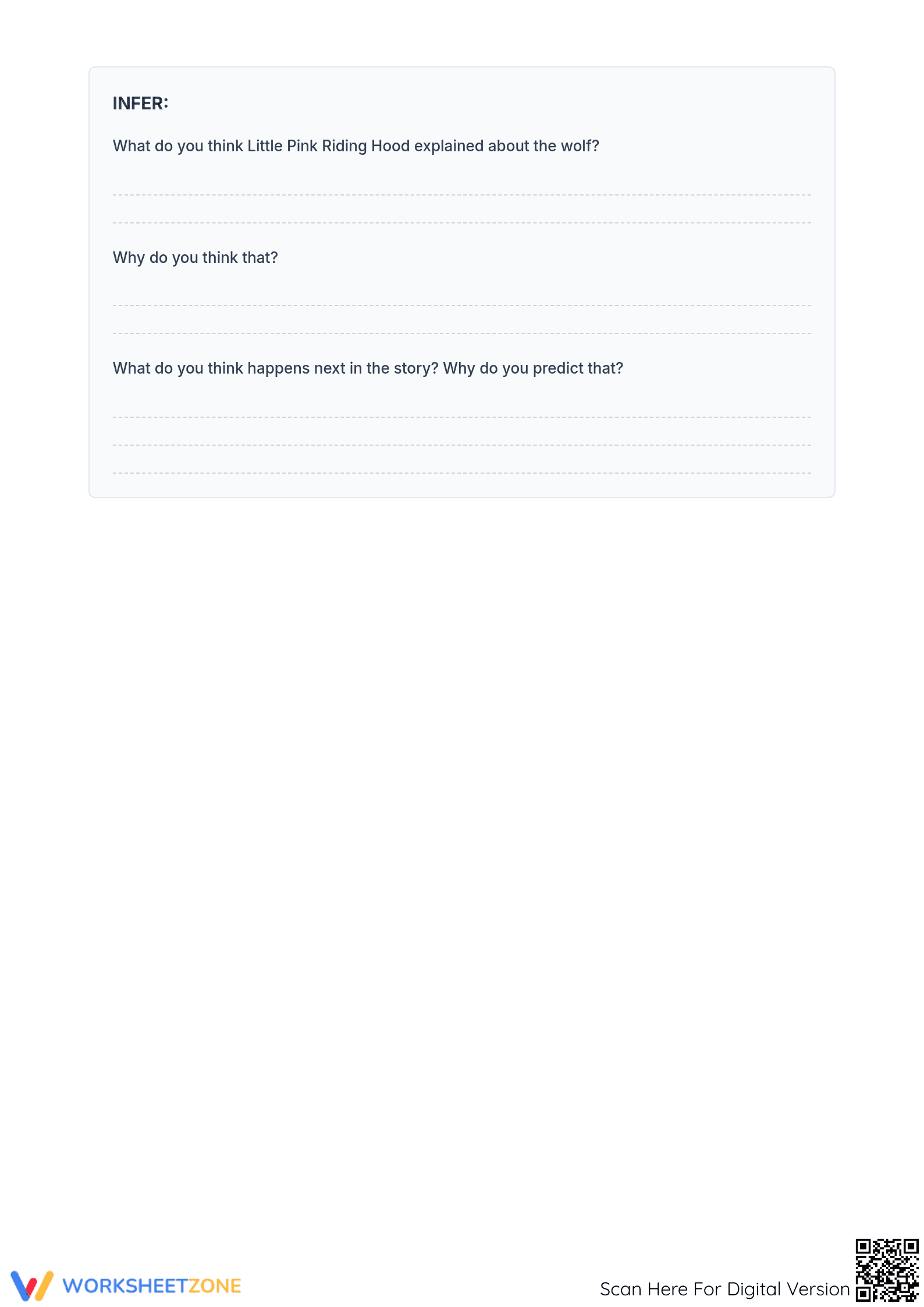
The resource contains a two-page spread featuring the "Little Pink Riding Hood" narrative. The first page includes the text and a "Show Character Traits" section where students draw and label three distinct characters. The second page provides a dedicated "Infer" box with three multi-part questions requiring students to explain their reasoning and make predictions based on textual cues.
Mastery Evidence
This worksheet functions as a direct evidence collector for standard RL.9-10.1. The tasks are tiered to show a progression toward mastery. The character trait section assesses the ability to identify implicit descriptions, while the inference questions require students to synthesize information to predict future events. Teachers can use the open-ended responses to evaluate the depth of student reasoning, making it easy to record progress in digital gradebooks or IEP tracking systems.
Standards Alignment
The primary focus is `CCSS.ELA-LITERACY.RL.9-10.1`, which requires students to cite strong and thorough textual evidence to support analysis of what the text says explicitly as well as inferences drawn from the text. It also supports RL.9-10.3 by analyzing how complex characters develop over the course of a text. Both standard codes can be copied directly into lesson plans, IEP goals, or district curriculum mapping tools.
How to Use It
Use this worksheet during guided practice. After reading together, have students complete character drawings to check comprehension. Use inference questions for small-group discussion before final writing. This allows for formative observation of how students bridge the gap between literal text and implied meaning.
Who It's For
This resource is designed for high school students in Grade 9 or 10 who need focused practice on evidence-based writing. It is particularly effective for students who benefit from visual organizers, as the drawing component scaffolds the transition to abstract analysis. Pair this with a short story unit or an anchor chart on common character archetypes to provide additional support.
According to the RAND AIRS 2024 report on secondary literacy, the ability to generate inferences is the single most significant predictor of long-term reading comprehension success in high school. This worksheet directly addresses this need by aligning with CCSS.ELA-LITERACY.RL.9-10.1, ensuring students practice the specific skill of citing textual evidence to support logical conclusions. By requiring students to explain "why do you think that?", the activity mirrors the cognitive demands found in high-stakes assessments and college-level reading tasks. Research from Fisher & Frey (2014) emphasizes that gradual release models, which move from identifying traits to predicting outcomes, help solidify these complex cognitive pathways. This 2-page PDF provides a clear, measurable way for educators to document student growth in inferential thinking, making it a reliable tool for both general education classrooms and targeted intervention settings where evidence-based practice is mandatory.


