


























Views
Downloads

Essential Letters Y & Z Trace and Write Worksheet
Paste this activity's link or code into your existing LMS (Google Classroom, Canvas, Teams, Schoology, Moodle, etc.).
Students can open and work on the activity right away, with no student login required.
You'll still be able to track student progress and results from your teacher account.
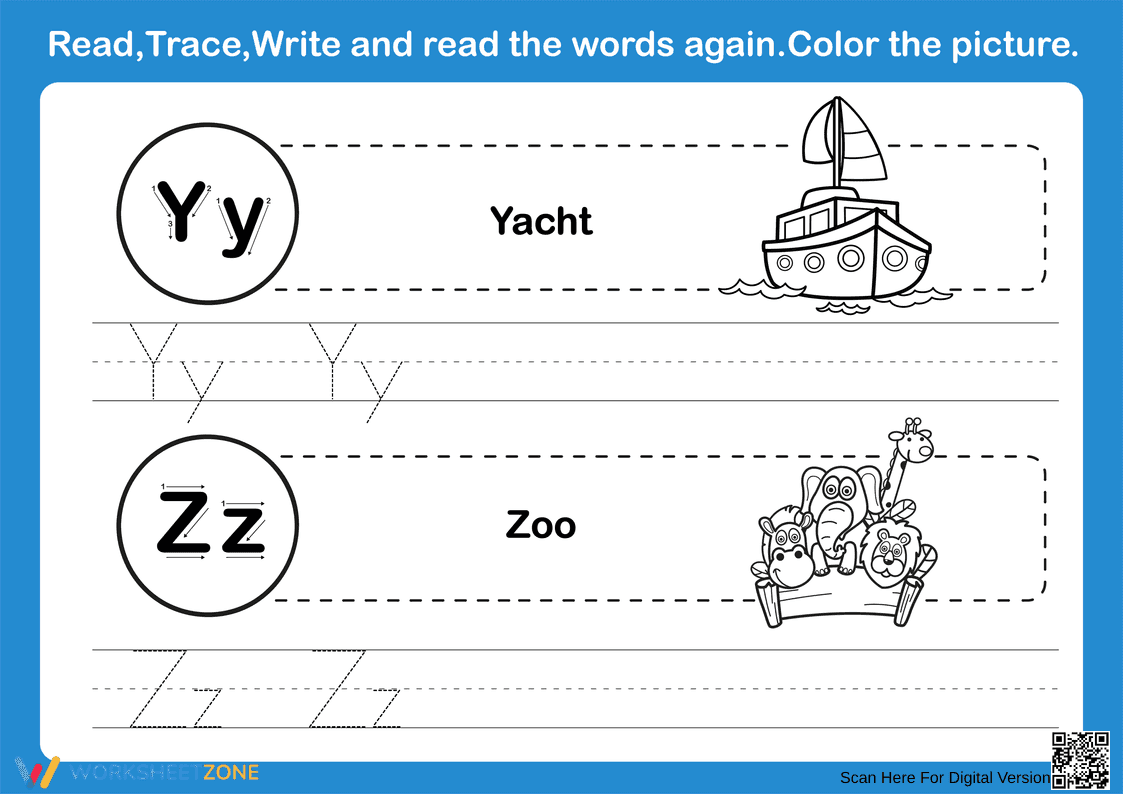
This foundational ELA worksheet helps early learners master the final letters of the alphabet through a multi-sensory approach. By combining reading, tracing, and independent writing, students build the muscle memory and phonemic awareness necessary for literacy. The inclusion of coloring elements ensures high engagement for preschool and kindergarten students.
At a Glance
- Grade: Kindergarten · Subject: ELA
- Standard:
CCSS.ELA-LITERACY.L.K.1.A— Print many upper- and lowercase letters correctly- Skill Focus: Letter formation and phonics
- Format: 1 page · 4 tasks · No answer key included · PDF
- Best For: Morning work or literacy centers
- Time: 10–15 minutes
The worksheet features dedicated sections for letters Y and Z. Each section includes a large visual anchor, a vocabulary word (Yacht and Zoo), and a dashed-line tracing path for both uppercase and lowercase versions. Below the tracing guide, students find a blank primary-ruled line to practice independent letter production. A thematic illustration is provided for coloring to reinforce fine motor control.
This resource is designed for a zero-prep classroom environment. Teachers can print the single-page PDF in less than 30 seconds. Distribution takes approximately 1 minute during transition periods. Reviewing student work is instantaneous as the visual tracing paths provide immediate feedback on stroke order and alignment. It serves as an ideal emergency sub plan or quiet-time activity.
This activity aligns with CCSS.ELA-LITERACY.L.K.1.A, which requires students to print many upper- and lowercase letters. It also supports CCSS.ELA-LITERACY.RF.K.1.D by helping students recognize and name all upper- and lowercase letters of the alphabet. Both standard codes can be copied directly into lesson plans, IEP goals, or district curriculum mapping tools.
Use this worksheet during the independent practice phase of a lesson after demonstrating letter strokes on a whiteboard. It is also effective as a formative assessment tool; observe students as they write to identify those struggling with pencil grip or top-to-bottom stroke direction. Expect completion within 10 to 15 minutes depending on the student's fine motor development.
This resource is tailored for preschool, kindergarten, and first-grade students who are refining their handwriting. It is particularly helpful for English Language Learners (ELLs) who benefit from the visual pairing of words like "Yacht" and "Zoo" with their corresponding letters. Pair this with an alphabet anchor chart or a letter-sound song for a complete instructional block.
Handwriting instruction remains a cornerstone of early literacy, as evidenced by the RAND AIRS 2024 report which highlights the correlation between manual letter production and long-term reading fluency. This worksheet targets CCSS.ELA-LITERACY.L.K.1.A by providing structured paths for letters Y and Z, ensuring students develop the specific motor patterns required for legible writing. Research from Fisher & Frey (2014) suggests that integrating visual anchors with motor practice, such as the "Yacht" and "Zoo" examples provided here, accelerates the orthographic mapping process. By focusing on the final letters of the alphabet, this resource fills a critical gap in many curriculum sequences that often rush through the end of the alphabet. The 1-page format provides 4 distinct practice opportunities, making it a high-utility tool for daily literacy rotations. This evidence-based approach ensures that students move beyond simple recognition to active, accurate production of the English alphabet.


