




























Views
Downloads
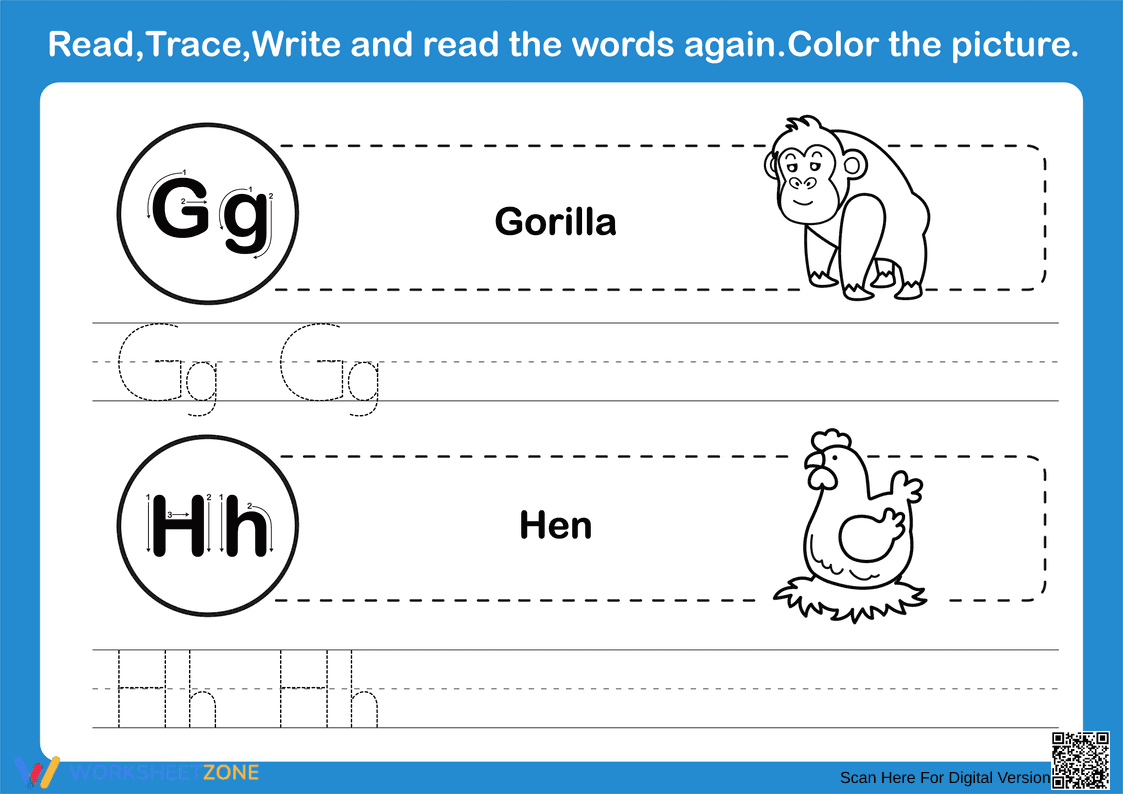

Grade K Letter G & H Printable Worksheet

Paste this activity's link or code into your existing LMS (Google Classroom, Canvas, Teams, Schoology, Moodle, etc.).
Students can open and work on the activity right away, with no student login required.
You'll still be able to track student progress and results from your teacher account.
This foundational handwriting worksheet helps early learners master the formation of uppercase and lowercase letters G and H. By combining guided tracing with independent writing practice, students develop essential fine motor skills and letter recognition. The simple layout ensures young readers can focus entirely on proper stroke order and pencil control.
At a Glance
- Grade: K · Subject: ELA
- Standard:
CCSS.ELA-LITERACY.L.K.1.A— Print many upper- and lowercase letters- Skill Focus: Letter formation and tracing
- Format: 1 page · 4 problems · No answer key · PDF
- Best For: Morning work or centers
- Time: 10–15 minutes
This single-page resource features dedicated sections for both the letter G and the letter H. Each section includes a large, numbered stroke-order guide, a traceable vocabulary word (Gorilla and Hen), and dotted lines for guided letter tracing. Students also have space to practice writing the letters independently. Engaging illustrations are provided alongside the text, offering a fun coloring opportunity that further reinforces fine motor development.
This resource offers a zero-prep workflow:
- Print (1 minute): Simply download the PDF and print the required number of copies. No special formatting or cutting is needed.
- Distribute (1 minute): Hand out the worksheets along with pencils and crayons. The visual instructions make it easy for students to begin immediately.
- Review (1 minute): Quickly check student work for proper letter formation and stroke direction as they complete the page.
Total teacher preparation time is under two minutes, making this an excellent option for emergency sub plans or quick morning work assignments.
This activity is directly aligned to CCSS.ELA-LITERACY.L.K.1.A, which requires students to print many upper- and lowercase letters. It also supports foundational phonics skills by pairing the target letters with corresponding initial-sound vocabulary words. Both standard codes can be copied directly into lesson plans, IEP goals, or district curriculum mapping tools.
Use this worksheet during morning arrival as an independent task to settle the classroom. It also functions perfectly as a literacy center station following direct instruction on the letters G and H. While students are working, observe their pencil grip and starting points to ensure they are following the numbered stroke guides rather than drawing the letters from the bottom up. Expected completion time ranges from 10 to 15 minutes.
This material is ideal for preschool, kindergarten, and first-grade students who are developing basic handwriting and letter recognition skills. For students needing extra support, teachers can highlight the dotted lines with a bright marker before tracing. This worksheet pairs naturally with an alphabet anchor chart or a read-aloud book featuring animals like gorillas and hens.
Early handwriting instruction remains a critical component of comprehensive literacy development in early childhood education. According to Fisher & Frey (2014), explicit instruction in letter formation, combined with repeated guided practice, significantly improves both writing fluency and subsequent reading comprehension. This targeted worksheet directly addresses CCSS.ELA-LITERACY.L.K.1.A by requiring students to print many upper- and lowercase letters accurately and consistently. By integrating numbered stroke-order models with immediate tracing application, the activity builds the automaticity necessary for higher-level composition tasks later in their academic journey. The inclusion of initial-sound vocabulary words, such as gorilla and hen, further bridges the gap between mechanical writing skills and essential phonemic awareness. Providing structured, targeted practice on specific letter pairs like G and H ensures that young learners establish the foundational motor memory required for long-term academic success in English Language Arts.


