


























Views
Downloads

Printable Letters E & F Worksheet | Grade K ELA
Paste this activity's link or code into your existing LMS (Google Classroom, Canvas, Teams, Schoology, Moodle, etc.).
Students can open and work on the activity right away, with no student login required.
You'll still be able to track student progress and results from your teacher account.
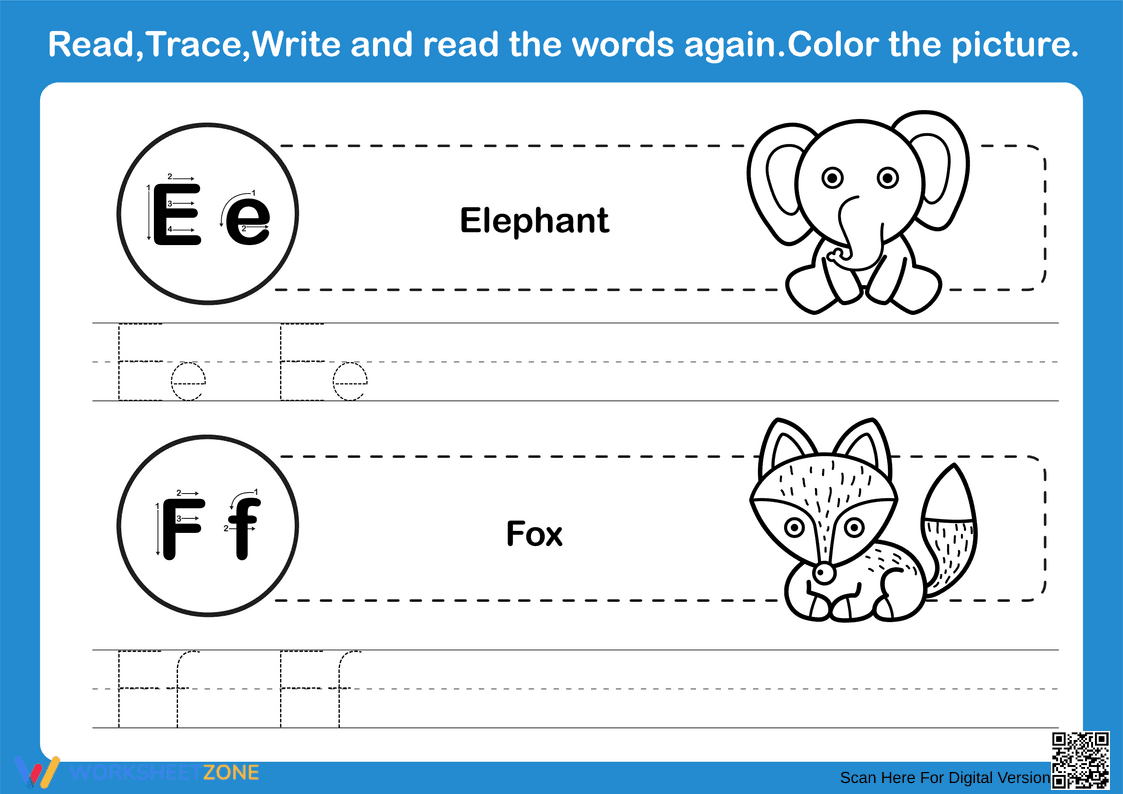
This foundational handwriting worksheet helps early learners master the letters E and F through targeted tracing and writing practice. Students build fine motor control and letter recognition skills by tracing uppercase and lowercase forms, reading associated sight words, and coloring corresponding illustrations to reinforce phonetic connections.
At a Glance
- Grade: K · Subject: ELA
- Standard:
CCSS.ELA-LITERACY.L.K.1.A— Print many upper- and lowercase letters- Skill Focus: Letter tracing and writing
- Format: 1 page · 4 problems · No answer key needed · PDF
- Best For: Morning work or centers
- Time: 10–15 minutes
This single-page resource features structured practice for uppercase and lowercase letters E and F. It includes guided tracing lines with directional arrows to ensure proper stroke order, followed by blank spaces for independent writing. Additionally, the page provides two decodable words—Elephant and Fox—paired with engaging illustrations that students can color, reinforcing initial consonant sounds.
This resource is designed for immediate classroom implementation with a streamlined zero-prep workflow:
- Print (1 minute): Generate the PDF and print a class set directly from your computer. No special formatting or cutting is required.
- Distribute (1 minute): Hand out the single-page sheets along with pencils and crayons. The visual instructions are intuitive for early readers.
- Review (1 minute): Quickly scan student work to ensure they are following the directional arrows and staying within the handwriting guidelines.
With under two minutes of total teacher prep time, this activity is highly suitable for emergency sub plans or independent literacy centers.
This activity is directly aligned to CCSS.ELA-LITERACY.L.K.1.A, requiring students to print many upper- and lowercase letters. It also supports foundational phonics skills by connecting the printed symbols to their initial sounds in familiar words. Both standard codes can be copied directly into lesson plans, IEP goals, or district curriculum mapping tools.
Integrate this worksheet into your daily literacy block during independent center time or as a focused morning work activity. Before direct instruction, it serves as a gentle warm-up for fine motor muscles. During independent practice, teachers can use it for formative assessment by observing students' pencil grip and stroke directionality. Ensure students are starting their letters from the top line rather than the bottom. Expected completion time ranges from 10 to 15 minutes, depending on the student's coloring detail.
This resource is primarily designed for Kindergarten students, though it serves as excellent remediation for first graders needing handwriting reinforcement or enrichment for preschool learners showing early literacy readiness. For differentiation, provide textured surfaces under the paper for students who need tactile feedback while tracing. Pair this worksheet with a whole-group alphabet anchor chart or a read-aloud focusing on the target letters.
Developing automaticity in letter formation is a critical precursor to fluent writing and reading comprehension. According to Fisher & Frey (2014), explicit instruction in handwriting mechanics reduces the cognitive load required for transcription, allowing young learners to allocate more mental resources to idea generation and phonemic awareness. This targeted practice aligns with CCSS.ELA-LITERACY.L.K.1.A, ensuring students can accurately print many upper- and lowercase letters. By combining guided tracing with independent writing and phonetic picture associations, this resource supports multimodal learning pathways. Consistent, structured repetition of these foundational motor patterns builds the muscle memory necessary for long-term literacy success. Early intervention and daily practice with specific letter pairs, such as E and F, establish a strong baseline for subsequent spelling and composition skills in early education.


