


























Views
Downloads

Printable Letters A & B Tracing Worksheet | Grade K
Paste this activity's link or code into your existing LMS (Google Classroom, Canvas, Teams, Schoology, Moodle, etc.).
Students can open and work on the activity right away, with no student login required.
You'll still be able to track student progress and results from your teacher account.
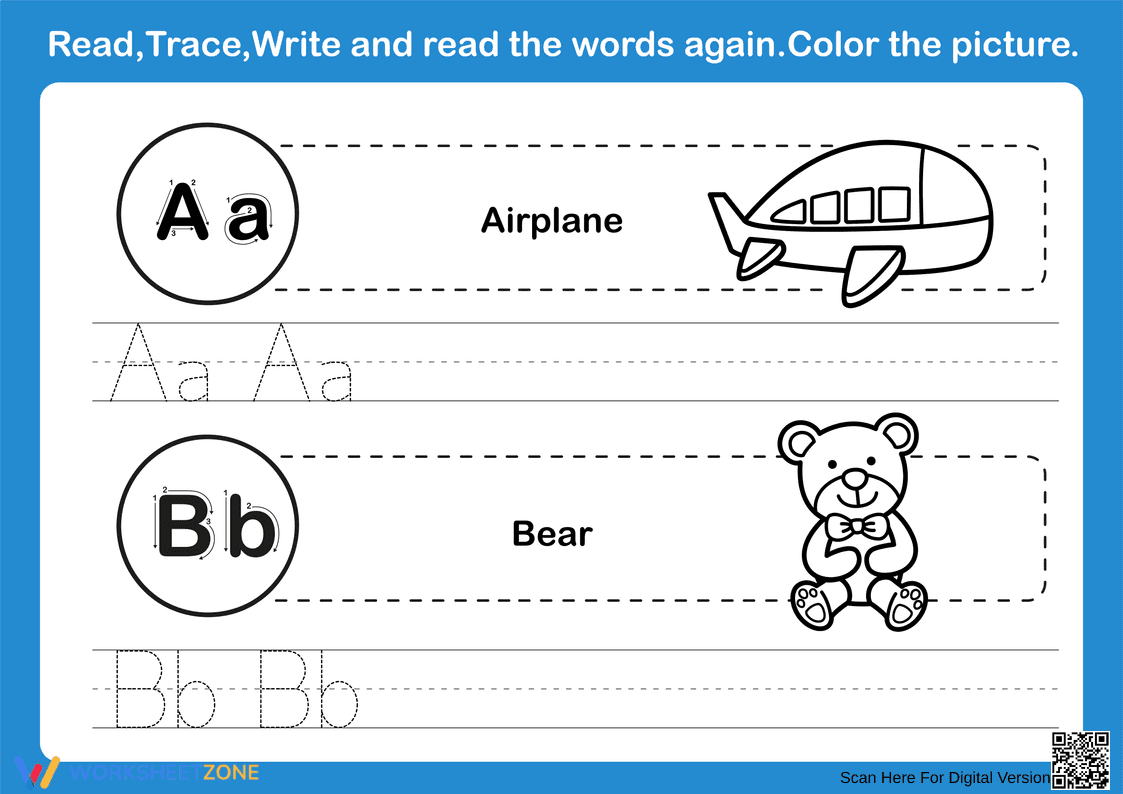
This foundational letter formation worksheet helps early learners master the alphabet by focusing on uppercase and lowercase letters A and B. Students practice fine motor skills and letter recognition through guided tracing, reading simple sight words, and engaging coloring activities, ensuring a solid start to their literacy journey.
At a Glance
- Grade: K · Subject: ELA
- Standard:
CCSS.ELA-LITERACY.L.K.1.A— Print many upper- and lowercase letters- Skill Focus: Letter formation and tracing
- Format: 1 page · 4 tasks · No answer key needed · PDF
- Best For: Morning work or literacy centers
- Time: 10–15 minutes
Inside this single-page resource, educators will find a streamlined layout for young learners. The worksheet features clear models of letters A and B with directional arrows guiding stroke order. Dashed lines provide structured tracing practice for uppercase and lowercase forms. Additionally, the page includes simple vocabulary words paired with illustrations to color, reinforcing letter-sound correspondence and fine motor control.
Zero-Prep Workflow
- Print (1 minute): Simply download the PDF and print the required number of copies. The black-and-white design is ink-friendly and requires no special formatting.
- Distribute (1 minute): Hand out the worksheets along with pencils and crayons. The visual instructions are intuitive enough that students can begin immediately.
- Review (1 minute): Quickly scan student work to ensure they are following the directional arrows and staying on the dashed lines. Total teacher prep time is under two minutes, making it ideal for sub plans.
Standards Alignment
This resource is directly aligned to CCSS.ELA-LITERACY.L.K.1.A, which requires students to print many upper- and lowercase letters. By providing explicit tracing paths and independent practice lines, the worksheet supports the physical mechanics of handwriting. Both standard codes can be copied directly into lesson plans, IEP goals, or district curriculum mapping tools.
How to Use It
This versatile printable is perfect for morning work as students settle into the classroom. Teachers can introduce the letters A and B during whole-group instruction, then transition students to this worksheet for immediate, hands-on practice. Alternatively, it serves as an excellent independent station during literacy centers. As a formative assessment tip, observe students while they trace to ensure they are starting their strokes from the top down, rather than from the bottom up. Expected completion time ranges from 10 to 15 minutes.
Who It's For
This worksheet is primarily designed for Preschool, Kindergarten, and early Grade 1 students who are developing foundational handwriting skills. It is highly effective for occupational therapy sessions focusing on pencil grip and stroke sequence. For differentiation, teachers can provide textured surfaces underneath the paper for tactile feedback or highlight the baseline to help students orient their letters. Pair this activity with an alphabet anchor chart or a read-aloud focusing on A and B vocabulary words.
Mastering early handwriting skills is a critical predictor of later reading and writing success. This resource targets CCSS.ELA-LITERACY.L.K.1.A, helping students print many upper- and lowercase letters accurately. According to Fisher & Frey (2014), explicit instruction in letter formation combined with guided, repetitive practice significantly improves both spelling fluency and written expression in early childhood education. When students do not have to expend excessive cognitive energy on the physical act of forming letters, they can allocate more working memory to vocabulary acquisition and sentence generation. By integrating tracing, reading, and coloring into a single activity, this worksheet provides the multimodal engagement necessary to solidify letter recognition and motor memory. Consistent practice with structured resources ensures young learners build the automaticity required for advanced literacy tasks.


