


























Views
Downloads

Rational & Irrational Numbers Worksheet | Grade 10 Essential
Paste this activity's link or code into your existing LMS (Google Classroom, Canvas, Teams, Schoology, Moodle, etc.).
Students can open and work on the activity right away, with no student login required.
You'll still be able to track student progress and results from your teacher account.
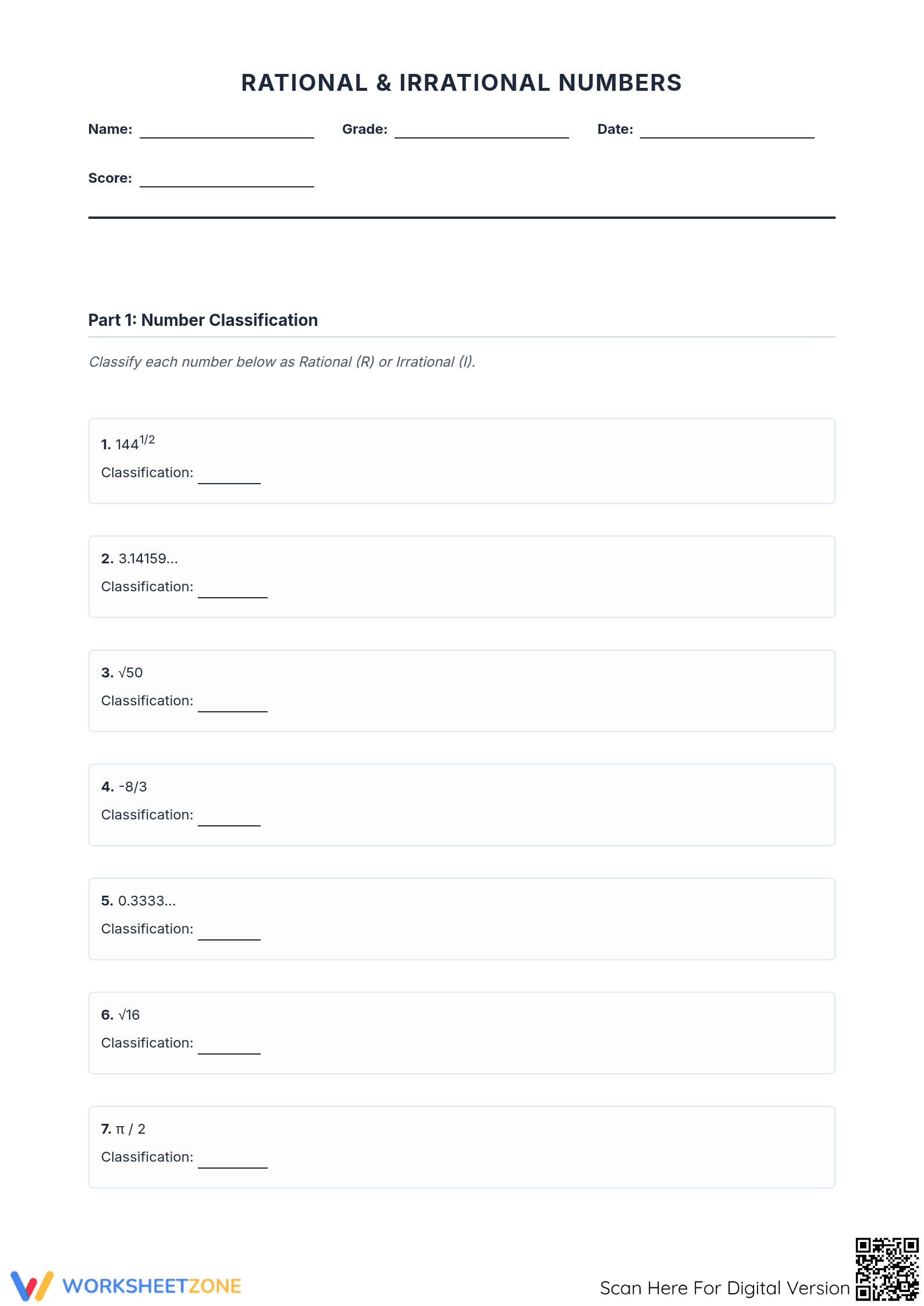
This Grade 10 math worksheet provides a comprehensive framework for students to master the properties of rational and irrational numbers. Students will learn to distinguish between these number sets, perform operations that test the closure properties of each, and develop logical proofs for real-world mathematical applications. It ensures students can confidently justify their numerical classifications.
At a Glance
- Grade: 10 · Subject: Mathematics
- Standard:
CCSS.MATH.CONTENT.HSN.RN.B.3— Explain why the sum or product of rational and irrational numbers is irrational- Skill Focus: Number system classification and operational logic
- Format: 5 pages · 35 problems · Answer key included · PDF
- Best For: High school algebra or number theory practice
- Time: 45–60 minutes
What's Inside
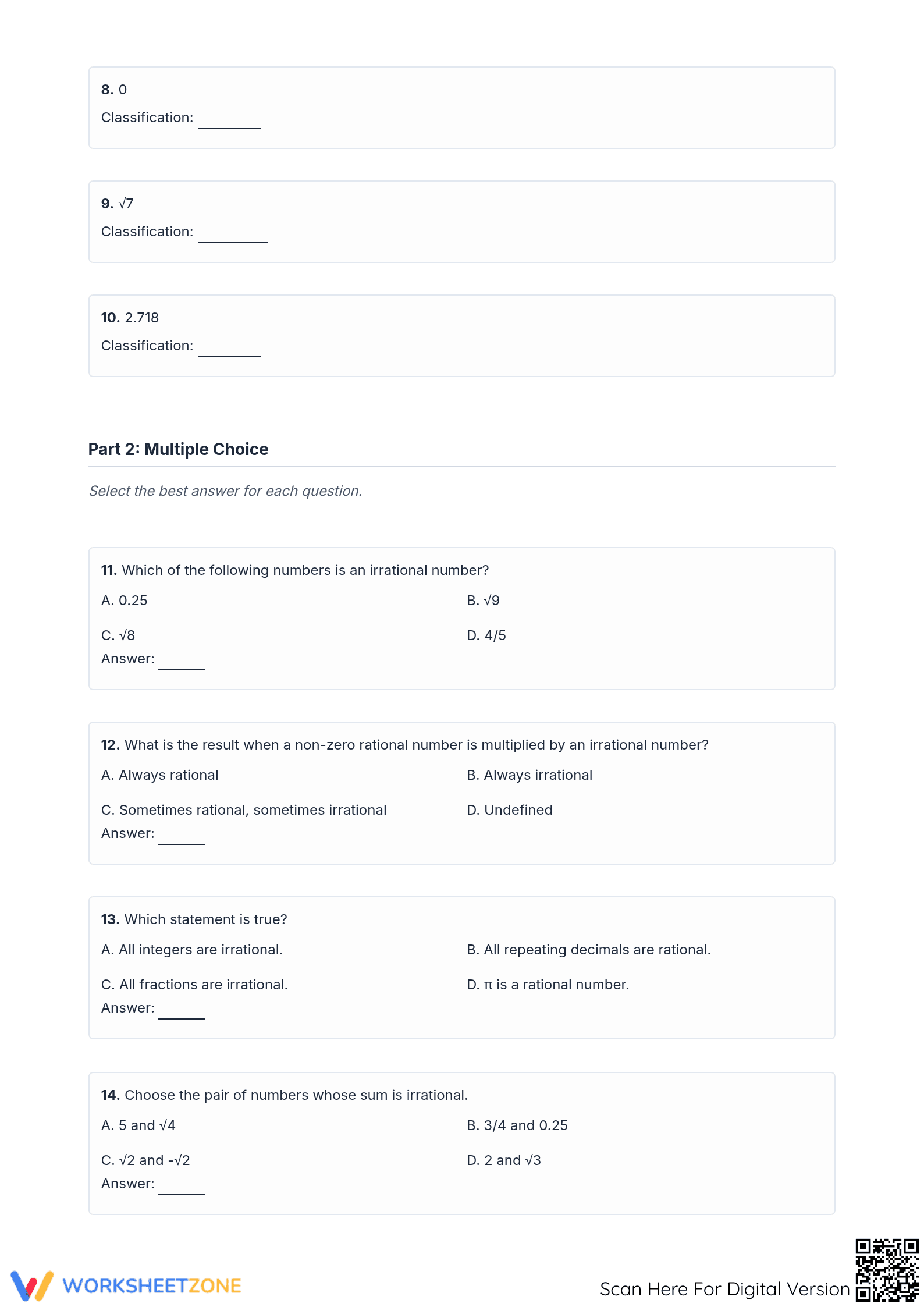
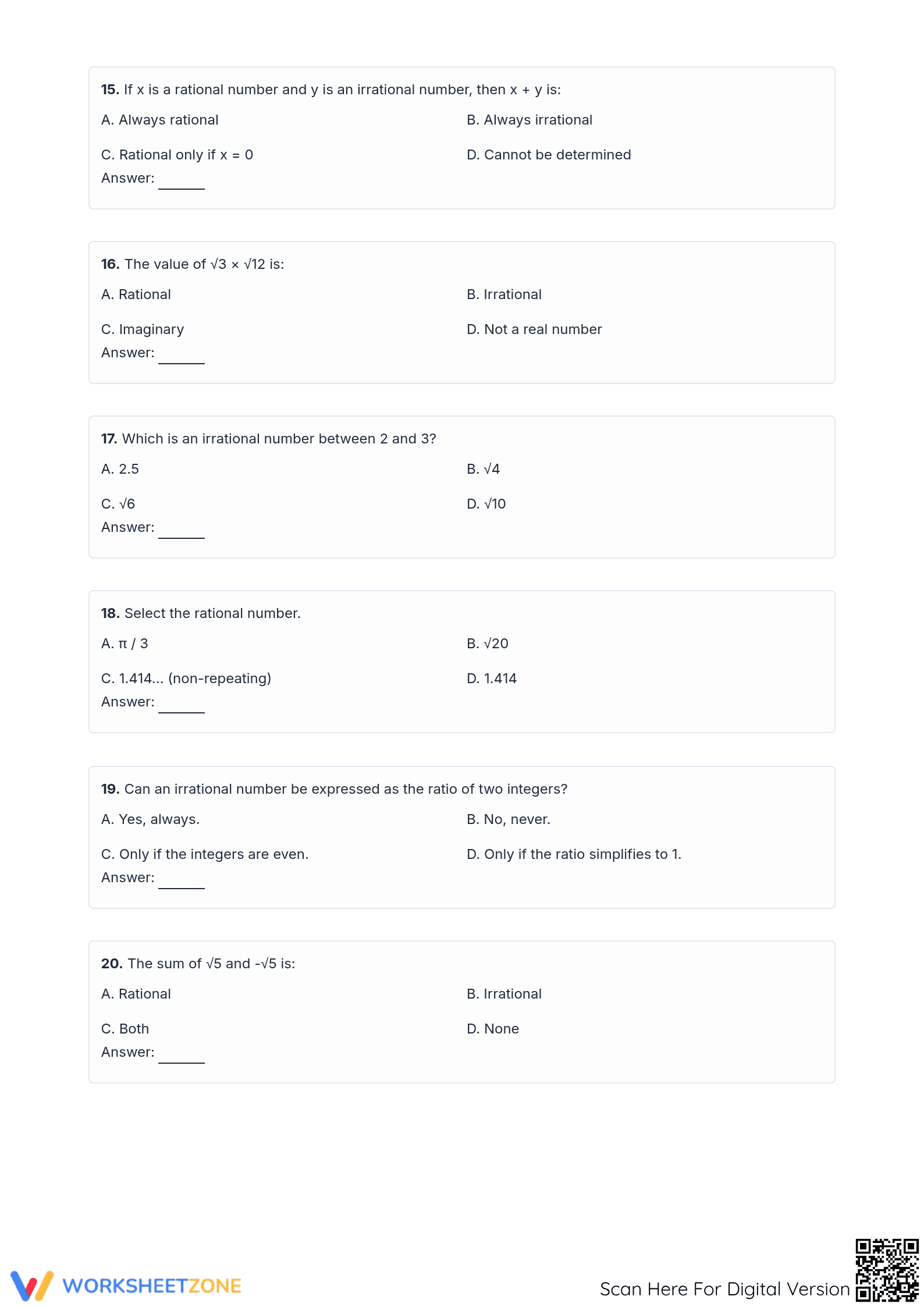
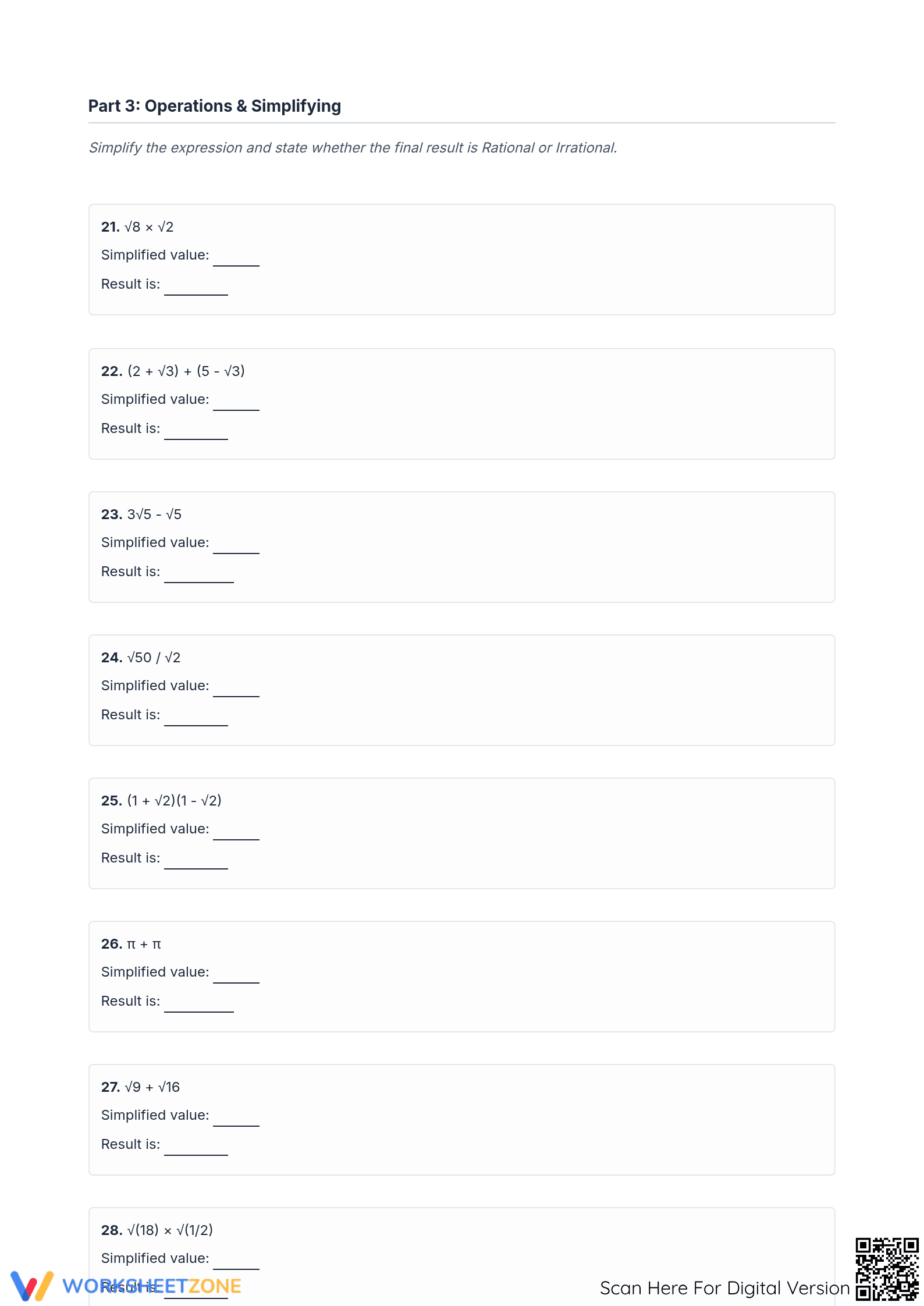
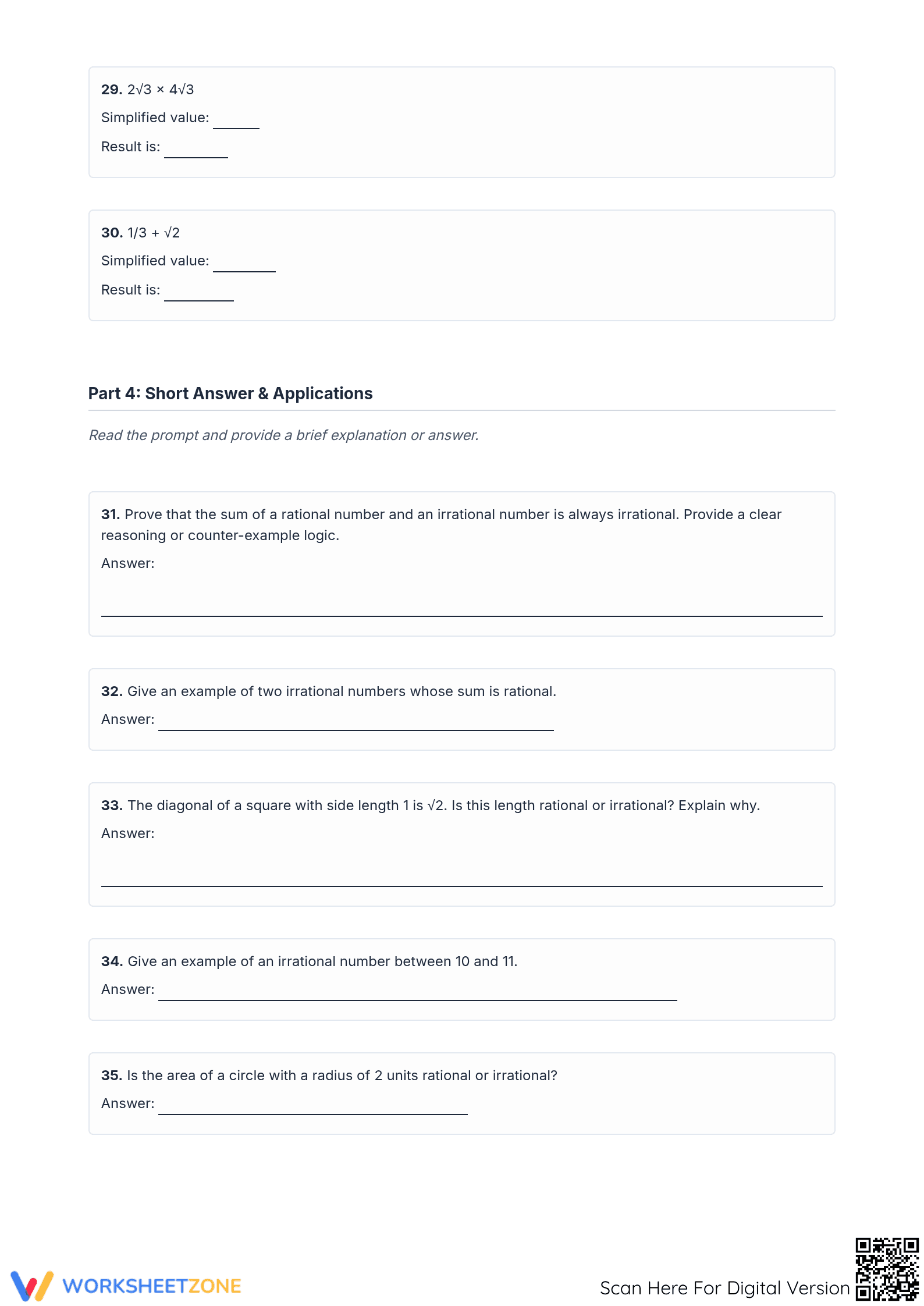
This five-page set is organized into four distinct modules designed to build complexity. It includes 10 classification tasks, 10 multiple-choice questions focusing on theoretical properties, 10 operations and simplifying problems, and 5 short-answer application prompts. The worksheet features a clean, distraction-free layout with dedicated space for students to record their score and date, alongside a full answer key for grading.
Skill Progression
- Guided classification: Students begin with 10 problems identifying numbers like square roots and pi, utilizing scaffolds like exponential notation to build initial confidence.
- Supported practice: The multiple-choice and operation sections provide 20 opportunities to analyze the results of adding and multiplying different number types, reinforcing the rules of the number system.
- Independent application: Five high-order reasoning tasks require students to provide written proofs and counter-examples, moving beyond simple identification toward true mathematical mastery.
This sequence follows a gradual-release model, transitioning students from recognizing patterns to explaining the underlying logic of number theory.
Standards Alignment
This resource aligns directly with CCSS.MATH.CONTENT.HSN.RN.B.3: "Explain why the sum or product of two rational numbers is rational; that the sum of a rational number and an irrational number is irrational; and that the product of a non-zero rational number and an irrational number is irrational." This standard code can be copied directly into lesson plans, IEP goals, or district curriculum mapping tools.
How to Use It
Assign this worksheet as a summative assessment after direct instruction on real number systems. During the practice session, observe students during the operations section to see if they are correctly simplifying radicals before classifying the final result. Most Grade 10 students will complete the full 35-task set within 50 minutes, making it ideal for a standard class period.
Who It's For
This practice set is designed for Grade 10 students in Algebra or General Mathematics. It serves as an excellent resource for students needing targeted practice on radical simplification and can be naturally paired with an anchor chart detailing the differences between terminating, repeating, and non-repeating decimals.
The mastery of CCSS.MATH.CONTENT.HSN.RN.B.3 is a critical milestone in high school mathematics, as it bridges the gap between basic arithmetic and the abstract logic required for advanced calculus. According to an EdReports 2024 analysis, high-quality mathematics instruction requires a balance of procedural fluency and conceptual understanding. This worksheet achieves that balance by requiring students to not only calculate values but also provide rigorous justifications for the irrationality of specific sums and products. By engaging with 35 unique tasks, learners move past rote memorization and toward a deeper grasp of how different number sets interact within operations. This foundational knowledge is essential for succeeding in standardized testing environments and prepares students for higher-order mathematical modeling where the distinction between exact and approximate values is paramount. The inclusion of proof-based applications ensures that students are meeting the rigorous demands of modern standards-aligned curricula.


