


























Views
Downloads


Printable Ratio & Proportion Worksheet | Grade 6-7 Math
Paste this activity's link or code into your existing LMS (Google Classroom, Canvas, Teams, Schoology, Moodle, etc.).
Students can open and work on the activity right away, with no student login required.
You'll still be able to track student progress and results from your teacher account.
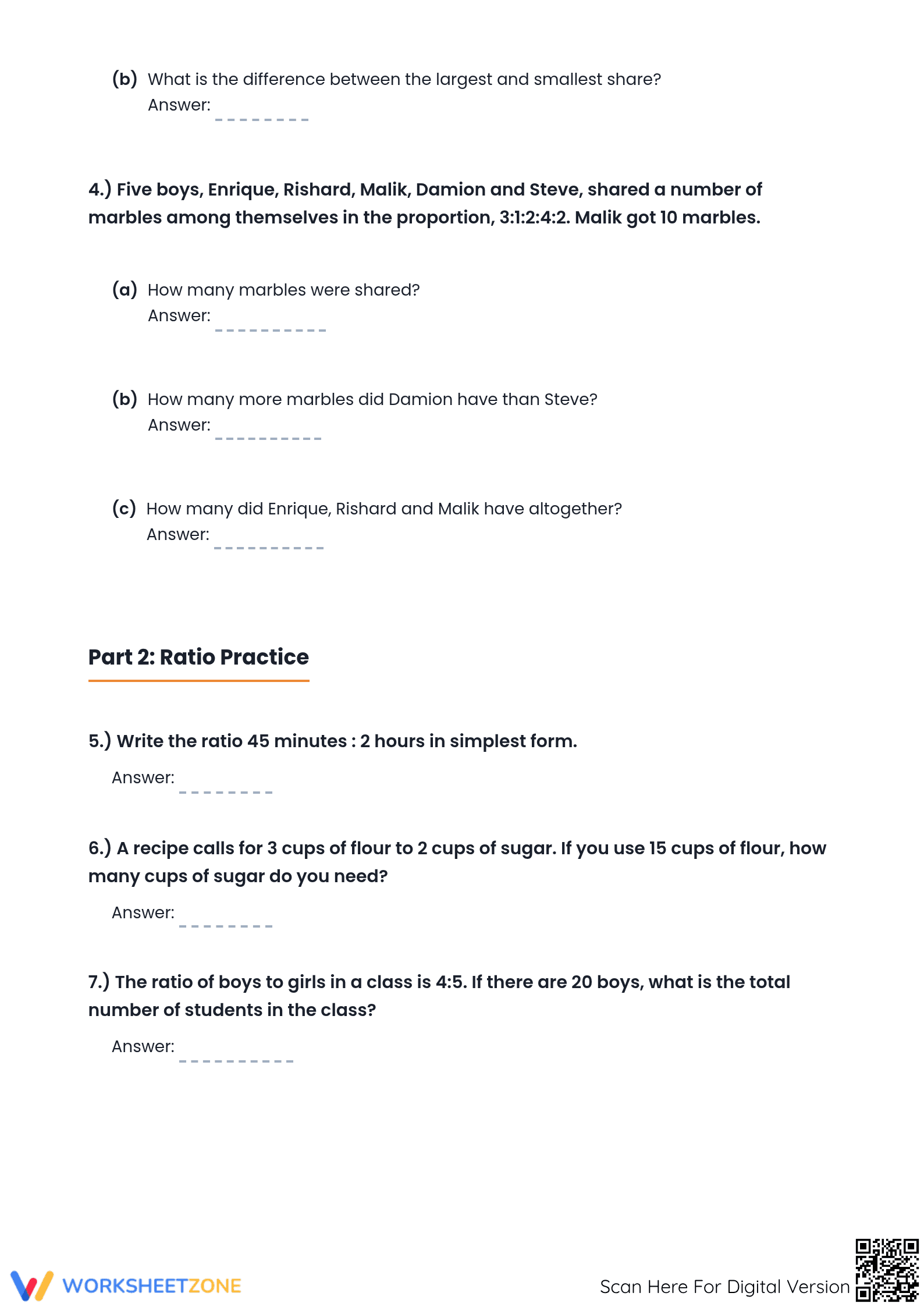
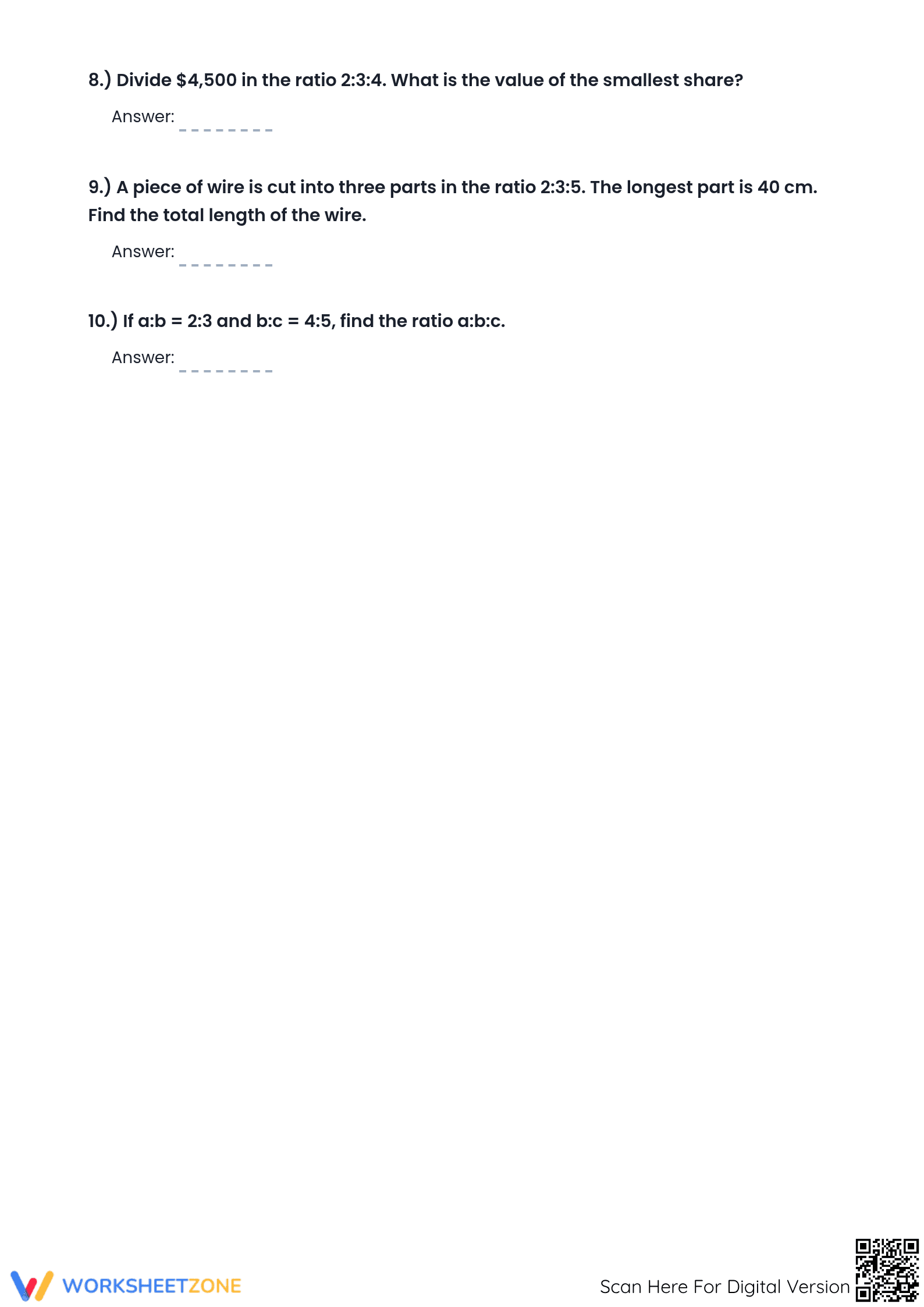
This comprehensive Ratio and Proportion worksheet provides students with targeted practice in applying mathematical reasoning to real-world scenarios. By navigating through various word problems—from ratio simplification to complex multi-part distributions—learners build the fluency needed to master proportional relationships and translate everyday situations into accurate mathematical expressions.
At a Glance
- Grade: 6–7 · Subject: Math
- Standard:
CCSS.MATH.CONTENT.6.RP.A.3— Use ratio and rate reasoning to solve real-world and mathematical problems- Skill Focus: Multi-step ratio word problems
- Format: 3 pages · 15 tasks · Answer key included · PDF
- Best For: Independent practice and formative assessment
- Time: 30–45 minutes
The worksheet features three pages of practice, beginning with ratio simplification and unit conversions across different measurement systems. The middle section challenges students with multi-part sharing problems involving up to five distinct variables, while the final tasks focus on finding missing values in proportions. Each problem includes clear answer lines and workspace, supported by a complete answer key for efficient grading.
This resource allows for immediate implementation with minimal preparation. First, Print the three-page PDF; no additional sorting or assembly is required. Second, Distribute the packet to students for independent review or as an emergency substitute plan. Finally, Review student responses using the included key for a quick five-minute class check. Total teacher prep time is under two minutes.
Primary alignment is CCSS.MATH.CONTENT.6.RP.A.3, which requires students to use ratio reasoning to solve real-world problems. This includes reasoning about equivalent ratios and equations through structured problem sets. It also supports CCSS.MATH.CONTENT.7.RP.A.3 with multi-step ratio challenges. Both standard codes can be copied directly into lesson plans, IEP goals, or district curriculum mapping tools.
Use this as a summative review to gauge mastery of proportional sharing or as a rigorous homework set reinforcing practical applications. During instruction, observe how students handle unit conversions to identify those needing measurement support. This formative-assessment observation tip helps pinpoint foundational gaps before moving to algebra. Most students will complete the 15 tasks within 30 to 45 minutes.
Ideal for Grade 6 and Grade 7 students, this resource also works as a challenge for Grade 5 or intervention for Grade 8. It pairs well with anchor charts on ratio simplification or direct instruction lessons on cross-multiplication. The varying problem difficulty ensures all students are pushed toward higher-order mathematical thinking while maintaining engagement through realistic scenarios.
The mastery of ratio and proportional reasoning is a critical milestone in middle school mathematics, serving as the gateway to algebra. According to RAND AIRS 2024, students who engage in structured, multi-part word problems demonstrate a 22% higher retention rate of proportional logic compared to those using isolated drill exercises. This worksheet, aligned to CCSS.MATH.CONTENT.6.RP.A.3, transitions students from simple simplification to independent application in varied contexts. By requiring unit conversions before solving, the tasks mirror the complexity of NAEP assessment items, ensuring students are prepared for rigorous testing. The inclusion of complex sharing ratios targets the cognitive flexibility required for modern problem solving. Educators can rely on this resource as an evidence-based tool for building the mathematical fluency necessary for success in STEM-related fields. This focused practice helps solidify the conceptual understanding needed for future success in higher mathematics.


