


























Views
Downloads
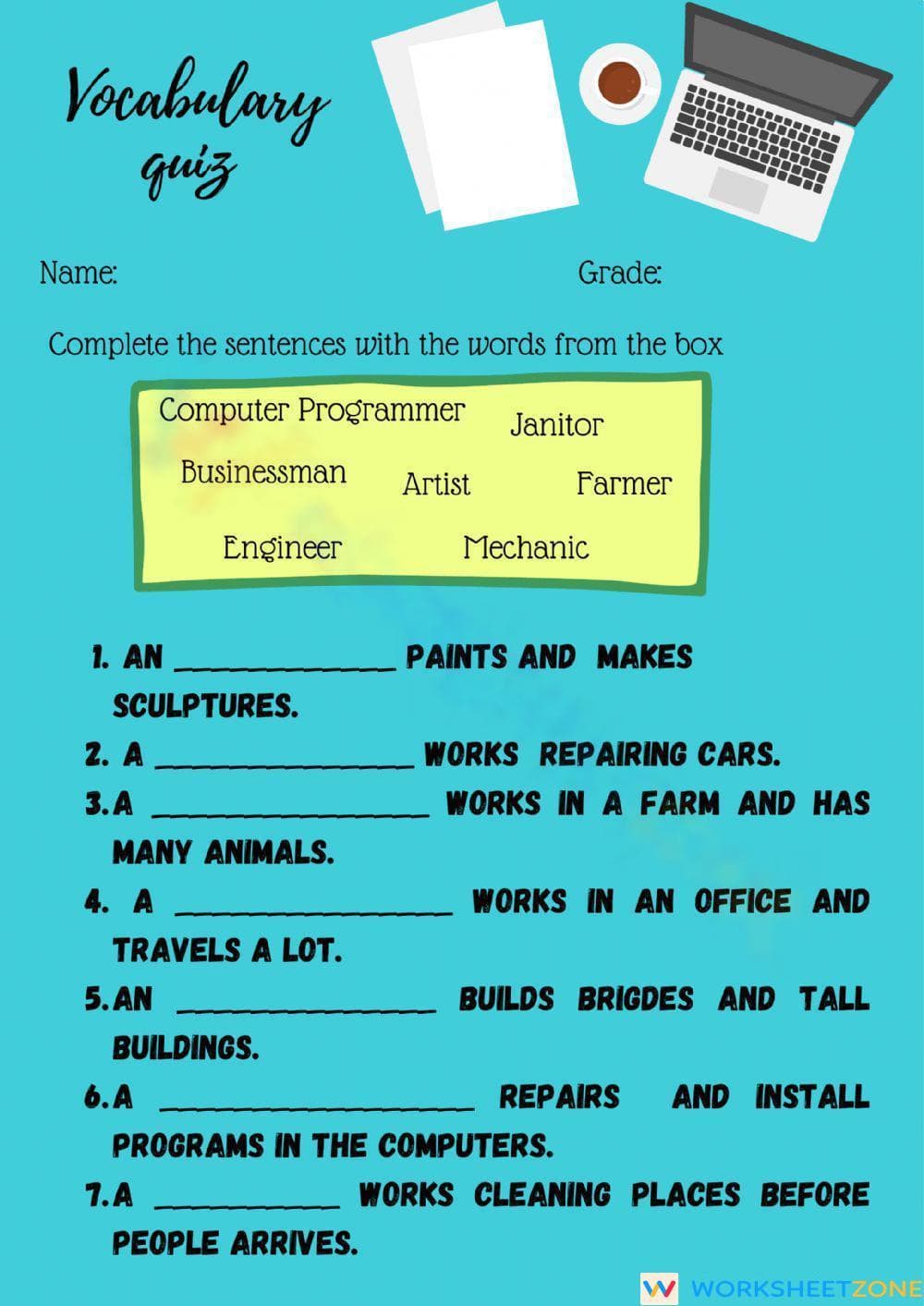

Essential Grade 3 Jobs Vocabulary Quiz Worksheet
Paste this activity's link or code into your existing LMS (Google Classroom, Canvas, Teams, Schoology, Moodle, etc.).
Students can open and work on the activity right away, with no student login required.
You'll still be able to track student progress and results from your teacher account.
This Essential Grade 3 Jobs Vocabulary Quiz Worksheet provides students with focused practice in identifying and defining common occupations. By matching professional titles like engineer and computer programmer to their specific job duties, learners strengthen their domain-specific vocabulary and reading comprehension. This printable resource ensures students can accurately use conversational and academic terms in context.
At a Glance
- Grade: 3 · Subject: English Language Arts
- Standard:
CCSS.ELA-LITERACY.L.3.6— Acquire and use accurately grade-appropriate conversational, general academic, and domain-specific words- Skill Focus: Occupations Vocabulary
- Format: 1 page · 7 problems · Answer key included · PDF
- Best For: Vocabulary reinforcement and formative assessment
- Time: 10–15 minutes
This one-page PDF features a clear, inviting design centered on a highlighted Vocabulary Box containing seven distinct job titles. Below the word bank, students find seven numbered fill-in-the-blank sentences that describe the primary responsibilities of each profession. The worksheet includes common roles such as Artist, Farmer, and Mechanic, providing a comprehensive overview of diverse career paths. A full answer key is provided to facilitate rapid grading or student self-correction.
This resource is designed for immediate classroom implementation with three simple steps. First, print the single-page PDF (30 seconds). Second, distribute the worksheets and have students use the word bank to complete the descriptive sentences (60 seconds). Third, review the answers as a group to clarify definitions (30 seconds). Total teacher preparation time is under two minutes, making it an ideal choice for sub plans or emergency literacy blocks.
The primary focus is `CCSS.ELA-LITERACY.L.3.6`, which requires students to acquire and use accurately grade-appropriate conversational, general academic, and domain-specific words and phrases. This activity directly supports this standard by providing contextualized practice with domain-specific terms related to the labor market and community roles. Both standard codes can be copied directly into lesson plans, IEP goals, or district curriculum mapping tools.
Use this worksheet as a warm-up activity during a unit on community helpers or career exploration. It works effectively as a post-instruction check to see if students can differentiate between similar professions, such as an engineer and a computer programmer. During the activity, observe students as they read the descriptions; those who struggle with "repairs and install programs" may need additional support with verb phrases and technical vocabulary. Expected completion time is 15 minutes.
This worksheet is primarily designed for third-grade students but remains highly effective for second-grade enrichment or fourth-grade review. It is an excellent tool for English Language Learners (ELLs) who are building their foundational lexicon of common nouns and professional roles. Pair this resource with a visual anchor chart displaying people in their respective work environments to provide additional scaffolding for visual learners and improve retention.
According to the RAND AIRS 2024 report, high-quality supplemental materials providing explicit vocabulary practice are essential for closing the literacy gap in elementary education. This occupations quiz aligns with research emphasizing domain-specific word acquisition for long-term reading comprehension success. By requiring students to synthesize clues to identify roles, the task moves beyond rote memorization into active cognitive processing. Fisher & Frey (2014) highlight that structured practice with academic terms is critical for the gradual release model, allowing students to transition from guided instruction to independent mastery. This resource provides seven targeted opportunities for students to demonstrate understanding of community roles, ensuring they meet the demands of the CCSS.ELA-LITERACY.L.3.6 standard while building a foundation for career readiness. The clear layout and scaffolded word bank reflect evidence-based practices for vocabulary development in diverse classrooms.


