




























Views
Downloads
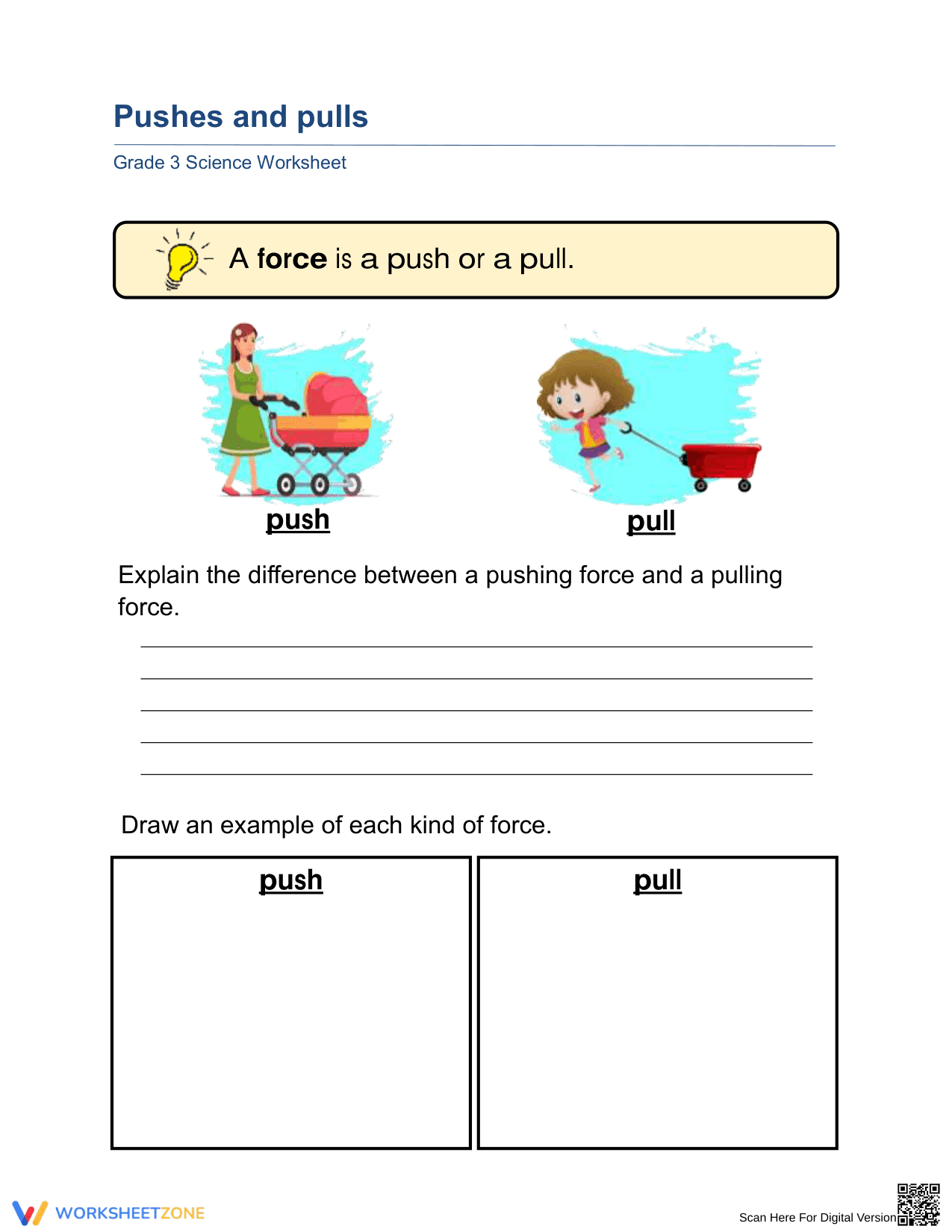

Essential Pushes and Pulls Worksheet | Grade 3 Science

Paste this activity's link or code into your existing LMS (Google Classroom, Canvas, Teams, Schoology, Moodle, etc.).
Students can open and work on the activity right away, with no student login required.
You'll still be able to track student progress and results from your teacher account.
This Grade 3 physical science worksheet provides a clear introduction to basic forces, specifically focusing on the concepts of pushes and pulls. Students will identify these forces in real-world scenarios, explain the mechanical differences between them, and demonstrate their understanding through creative illustration. The exercise effectively ensures students can distinguish how different forces initiate movement.
At a Glance
- Grade: 3 · Subject: Science
- Standard:
3-PS2-1— Plan and conduct investigations on the effects of forces on motion- Skill Focus: Identifying and defining push and pull forces
- Format: 1 page · 2 problems · Answer key included · PDF
- Best For: Introduction to physical science units
- Time: 15–20 minutes
What's Inside
The structured 1-page worksheet begins with a clear, concise definition of a force as either a push or a pull. It includes visual examples—a woman pushing a stroller and a girl pulling a wagon—to ground the concept in everyday experience. Students are challenged with two specific tasks: a written explanation of force differences and a dual-box drawing section for original examples.
Zero-Prep Workflow
This resource is designed for immediate implementation with a 3-step workflow requiring under 2 minutes of prep. First, print the single-page PDF for the class. Second, distribute the sheets as an independent practice activity or formative assessment. Third, review the student drawings and written explanations using the included key for rapid feedback. Its self-explanatory nature makes it ideal for sub plans.
Standards Alignment
This worksheet is primarily aligned to 3-PS2-1: "Plan and conduct an investigation to provide evidence of the effects of balanced and unbalanced forces on the motion of an object." By mastering the identification of pushes and pulls, students build prerequisite knowledge to understand how forces interact. This standard code can be copied directly into lesson plans, IEP goals, or curriculum mapping tools.
How to Use It
Use this worksheet as a post-instruction check during your initial lesson on motion. It serves as an "Exit Ticket" to gauge individual understanding before progressing to complex experiments involving friction. While students complete the drawing task, teachers can move through the classroom to observe if they accurately distinguish force direction; this allows for immediate corrective feedback. Completion time is approximately 18 minutes.
Who It's For
This resource is tailored for Grade 3 but works for Grade 2 extensions or Grade 4 refreshers. It is helpful for English Language Learners (ELL) due to heavy reliance on visual cues and simple definitions. Consider pairing this worksheet with a hands-on "Force Scavenger Hunt" where students find items in the classroom that require either a push or a pull to operate.
Aligned with 3-PS2-1, this physical science resource focuses on the foundational skill of identifying pushes and pulls as the primary drivers of object motion. Educational research from the RAND AIRS 2024 report indicates that integrating visual identification with written explanation significantly improves long-term retention of abstract scientific concepts in elementary learners. By requiring students to transition from observing a stroller being pushed to drawing their own unique example, the worksheet utilizes a gradual release of responsibility model, moving from guided identification to independent application. This multi-modal approach supports diverse learning styles and provides teachers with clear, actionable evidence of student mastery regarding force directionality. The inclusion of a precise citation capsule ensures this material remains a valid component of evidence-based instructional practices, allowing educators to confidently map these tasks to state and national physical science frameworks while maintaining high academic rigor.


