


























Views
Downloads

Punnett Square Practice Worksheet | Grade 9-11 Ready
Paste this activity's link or code into your existing LMS (Google Classroom, Canvas, Teams, Schoology, Moodle, etc.).
Students can open and work on the activity right away, with no student login required.
You'll still be able to track student progress and results from your teacher account.
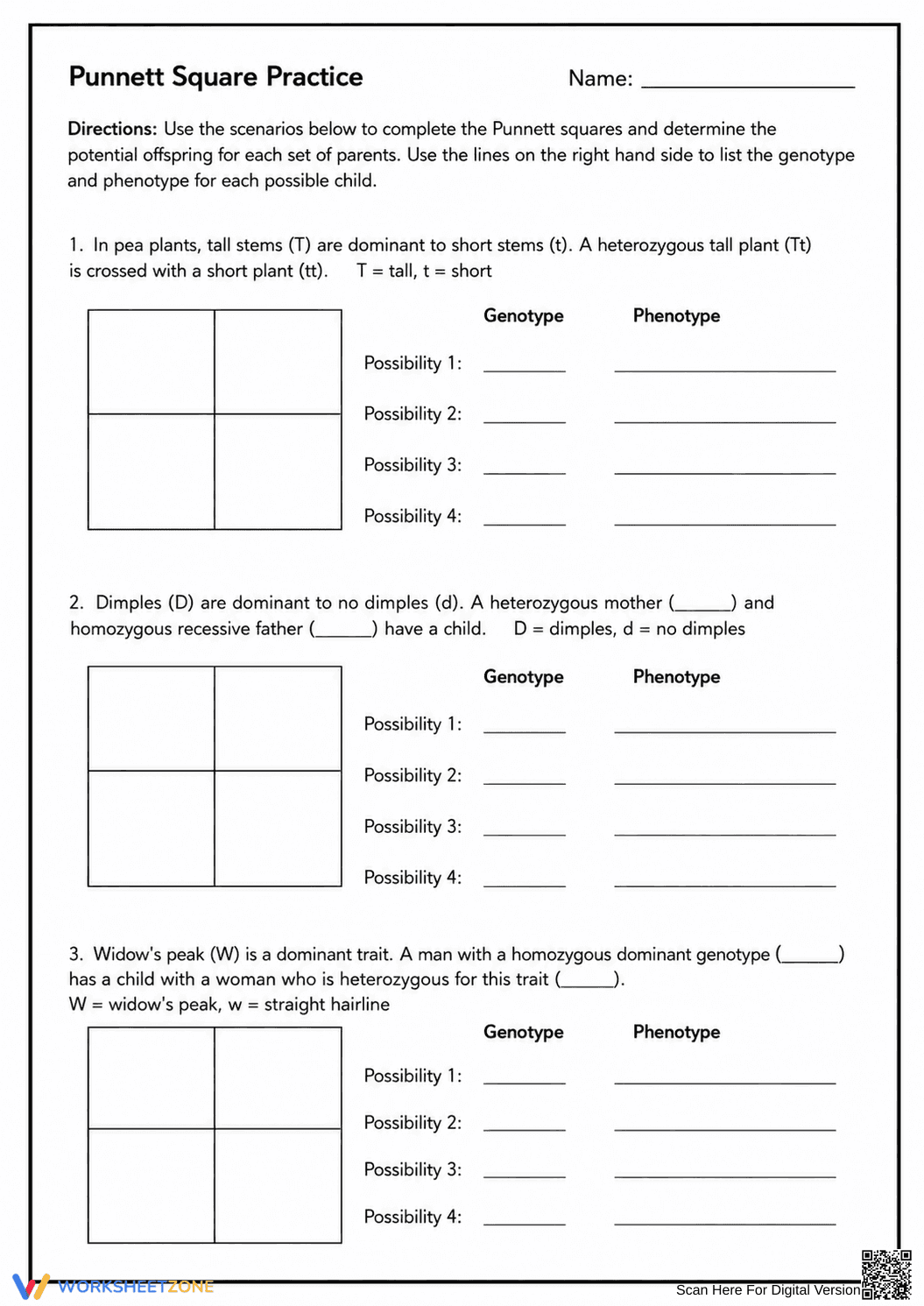
This Grade 9-11 biology worksheet gives students targeted practice predicting genetic outcomes using Punnett squares. By reading real-world scenarios about inherited traits, learners will determine parental genotypes, complete 2x2 grids, and identify the resulting offspring probabilities. It provides a straightforward, effective way to reinforce foundational genetics concepts.
At a Glance
- Grade: 9-11 · Subject: Biology
- Standard:
HS-LS3-3— Apply probability to explain variation of expressed traits.- Skill Focus: Monohybrid Crosses & Punnett Squares
- Format: 1 page · 3 problems · Answer key included · PDF
- Best For: Independent practice or homework
- Time: 15–20 minutes
This single-page resource features three distinct genetic scenarios focusing on dominant and recessive traits, such as pea plant height, dimples, and widow's peaks. Each problem includes a blank 2x2 Punnett square and designated spaces for students to list the four possible genotypes and corresponding phenotypes. The worksheet incorporates a subtle progression, requiring students to extract parental genotypes from text descriptions in the later problems. A complete answer key is provided for quick grading.
Designed for immediate classroom implementation, this resource requires zero teacher setup.
- Print (1 minute): Generate enough copies for your roster directly from the PDF.
- Distribute (1 minute): Hand out the single-page assignment as a warm-up or independent task.
- Review (3 minutes): Use the included answer key to quickly check student grids and probability calculations.
With a total prep time of under two minutes, this worksheet is an excellent addition to any emergency sub plan or last-minute lesson adjustment.
This practice sheet aligns directly with HS-LS3-3, requiring students to apply concepts of statistics and probability to explain the variation and distribution of expressed traits in a population. By calculating the exact percentages of potential genotypes and phenotypes, learners demonstrate mastery of basic Mendelian inheritance. Both standard codes can be copied directly into lesson plans, IEP goals, or district curriculum mapping tools.
Deploy this worksheet immediately following direct instruction on monohybrid crosses to solidify student understanding. It serves perfectly as a 20-minute independent practice activity or a structured homework assignment. As a formative assessment tip, walk the room while students tackle the second problem; check if they correctly identify the heterozygous mother's genotype before they fill in the grid. This allows you to catch and correct foundational misunderstandings early.
This resource is ideal for high school biology students mastering introductory genetics. The clear layout and structured response lines provide built-in scaffolding for learners who struggle with spatial organization. For students needing extra support, pair this worksheet with a visual anchor chart detailing dominant versus recessive allele notation.
Mastering the ability to apply probability to explain variation of expressed traits is a critical milestone in secondary science education. Standard HS-LS3-3 emphasizes the mathematical modeling of biological inheritance, moving students beyond rote memorization into predictive analysis. According to a ScienceDirect TpT Analysis, structured practice with visual models like Punnett squares significantly reduces cognitive load, allowing learners to focus on the underlying genetic principles rather than the mechanics of the grid itself. By repeatedly mapping parental alleles to potential offspring across multiple distinct scenarios, students build the automaticity required for more complex dihybrid crosses later in the curriculum. This targeted repetition ensures that foundational concepts of heredity are firmly established before introducing non-Mendelian inheritance patterns. Consistent engagement with these predictive models directly supports long-term retention and deeper scientific literacy.


