


























Views
Downloads


Punnett Square Practice Worksheet | Essential Biology
Paste this activity's link or code into your existing LMS (Google Classroom, Canvas, Teams, Schoology, Moodle, etc.).
Students can open and work on the activity right away, with no student login required.
You'll still be able to track student progress and results from your teacher account.
This comprehensive Punnett Square practice worksheet provides students with 16 structured problems to master the fundamentals of Mendelian genetics. By calculating genotypic ratios and predicting phenotypic outcomes, learners develop a concrete understanding of how traits are inherited. This resource ensures students can move from basic identification to complex scenario-based application.
At a Glance
- Grade: 7-12 · Subject: Biology
- Standard:
HS-LS3-3— Apply concepts of statistics and probability to explain variation of expressed traits- Skill Focus: Punnett Square construction and probability analysis
- Format: 3 pages · 16 problems · Answer key included · PDF
- Best For: Independent practice and formative assessment
- Time: 30–45 minutes
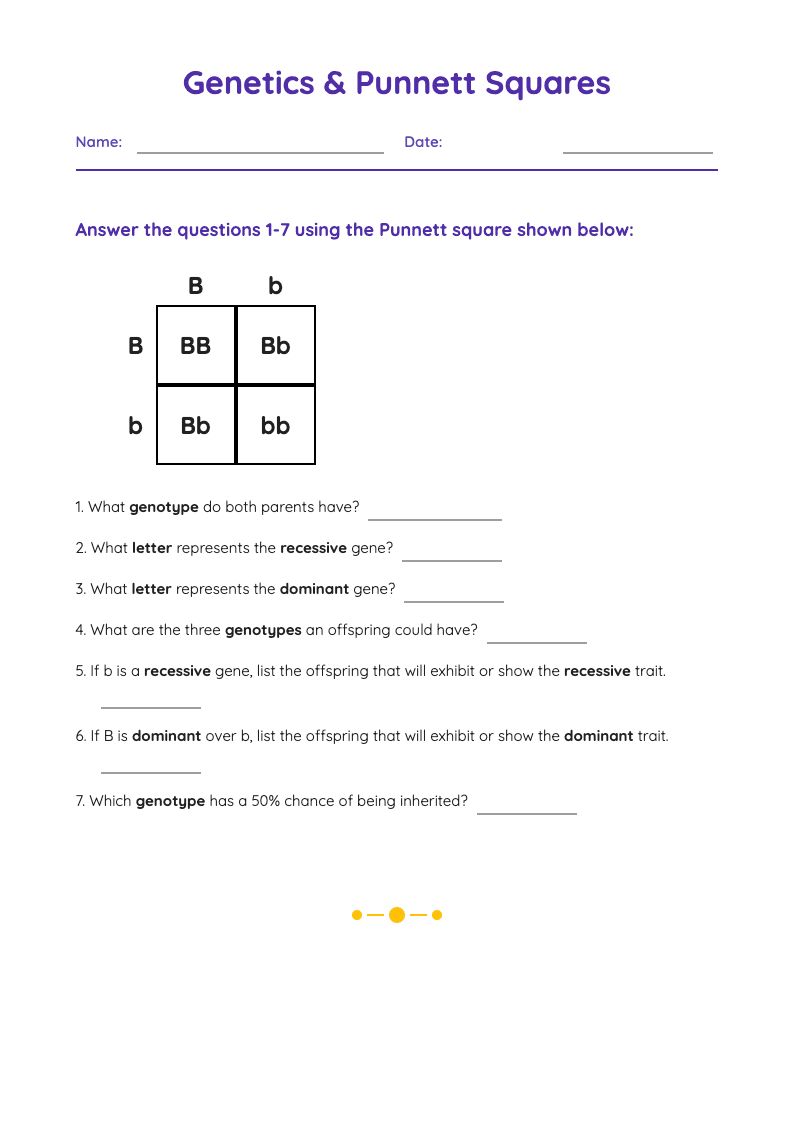
What's Inside: The three-page PDF includes a mix of direct identification and creative problem-solving. Page one features a pre-filled square to establish vocabulary like homozygous and heterozygous. Page two requires students to draw three distinct squares from given genotypes. Page three introduces Applied Genetics Scenarios involving rabbit fur color, forcing students to translate word problems into mathematical models.
Skill Progression
- Guided Practice: The first 7 questions provide a visual model, helping students identify recessive and dominant genes with immediate feedback.
- Supported Practice: Questions 8 through 10 remove the pre-filled data, requiring students to set up their own 2x2 grids and calculate percentages for specific allele combinations.
- Independent Practice: The final section presents real-world scenarios where students must determine parental genotypes from descriptions before predicting offspring traits.
This gradual-release approach moves from simple recognition to higher-order synthesis using the I Do, We Do, You Do model.
Standards Alignment
This resource is primarily aligned with HS-LS3-3: "Apply concepts of statistics and probability to explain the variation and distribution of expressed traits in a population." It also supports MS-LS3-2 by modeling how sexual reproduction results in genetic variation. Both standard codes can be copied directly into lesson plans, IEP goals, or district curriculum mapping tools.
How to Use It
Use this worksheet as a mid-unit formative assessment after introducing allele theory. Teachers should circulate during the Applied Genetics Scenarios to observe if students correctly identify homozygous black as FF versus Ff. It serves as an excellent homework assignment or a quiet activity for a substitute lesson plan. Completion typically takes 30 to 45 minutes.
Who It's For
This is designed for middle and high school biology students, ranging from introductory 7th-grade life science to 10th-grade general biology. It is particularly effective for students who need visual scaffolds to understand probability. Pair this with a digital chromosome simulation or a physical coin flip genetics lab for a complete instructional cycle.
According to the RAND AIRS 2024 report on secondary science instruction, the use of visual modeling tools like Punnett squares is essential for bridging the gap between abstract genetic theory and observable biological data. This worksheet implements these findings by requiring students to translate textual descriptions into 2x2 probability matrices. By engaging with 16 distinct tasks that progress in complexity, students reinforce their understanding of HS-LS3-3 and the statistical nature of inheritance. Research from Fisher & Frey (2014) supports this gradual release of responsibility, noting that students who move from guided identification to independent scenario modeling show significantly higher retention of Mendelian principles. This resource provides the necessary scaffolding to ensure that learners can accurately predict genotypic and phenotypic ratios, a core competency identified in national science frameworks for secondary education.


