


























Views
Plays
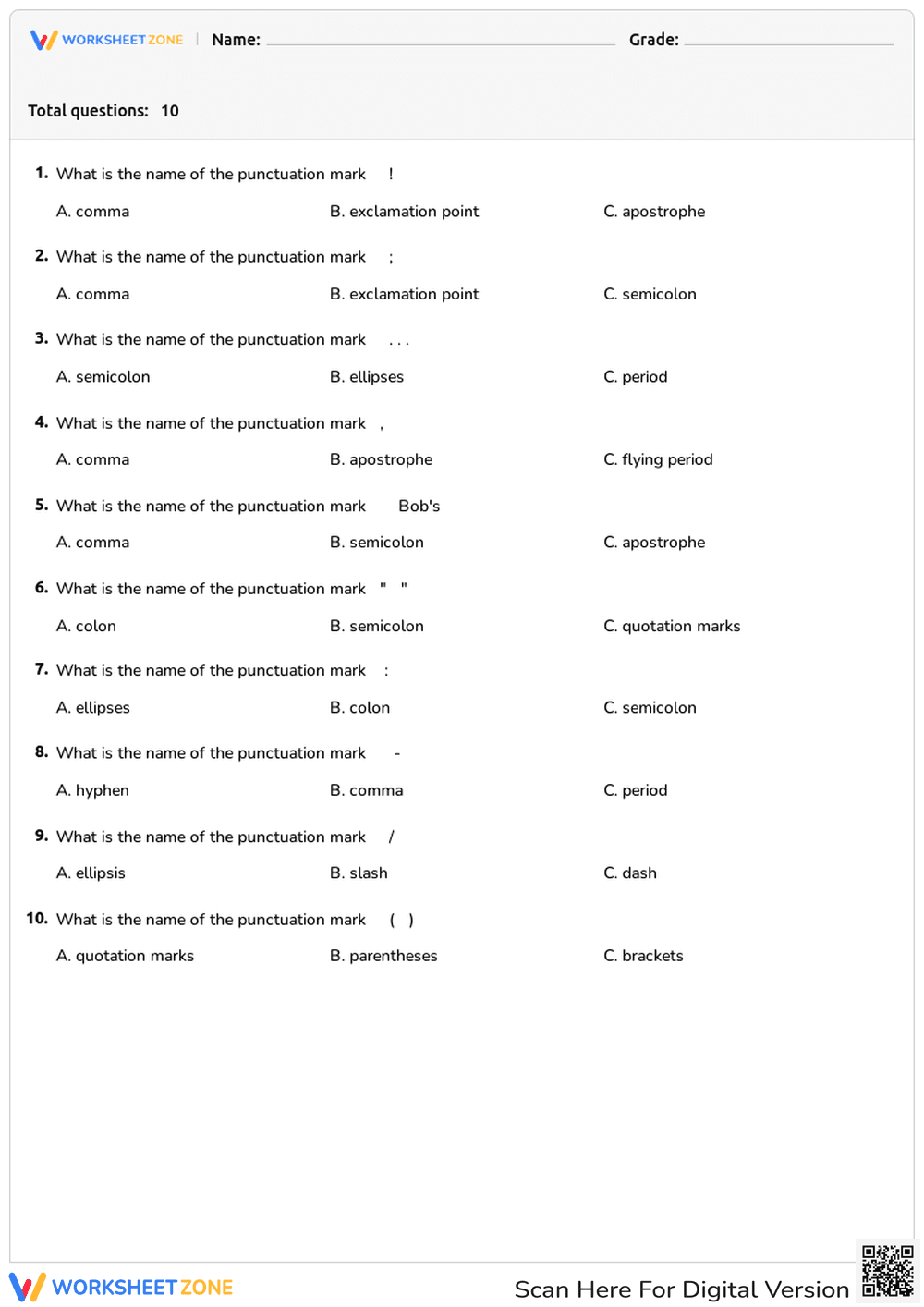

Punctuation Marks Worksheet | Grade 1 Printable Quiz
Paste this activity's link or code into your existing LMS (Google Classroom, Canvas, Teams, Schoology, Moodle, etc.).
Students can open and work on the activity right away, with no student login required.
You'll still be able to track student progress and results from your teacher account.
This Grade 1 English Language Arts worksheet provides students with targeted practice in identifying common punctuation marks. By completing this multiple-choice quiz, early learners build foundational grammar skills and improve their reading comprehension. The straightforward format ensures students can confidently recognize essential symbols used in everyday texts.
At a Glance
- Grade: 1 · Subject: ELA
- Standard:
CCSS.ELA-LITERACY.L.1.2— Demonstrate command of punctuation conventions.- Skill Focus: Punctuation Mark Identification
- Format: 1 page · 10 problems · Answer key included · PDF
- Best For: Formative assessment and review
- Time: 10–15 minutes
Inside this printable resource, educators will find a single-page, ten-question multiple-choice assessment focused on punctuation identification. Each question presents a specific symbol—ranging from basic periods to semicolons—and asks students to select the correct name. The clear layout minimizes distractions, while the answer key allows for rapid grading.
Zero-Prep Workflow
This worksheet requires under two minutes of total teacher preparation time.
- Print (1 minute): Download the PDF and print copies. The design is printer-friendly.
- Distribute (1 minute): Hand out the single-page quiz. Instructions are self-explanatory, allowing immediate engagement.
- Review (3 minutes): Use the answer key to quickly score assessments or conduct a class review.
Because it requires no setup, this resource is highly suitable for emergency sub plans.
Standards Alignment
This resource is directly aligned to CCSS.ELA-LITERACY.L.1.2, which requires students to demonstrate command of the conventions of standard English capitalization, punctuation, and spelling when writing. By accurately identifying these marks, students take the first critical step toward using them correctly in their own compositions. Both standard codes can be copied directly into lesson plans, IEP goals, or district curriculum mapping tools.
How to Use It
Deploy this versatile worksheet during various instructional moments. Use it as a quick formative assessment after direct instruction to gauge class-wide understanding. Alternatively, assign it as a morning bell-ringer to activate prior knowledge. As students work, observe whether they struggle with visually similar marks, such as commas and apostrophes, to inform targeted interventions. Expected completion time is 10 to 15 minutes.
Who It's For
Designed for Grade 1 students developing foundational literacy, this worksheet also serves as an excellent review for second graders. For differentiation, teachers can read options aloud for students requiring accommodations, ensuring the assessment measures punctuation knowledge rather than decoding ability. It pairs perfectly with a classroom anchor chart.
Mastering the visual identification of grammar symbols is a critical precursor to reading fluency and writing proficiency. According to Fisher & Frey (2014), explicit instruction and repeated exposure to foundational literacy conventions significantly improve students' ability to parse complex texts and express their ideas clearly. This resource supports that pedagogical framework by providing targeted practice aligned with CCSS.ELA-LITERACY.L.1.2, ensuring students can accurately demonstrate command of punctuation conventions. When early learners can rapidly identify marks like commas, quotation marks, and exclamation points, they reduce the cognitive load required during independent reading, allowing them to focus on comprehension and meaning-making. By integrating this ten-question assessment into regular literacy routines, educators provide the structured repetition necessary for long-term retention and academic success across all subject areas.


