


























Views
Downloads

Printable Pumpkin Labeling Worksheet | Grade 1 Science
Paste this activity's link or code into your existing LMS (Google Classroom, Canvas, Teams, Schoology, Moodle, etc.).
Students can open and work on the activity right away, with no student login required.
You'll still be able to track student progress and results from your teacher account.
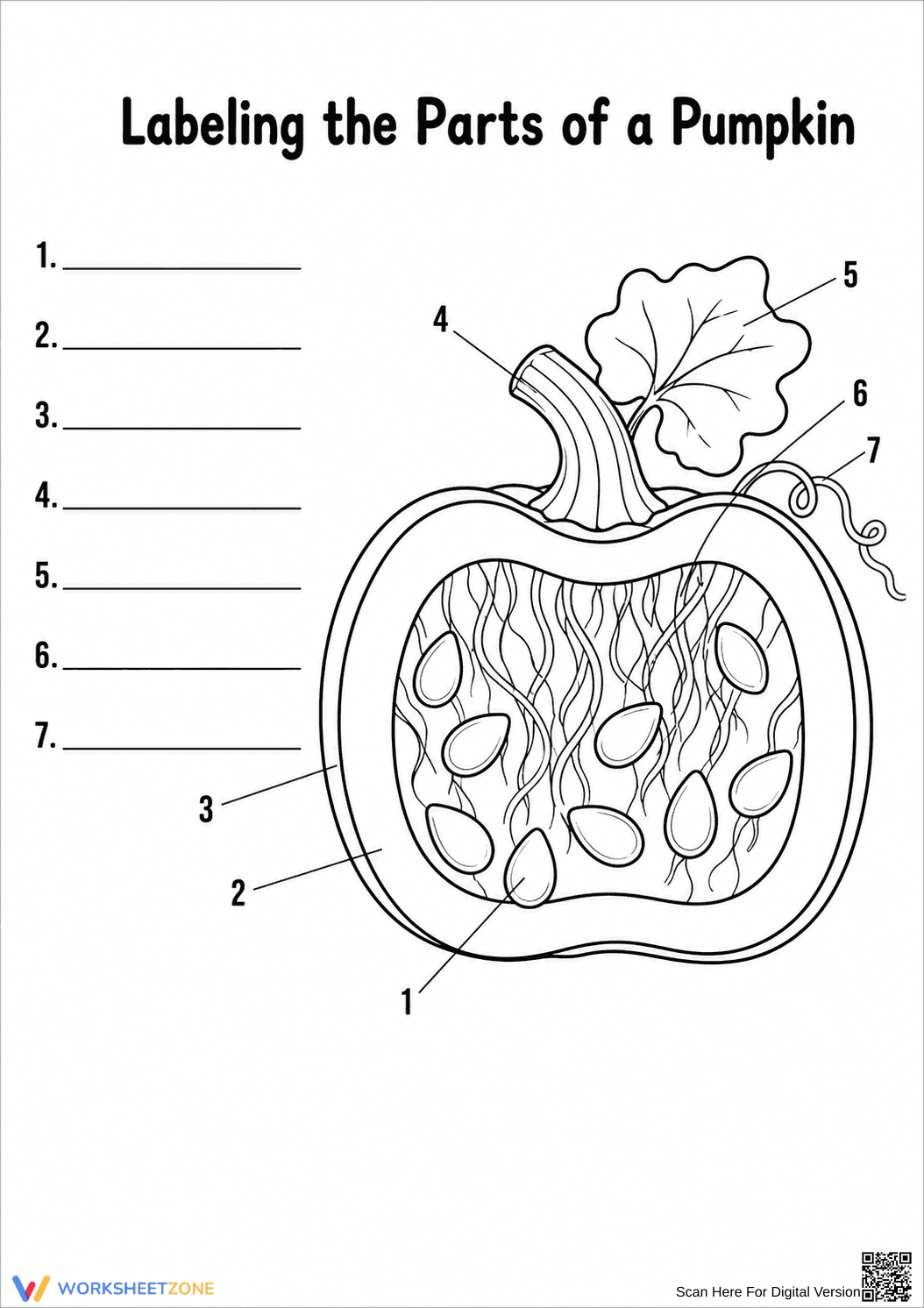
This Grade 1 science worksheet helps students identify and label the anatomical structures of a pumpkin. By examining a clear cross-section diagram, young learners build essential life science vocabulary and develop foundational observation skills. The activity connects seasonal fall themes directly to core biological concepts.
At a Glance
- Grade: 1 · Subject: Science
- Standard:
1-LS1-1— Identify and describe plant parts and their functions.- Skill Focus: Labeling plant anatomy
- Format: 1 page · 7 problems · Answer key included · PDF
- Best For: Independent practice
- Time: 10–15 minutes
This single-page resource features a black-and-white illustration of a cut-open pumpkin. Students see seven numbered pointers directing them to specific structures, such as the stem, leaves, seeds, and fibrous strands. Seven corresponding blank lines are provided for students to write the correct anatomical terms. A complete answer key is included.
This resource is designed for immediate classroom application with a highly efficient workflow.
- Print (1 minute): Generate copies of the single-page PDF for your entire class.
- Distribute (1 minute): Hand out the diagram alongside pencils or crayons.
- Review (3 minutes): Go over the correct labels using the provided answer key.
With under two minutes of total teacher prep time required, this activity is an excellent addition to emergency sub plans or spontaneous science blocks during the autumn season.
This activity aligns with primary science frameworks, specifically 1-LS1-1: Use materials to design a solution to a human problem by mimicking how plants and/or animals use their external parts to help them survive, grow, and meet their needs. While focused on the identification phase, recognizing these structures is the first step toward understanding their survival functions. Both standard codes can be copied directly into lesson plans, IEP goals, or district curriculum mapping tools.
Deploy this labeling task during a broader unit on plant life cycles or seasonal botany. It works exceptionally well as an independent practice activity following a whole-class pumpkin dissection or a read-aloud about how plants grow. As a formative assessment observation tip, watch whether students can independently distinguish between the pulp and the seeds, which often confuse early learners. Expect students to complete the labeling and optional coloring within 10 to 15 minutes.
This resource is primarily designed for first-grade students, though it serves as an excellent review for second graders or an advanced challenge for kindergarteners. For differentiation, teachers can write a word bank on the whiteboard to support developing readers and English Language Learners. Pair this diagram with a hands-on sensory station where students can physically touch the pumpkin parts they are identifying on paper.
Mastering domain-specific vocabulary through visual diagrams is a critical component of early elementary science education. When students engage with materials aligned to 1-LS1-1, they learn to identify and describe plant parts and their functions, laying the groundwork for more complex biological concepts in later grades. According to Fisher & Frey (2014), integrating clear visual aids with targeted vocabulary instruction significantly improves retention and comprehension for young learners, particularly in the STEM fields. Labeling exercises require students to actively connect spatial representations with academic language, reinforcing their understanding of structural organization in living organisms. This targeted practice ensures that foundational life science concepts are firmly established before students progress to studying the functional purposes of these anatomical features. By isolating the identification of specific structures like stems, seeds, and leaves, educators provide the necessary scaffolding for future scientific inquiry and observation.


