


























Views
Downloads
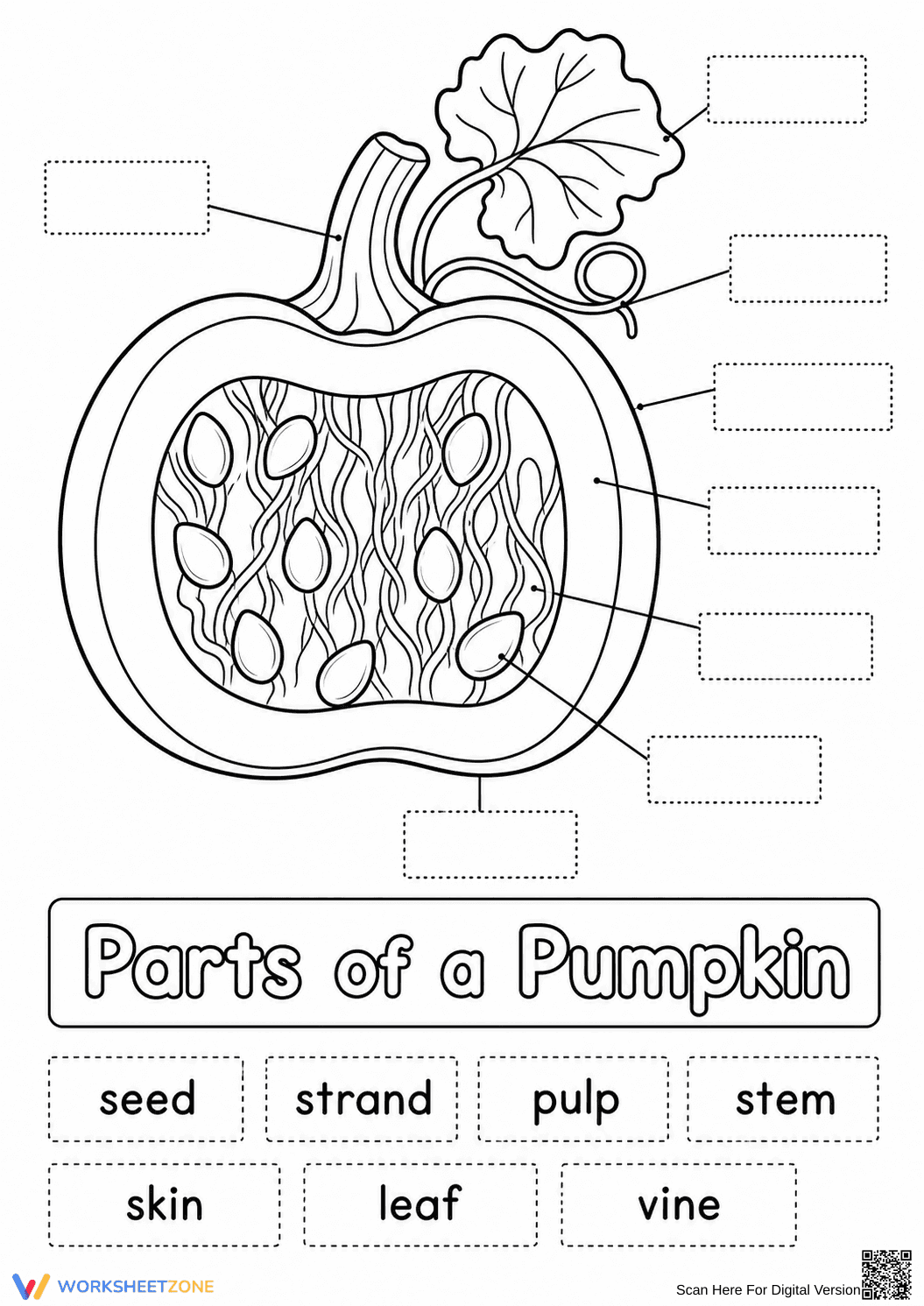

Grade 1 Pumpkin Anatomy — Printable No-Prep Worksheet
Paste this activity's link or code into your existing LMS (Google Classroom, Canvas, Teams, Schoology, Moodle, etc.).
Students can open and work on the activity right away, with no student login required.
You'll still be able to track student progress and results from your teacher account.
This hands-on worksheet helps early learners identify plant anatomy. By cutting and pasting seven vocabulary words onto a pumpkin cross-section, students build life science knowledge and fine motor skills in one engaging activity.
At a Glance
- Grade: 1 · Subject: Science
- Standard:
1-LS1-1— Identify and describe external parts of plants.- Skill Focus: Plant Anatomy Labeling
- Format: 1 page · 7 problems · Answer key included · PDF
- Best For: Independent practice or centers
- Time: 15–20 minutes
Inside this single-page resource, educators will find a clear illustration of a pumpkin sliced in half. The worksheet features seven dashed boxes pointing to areas like the stem, leaf, vine, skin, pulp, strand, and seed. A bottom word bank provides dashed cut-out boxes, allowing students to physically manipulate the terms and paste them into correct locations.
This resource is designed for a zero-prep classroom experience:
- Print (1 minute): Print the single-page PDF. The black-and-white design is ink-friendly.
- Distribute (1 minute): Hand out worksheets, scissors, and glue. No complex modeling required.
- Review (1 minute): Use the answer key to quickly check student work.
With teacher prep time under two minutes, this is an excellent addition to any sub plan.
This activity aligns with 1-LS1-1: Use materials to design a solution by mimicking how plants use their external parts to survive. Recognizing these structures is essential for understanding plant biology. Both standard codes can be copied directly into lesson plans, IEP goals, or district curriculum mapping tools.
Use this during a life science lesson after reading about the pumpkin life cycle, or as an independent science center. As a formative assessment tip, observe if students correctly differentiate the "pulp" versus the "strand" before gluing, indicating deeper anatomical understanding. Expect completion in 15 to 20 minutes.
Ideal for K-2 students developing science vocabulary and fine motor skills. The cut-and-paste format provides scaffolding for emerging writers. For differentiation, advanced students can write a sentence on the back describing one part's function. This pairs beautifully with a hands-on pumpkin carving demonstration.
Integrating manipulatives with vocabulary acquisition enhances retention for early learners. This worksheet targets 1-LS1-1, requiring students to identify and describe external parts of plants. According to Fisher & Frey (2014), instructional routines combining physical movement—like cutting and pasting—with academic vocabulary practice lead to deeper cognitive processing and better recall. By physically moving labels for the seed, stem, and pulp to their correct locations, students map spatial relationships and build a concrete understanding of plant biology. This multimodal approach ensures foundational science concepts are accessible, supporting fine motor development and scientific literacy in a single task.


