


























Views
Downloads
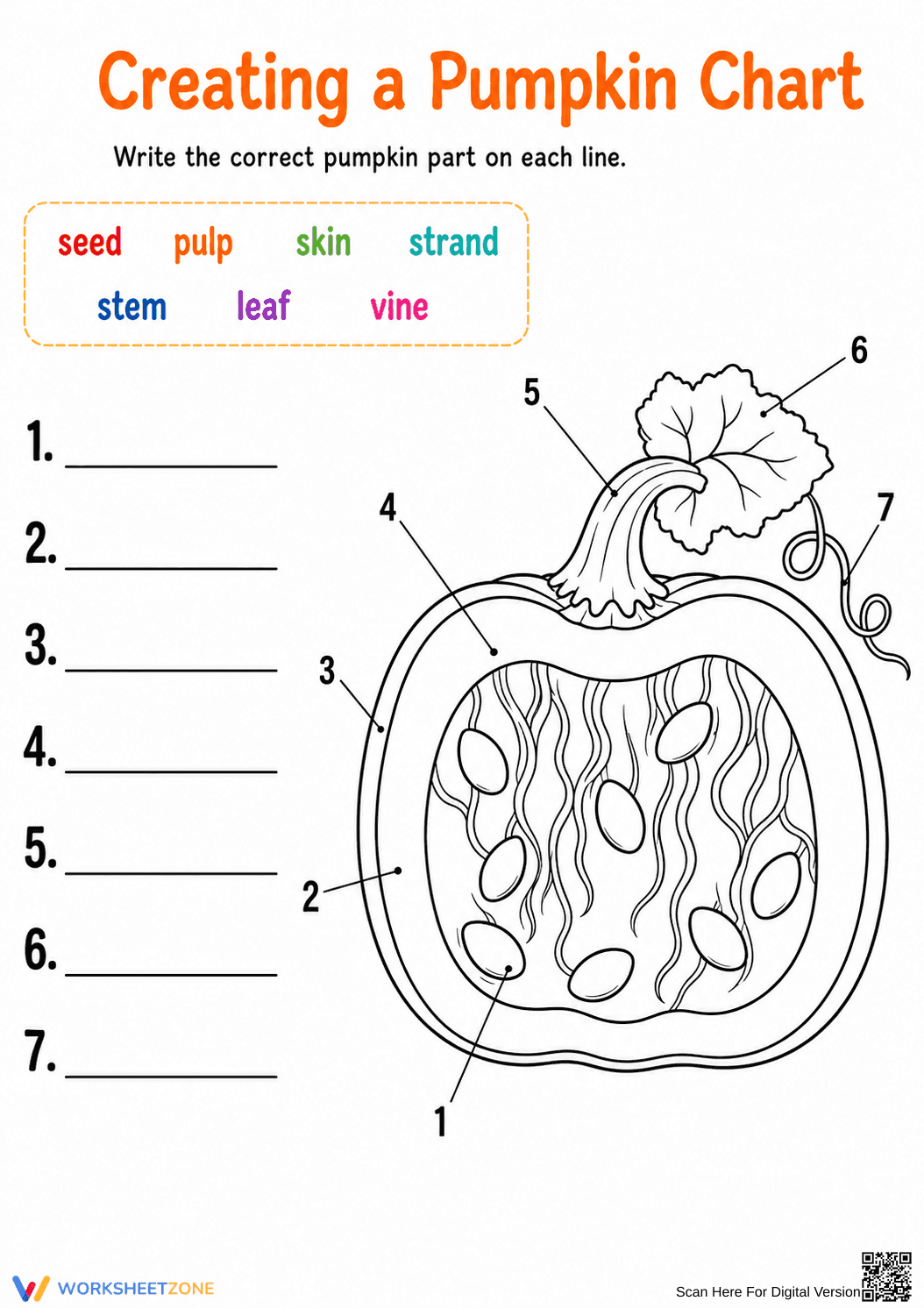

Grade 1 Pumpkin Anatomy — Printable No-Prep Worksheet
Paste this activity's link or code into your existing LMS (Google Classroom, Canvas, Teams, Schoology, Moodle, etc.).
Students can open and work on the activity right away, with no student login required.
You'll still be able to track student progress and results from your teacher account.
This Grade 1 science worksheet helps students identify and label the anatomical parts of a pumpkin. By using a provided word bank, young learners will connect scientific vocabulary to a clear visual diagram, building foundational observation skills and reinforcing their understanding of plant structures.
At a Glance
- Grade: 1 · Subject: Science
- Standard:
1-LS1-1— Identify external parts of plants- Skill Focus: Labeling plant anatomy
- Format: 1 page · 7 problems · Answer key included · PDF
- Best For: Independent practice
- Time: 10–15 minutes
This single-page resource features a large, clear cross-section illustration of a pumpkin with seven numbered pointers. Students utilize a color-coded word bank containing terms like seed, pulp, skin, strand, stem, leaf, and vine to complete the fill-in-the-blank lines. A complete answer key is provided to ensure accurate grading and quick reference.
- Print (1 minute): Simply download the PDF and print a class set. The black-and-white diagram is optimized for standard classroom printers.
- Distribute (1 minute): Hand out the sheets along with pencils. The built-in word bank means students can begin immediately without extra materials.
- Review (3 minutes): Go over the seven anatomical terms together using the included answer key.
With under two minutes of total teacher prep time, this activity is an excellent addition to any fall science unit or emergency sub plan.
Aligned to primary standard 1-LS1-1, this activity supports students as they observe and identify the external and internal parts of plants. It reinforces the concept that plants have specific structures that help them grow and survive. Both standard codes can be copied directly into lesson plans, IEP goals, or district curriculum mapping tools.
Deploy this worksheet during a fall-themed science center or as an independent follow-up task after a read-aloud about the plant life cycle. As a formative assessment observation tip, watch how students use the process of elimination with the word bank to identify unfamiliar parts like the strand or pulp. Expected completion time ranges from 10 to 15 minutes.
This resource is primarily designed for first-grade students, though it serves as an excellent review for second graders or a guided activity for kindergarteners. The visual supports and word bank make it highly accessible for English Language Learners. Pair this worksheet with a hands-on pumpkin carving demonstration or a physical anchor chart detailing plant life cycles.
Integrating visual diagrams with targeted vocabulary practice significantly enhances early childhood science comprehension. When students identify external parts of plants, as outlined in standard 1-LS1-1, they develop critical observation skills necessary for later STEM success. According to Fisher & Frey (2014), providing structured visual scaffolds, such as labeled diagrams and word banks, allows young learners to process complex domain-specific vocabulary more effectively. This pumpkin anatomy worksheet applies these evidence-based instructional principles by isolating seven distinct plant structures and pairing them with clear, numbered visual cues. By requiring students to actively map text to imagery, the activity strengthens cognitive associations between scientific terms and physical plant characteristics. This method ensures that foundational biology concepts are firmly established, preparing students for more advanced life science curricula in subsequent grade levels.


