


























Views
Downloads

Essential Pumpkin Anatomy Study Guide | Grade 1-2 Science
Paste this activity's link or code into your existing LMS (Google Classroom, Canvas, Teams, Schoology, Moodle, etc.).
Students can open and work on the activity right away, with no student login required.
You'll still be able to track student progress and results from your teacher account.
This comprehensive pumpkin anatomy study guide provides young learners with a clear, visual breakdown of plant structures. Students identify external features like tendrils and ribs while exploring internal components such as the germ and seed coat. It transforms complex biological concepts into accessible, illustrated segments that build foundational scientific vocabulary and observation skills during autumn science units.
At a Glance
- Grade: 1-2 · Subject: Science
- Standard:
1-LS1-1— Identify plant parts and their functions for growth and survival- Skill Focus: Pumpkin Anatomy
- Format: 3 pages · 10 anatomical parts · Study Guide · PDF
- Best For: Life science units and autumn lessons
- Time: 15–25 minutes
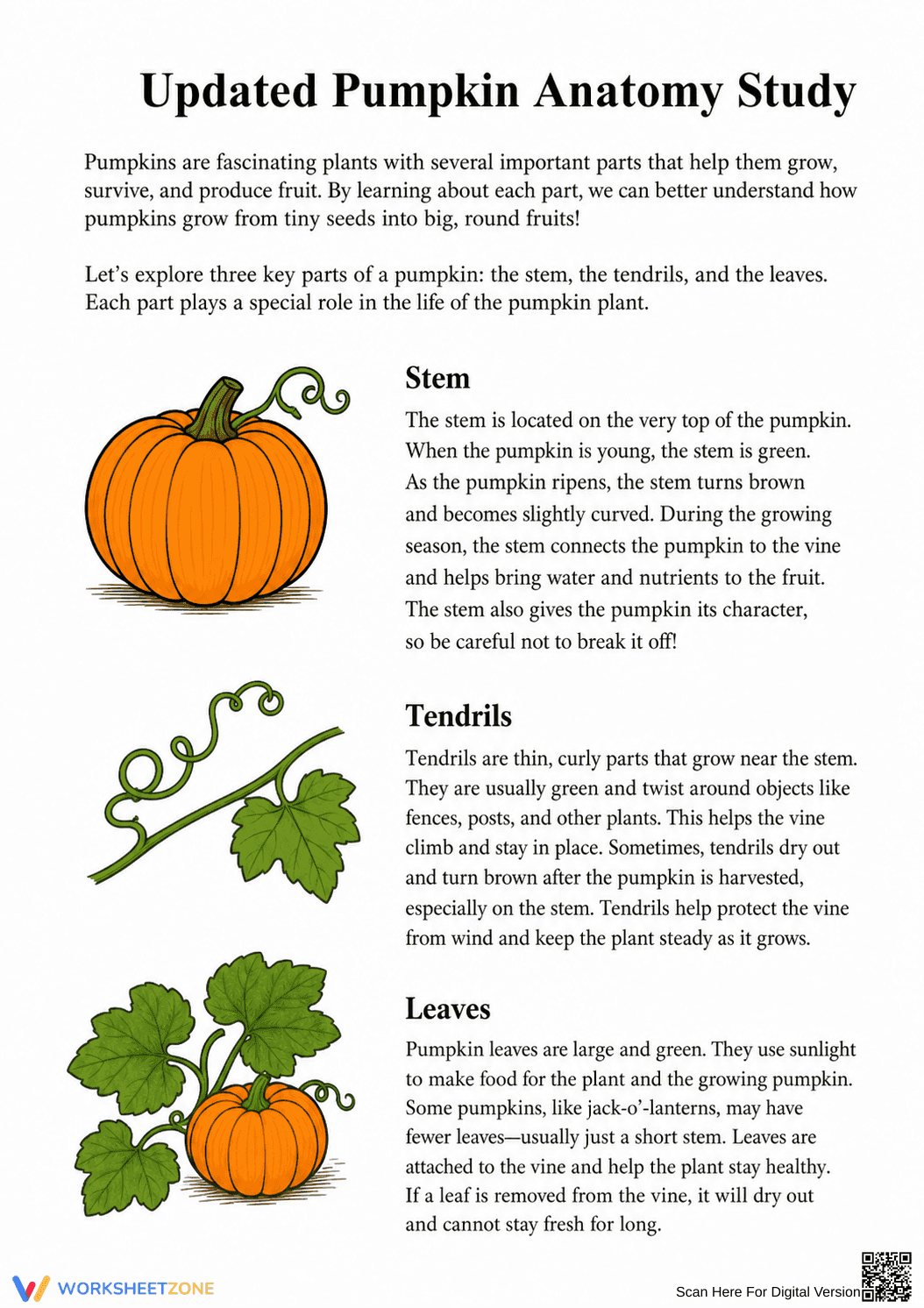
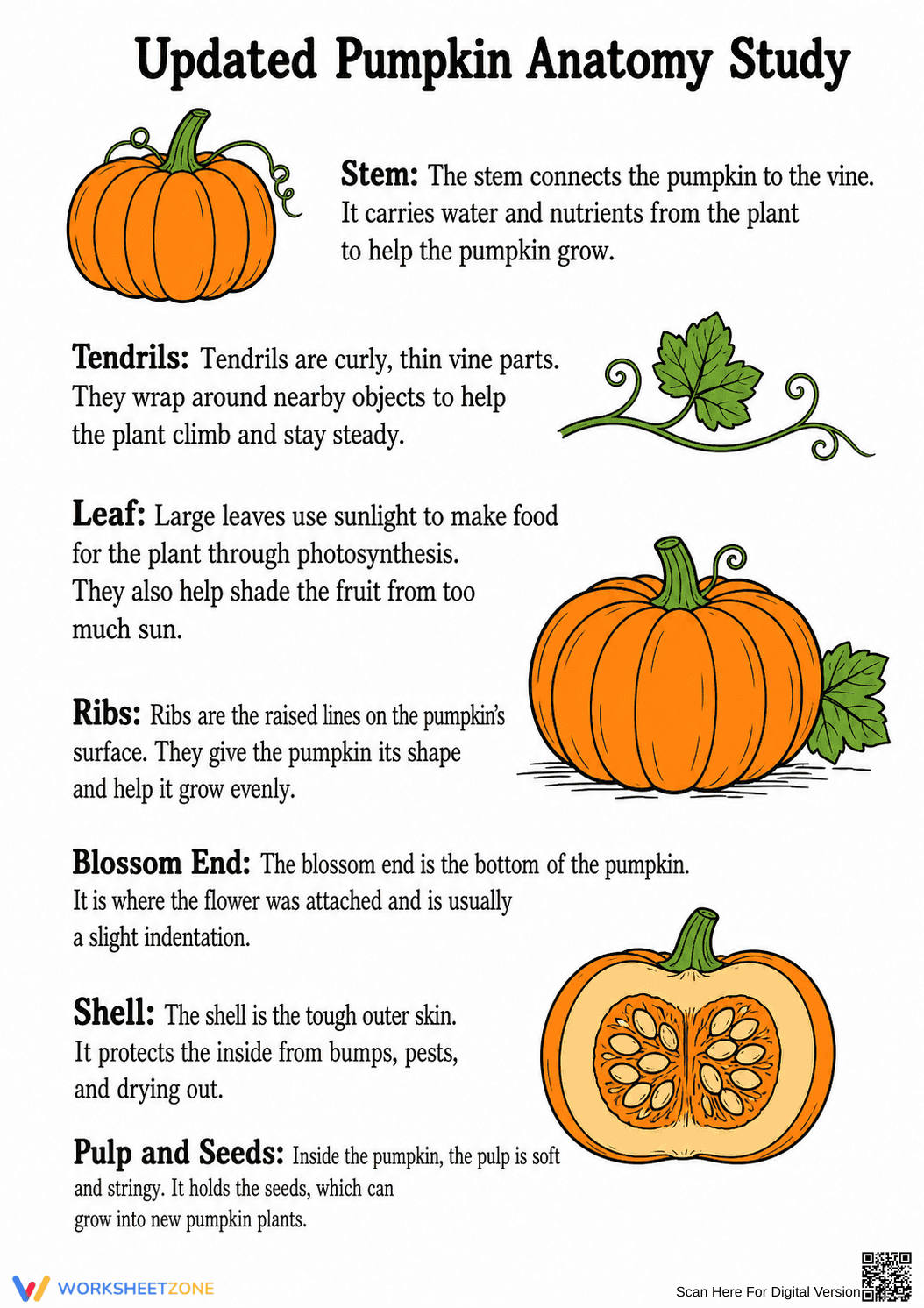
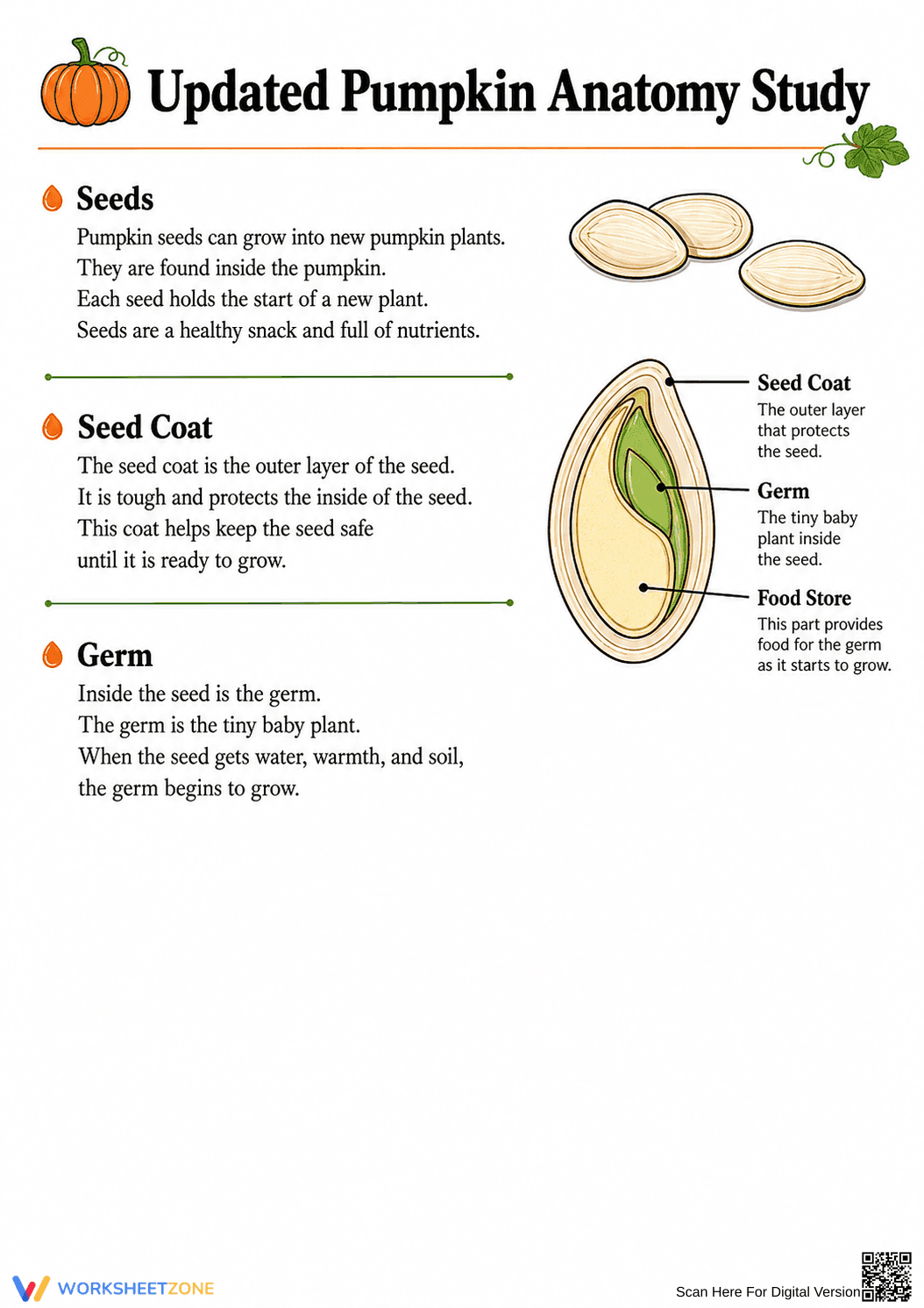
The packet contains three distinct pages of illustrated content. The first page introduces the primary external structures, including the stem, tendrils, and leaves, with descriptive paragraphs explaining their roles in water transport and photosynthesis. The second page expands to the full fruit anatomy, defining the ribs, shell, blossom end, and pulp. The final page provides a microscopic view of seed anatomy, detailing the seed coat, germ, and food store.
This resource is designed for a zero-prep classroom workflow. Teachers can print the three-page set in approximately 30 seconds. Distribution takes less than a minute, and because the text is self-explanatory, it functions perfectly as an independent reading activity or a quiet-time study guide. It is an ideal choice for emergency sub plans or transition periods between hands-on lab activities.
Standards Alignment
Primary Standard: 1-LS1-1. "All organisms have external parts. Plants also have different parts (roots, stems, leaves, flowers, fruits) that help them survive and grow." This standard code can be copied directly into lesson plans, IEP goals, or district curriculum mapping tools.
How to Use It
Use this guide as a pre-lab resource before a live pumpkin dissection to front-load vocabulary. During the lesson, have students find the "ribs" or "pulp" on a real pumpkin as they read the descriptions. For a formative assessment, ask students to point to the "germ" on the third page and explain its function in their own words. Expected completion time ranges from 15 to 25 minutes.
Who It's For
This worksheet is designed for Grade 1 and Grade 2 students, though it remains accessible for Kindergarteners with teacher support. It is particularly effective for visual learners and English Language Learners (ELLs) who benefit from the direct pairing of labels with realistic illustrations. Pair this resource with a life cycle anchor chart or a sequencing activity for a complete unit.
This resource aligns with the 1-LS1-1 standard, focusing on how plant structures like the stem, shell, and seeds facilitate growth and survival. According to Fisher & Frey (2014), the use of complex informational texts paired with detailed visual scaffolds is critical for developing academic vocabulary in early elementary science. By breaking down the pumpkin into ten distinct anatomical parts—including the often-overlooked germ and seed coat—this worksheet provides the high-quality non-fiction exposure necessary for scientific literacy. The 3-page layout ensures that students are not overwhelmed, allowing for deep focus on specific biological functions. Research indicates that early exposure to technical diagrams helps bridge the gap between observational play and formal inquiry-based learning. This study guide serves as a foundational tool for life science units, ensuring students can accurately identify and describe the physical patterns of the natural world while building a robust lexicon for future biology coursework.


