


























Views
Plays


Proverbs Reading Quiz — Printable Grade 6 Worksheet
Paste this activity's link or code into your existing LMS (Google Classroom, Canvas, Teams, Schoology, Moodle, etc.).
Students can open and work on the activity right away, with no student login required.
You'll still be able to track student progress and results from your teacher account.
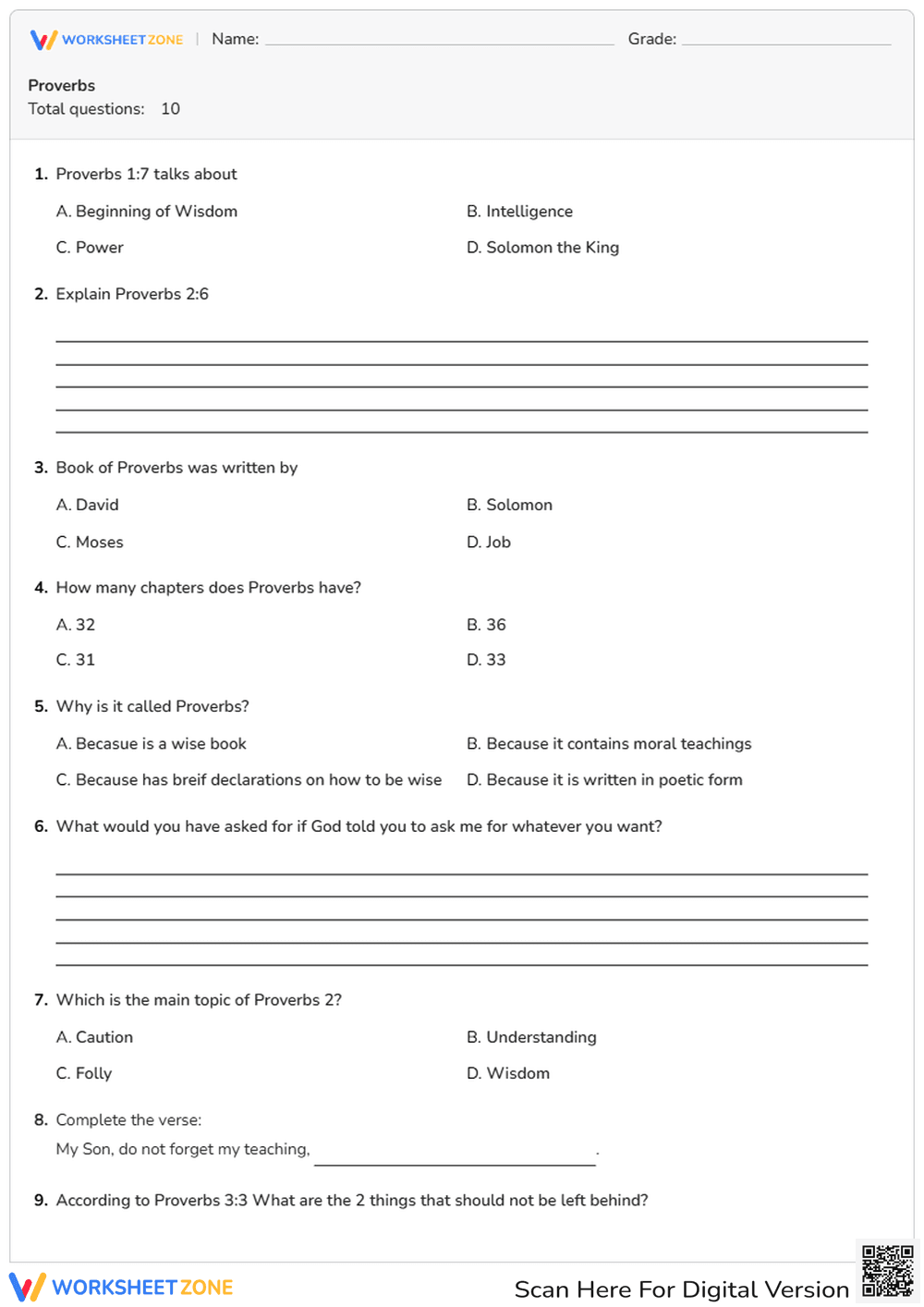
This printable reading comprehension worksheet helps middle school students test their knowledge of the Book of Proverbs. By answering a mix of multiple-choice and short-response questions, learners will demonstrate their understanding of key themes, authorship, and specific verses, reinforcing their ability to recall and analyze textual details.
At a Glance
- Grade: 6 · Subject: Reading
- Standard:
CCSS.ELA-LITERACY.RI.6.1— Cite textual evidence to support analysis of the text- Skill Focus: Reading Comprehension and Factual Recall
- Format: 2 pages · 10 problems · PDF
- Best For: Independent practice or assessment
- Time: 15–20 minutes
Inside this two-page resource, educators will find a straightforward 10-question quiz focused on the Book of Proverbs. The assessment includes a variety of question formats, featuring eight multiple-choice questions and two short-answer prompts. Students are asked to identify the author, recall the number of chapters, explain specific verses, and reflect on the overarching themes of wisdom and moral teachings found within the text.
This resource is designed for immediate classroom implementation with a zero-prep workflow.
- Print (1 minute): Simply download the PDF and print copies for your class.
- Distribute (1 minute): Hand out the two-page quiz as a standalone assignment or after a reading session.
- Review (5 minutes): Go over the answers together as a class to reinforce the moral teachings and historical context.
With under two minutes of total teacher prep time, this worksheet is an excellent option for emergency sub plans or quick formative assessments.
This worksheet aligns with CCSS.ELA-LITERACY.RI.6.1: "Cite textual evidence to support analysis of what the text says explicitly as well as inferences drawn from the text." It encourages students to draw on their reading of the text to answer specific factual and interpretive questions. Both standard codes can be copied directly into lesson plans, IEP goals, or district curriculum mapping tools.
Teachers can utilize this worksheet in multiple ways to support reading comprehension. It serves perfectly as an after-reading assessment once students have completed a study unit on the Book of Proverbs or ancient wisdom literature. Alternatively, it can be used as a guided reading activity where students search the text to find the answers. As a formative assessment observation tip, monitor how students approach the short-answer questions to gauge their ability to articulate complex themes like wisdom and understanding. Expected completion time is 15 to 20 minutes.
This resource is primarily designed for middle school students in grades 5 through 8 studying literature, history, or religious texts. The mix of multiple-choice and short-answer questions provides built-in differentiation, allowing students who struggle with writing to still demonstrate their knowledge through selected-response items. It pairs naturally with a direct instruction lesson on ancient proverbs or a reading passage covering the historical context of King Solomon.
Aligning instructional materials with rigorous standards like CCSS.ELA-LITERACY.RI.6.1 ensures that students can effectively cite textual evidence to support analysis of the text. According to EdReports 2024, high-quality instructional materials that require students to engage directly with source texts significantly improve reading comprehension and analytical skills. When students practice retrieving specific information and explaining textual themes, they build the cognitive stamina necessary for advanced literacy tasks. This targeted practice helps learners transition from basic recall to deeper inferential thinking. By integrating structured assessments into the curriculum, educators can accurately measure student progress and identify areas needing additional support. Utilizing standards-aligned resources streamlines lesson planning and guarantees that students receive evidence-based instruction.


