




























Views
Downloads




Proven Explanatory Draft Revision Worksheet | Grade 6 ELA

Paste this activity's link or code into your existing LMS (Google Classroom, Canvas, Teams, Schoology, Moodle, etc.).
Students can open and work on the activity right away, with no student login required.
You'll still be able to track student progress and results from your teacher account.
This explanatory writing revision worksheet equips sixth-grade students to diagnose and repair weak drafts by eliminating irrelevant anecdotes, replacing vague language with technical vocabulary, and inserting transitions. Students analyze a hydroponics case study to transform disjointed prose into an authoritative, cohesive scientific explanation.
At a Glance
- Grade: 6 · Subject: ELA
- Standard:
W.6.5— Develop and strengthen writing by revising for cohesion, clarity, and precision- Skill Focus: Repair an Unclear Explanatory Draft
- Format: 5 pages · 10 problems · Complete 3-page answer key · PDF document
- Best For: Writing revision stations, small-group intervention, and sub plans
- Time: 40–50 minutes
What's Inside
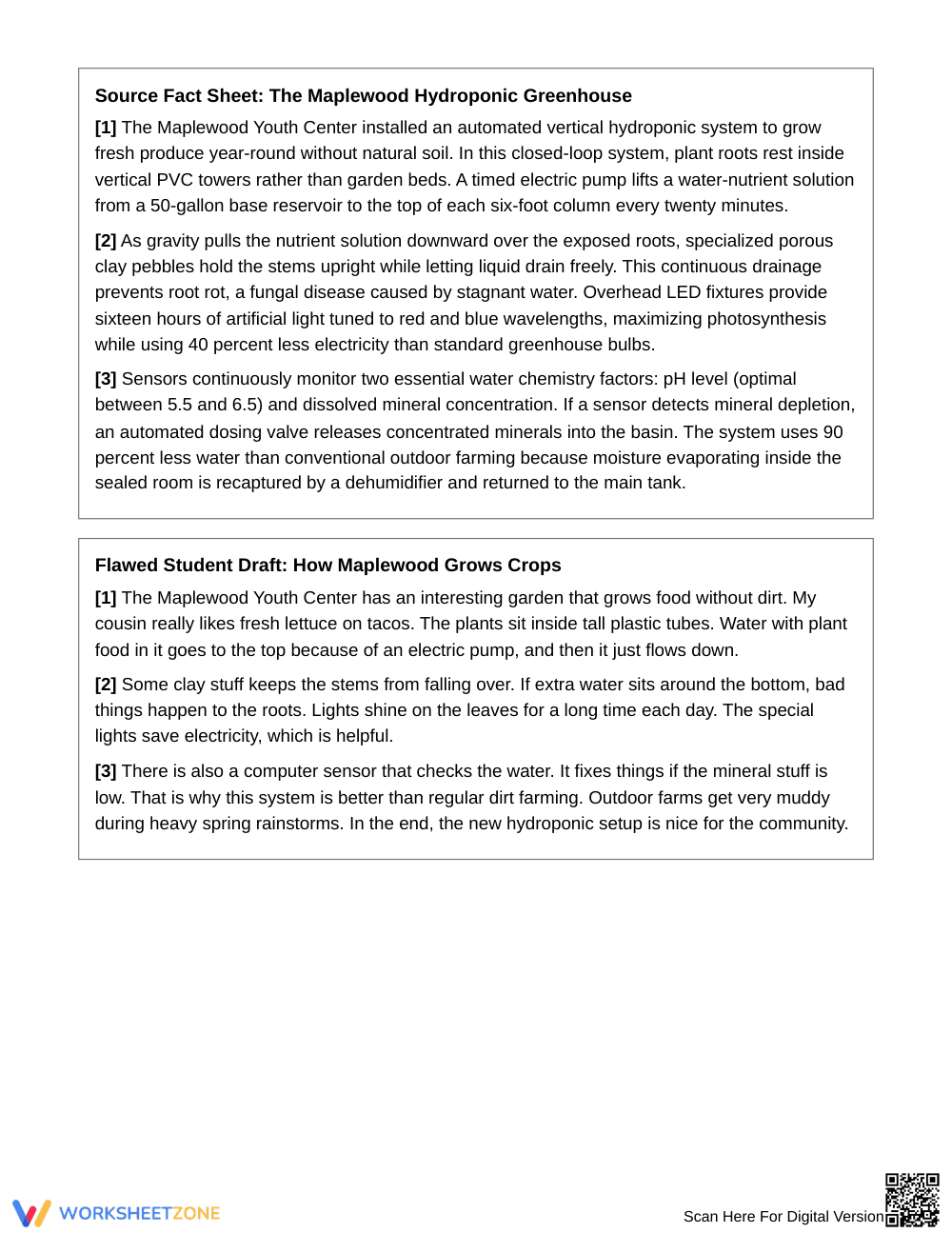
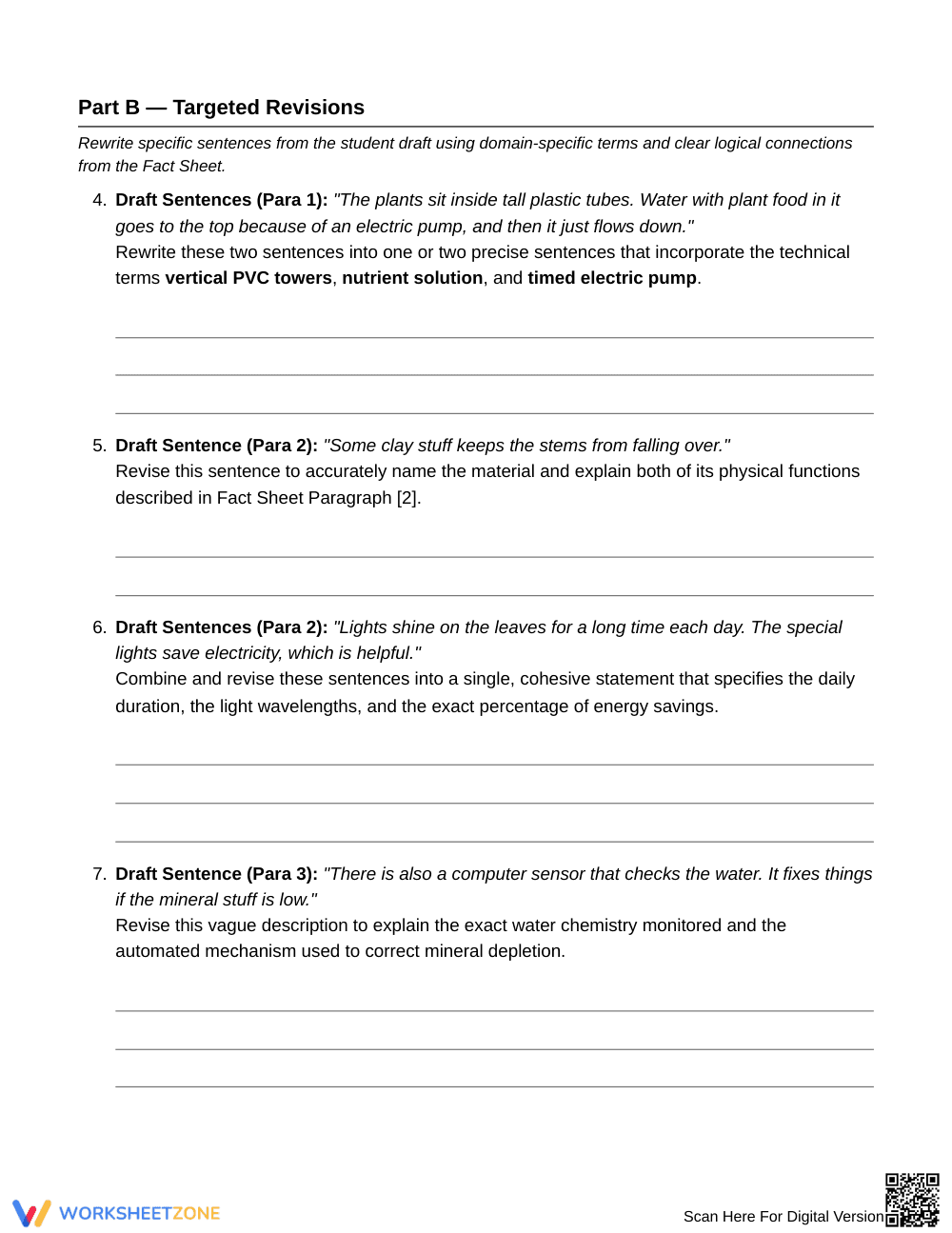
This five-page worksheet features a revision strategy reference box with an annotated mentor example, an informational fact sheet on hydroponics, and a flawed student draft. Students complete 10 exercises, including three diagnostic critique questions, five targeted sentence rewrites, a multiple-choice conclusion evaluation, and a full paragraph rewrite. A detailed three-page answer key provides complete model responses.
Skill Progression
- Guided practice (Items 1–3): Students diagnose draft flaws by identifying irrelevant personal details, missing technical terms, and ineffective comparisons.
- Supported practice (Items 4–8): Learners rewrite draft sentences using provided domain-specific terms, precise data, and transitional phrases.
- Independent practice (Items 9–10): Students evaluate concluding statements and independently draft a cohesive, fully revised explanatory paragraph.
This sequence follows a gradual-release framework, shifting students from error diagnosis to independent expository revision.
Standards Alignment
Primary alignment is to W.6.5: "With some guidance and support from peers and adults, develop and strengthen writing as needed by planning, revising, editing, rewriting, or trying a new approach." The revision tasks also support W.6.2 by requiring domain-specific vocabulary and clear organization. Both standard codes can be copied directly into lesson plans, IEP goals, or district curriculum mapping tools.
How to Use It
Use this worksheet after direct instruction on informational writing techniques or as a collaborative revision workshop. During practice, check Items 4 and 7 to verify that students replace vague words with exact technical facts. Most students complete the 10 tasks in 40 to 50 minutes.
Who It's For
This activity supports general Grade 6 ELA classes, writing intervention groups, and English learners mastering academic syntax. Struggling writers benefit from highlighting text evidence in the fact sheet before drafting. Pair this assignment with an anchor chart on explanatory transitions or a scientific mentor text.
Targeted revision practice directly accelerates middle school literacy achievement under Common Core standard W.6.5 by equipping learners to detect and repair unclear explanatory drafts. According to Fisher & Frey (2014), gradual release instructional frameworks that transition students from guided diagnostic critique to supported sentence manipulation and independent synthesis significantly increase student mastery of complex informational writing. Sixth-grade writers frequently struggle to bridge the gap between informal spoken vocabulary and formal domain-specific terminology without structured textual models. By utilizing an authentic hydroponics source text alongside an intentionally flawed draft, this five-page instructional resource isolates critical revision mechanics, including removing irrelevant personal anecdotes, clarifying mechanical processes, and applying logical transitions. The ten rigorous tasks provide structured scaffolds that reinforce objective tone and informational cohesion, ensuring students develop lasting revision competencies necessary for academic success across secondary grade levels.


