


























Views
Downloads

Proven Allele Frequency Change Worksheet | Grade 10 Biology
Paste this activity's link or code into your existing LMS (Google Classroom, Canvas, Teams, Schoology, Moodle, etc.).
Students can open and work on the activity right away, with no student login required.
You'll still be able to track student progress and results from your teacher account.
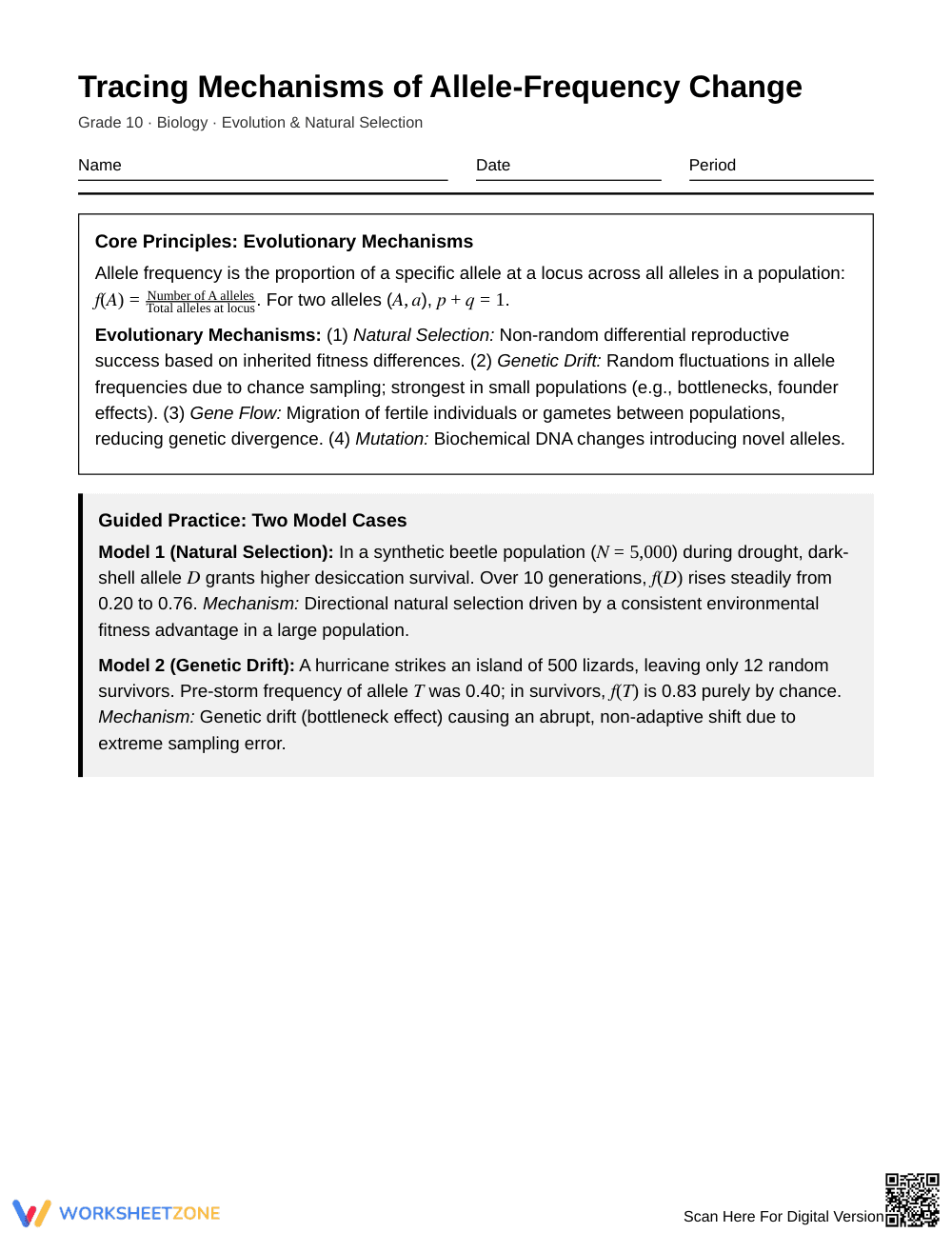
This comprehensive Grade 10 Biology worksheet equips high school students to calculate population genetic metrics and identify the four primary mechanisms of evolution. Working across authentic synthetic datasets, learners evaluate natural selection, genetic drift, gene flow, and mutation to explain how and why allele distributions shift over time.
At a Glance
- Grade: 10 · Subject: Biology
- Standard: Population Genetics — Calculate allele frequencies and evaluate evidence for evolutionary mechanisms over generations
- Skill Focus: Trace Allele-Frequency Change Mechanisms
- Format: 6 pages · 10 problems · Answer key included · PDF
- Best For: High school genetics and evolution units
- Time: 45–60 minutes
What's Inside
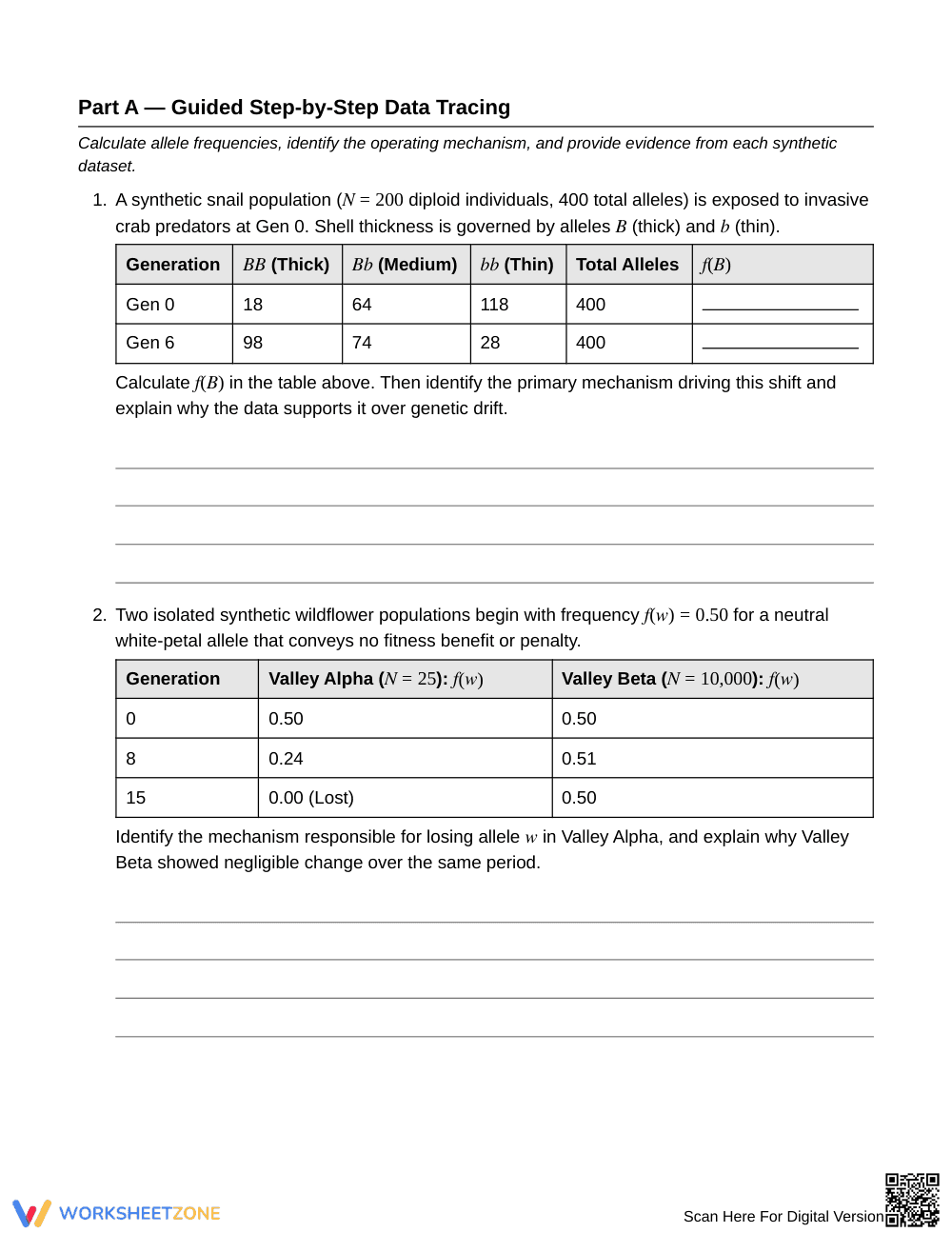
This 6-page printable worksheet includes core reference summaries, two worked model cases, 10 data-driven analytical tasks, and a full 2-page answer key. Students interpret structured data tables, calculate Hardy-Weinberg allele frequencies, classify modes of selection (directional, stabilizing, and disruptive), and contrast sampling errors in bottlenecks with adaptive shifts.
Skill Progression
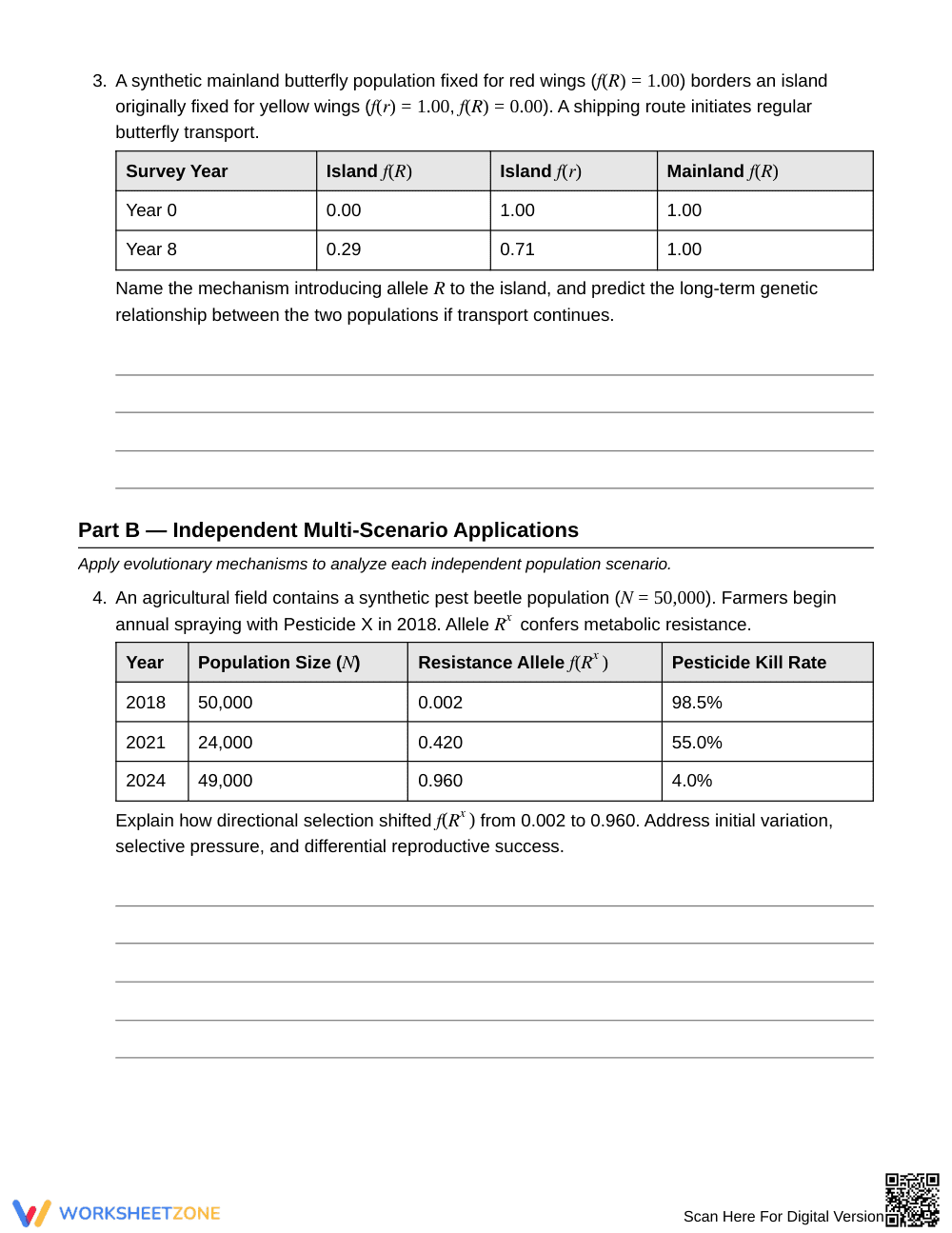
- Guided Practice (Part A, 3 tasks): Students compute frequencies from structured diploid population tables and evaluate clear numerical shifts driven by predation selection, demographic drift, and migration corridors.
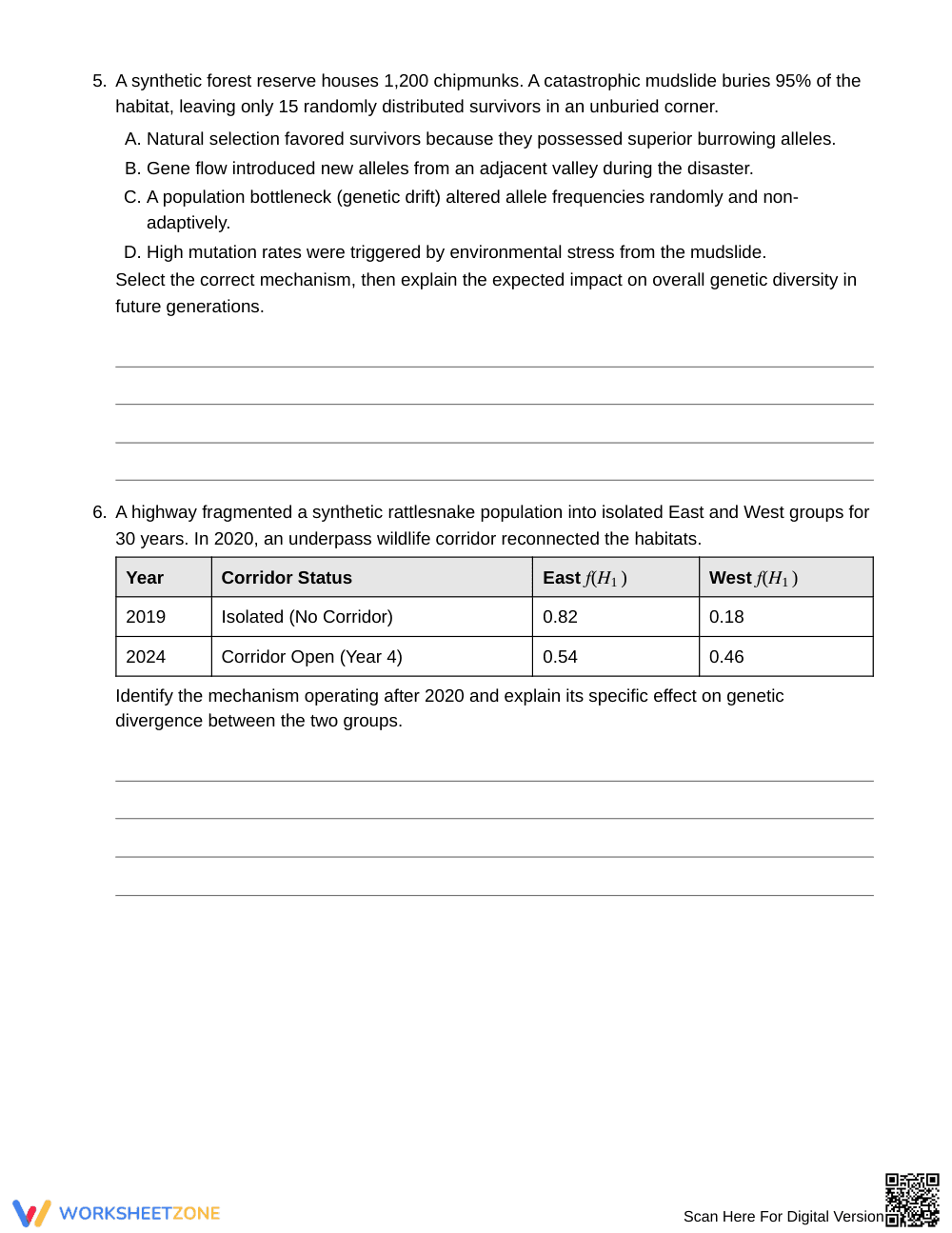
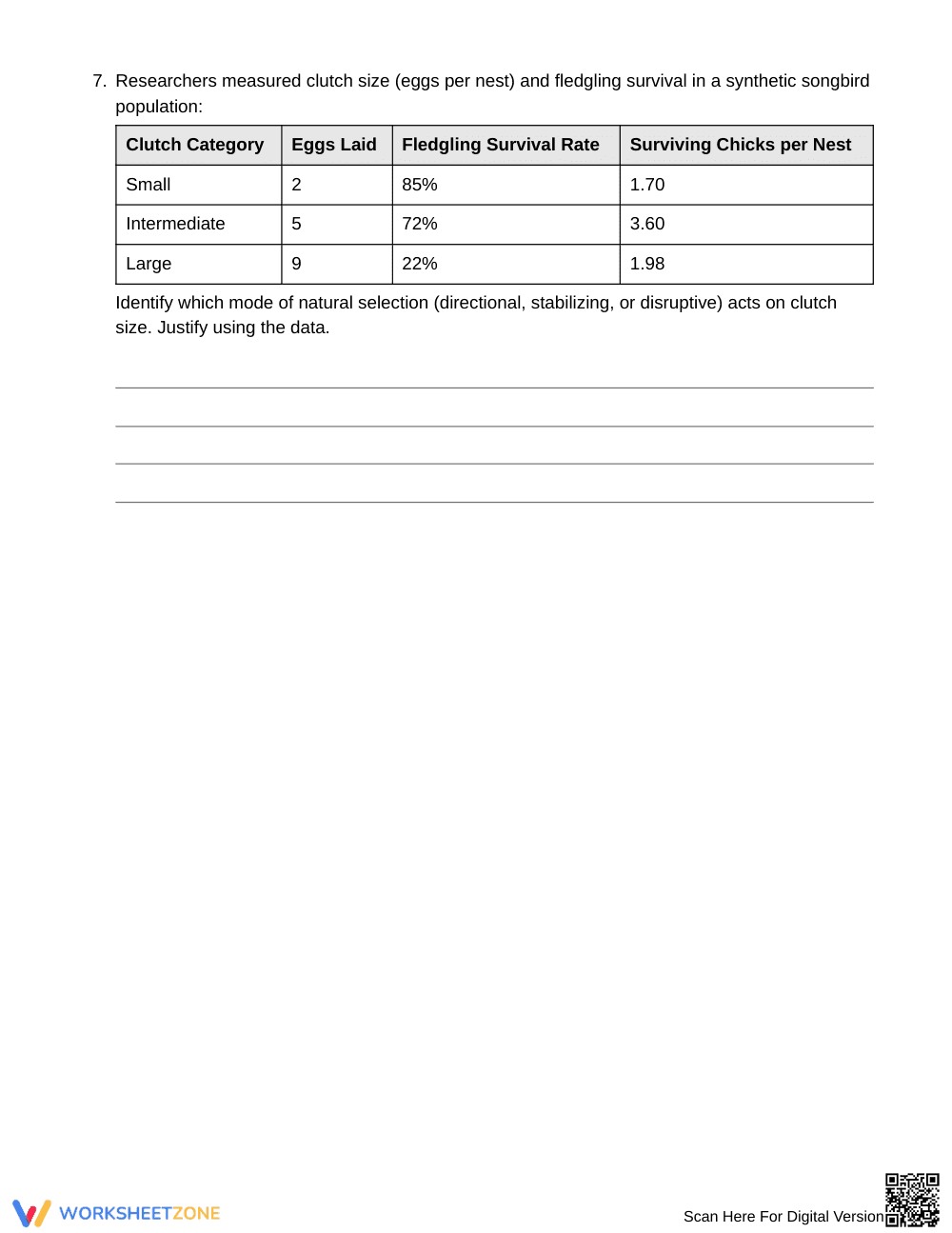
- Supported Practice (Part B, 5 tasks): Learners analyze multi-year pesticide resistance data, evaluate survival probabilities across bird clutch sizes, identify population bottleneck scenarios, and differentiate drift from neutral variation in small populations.
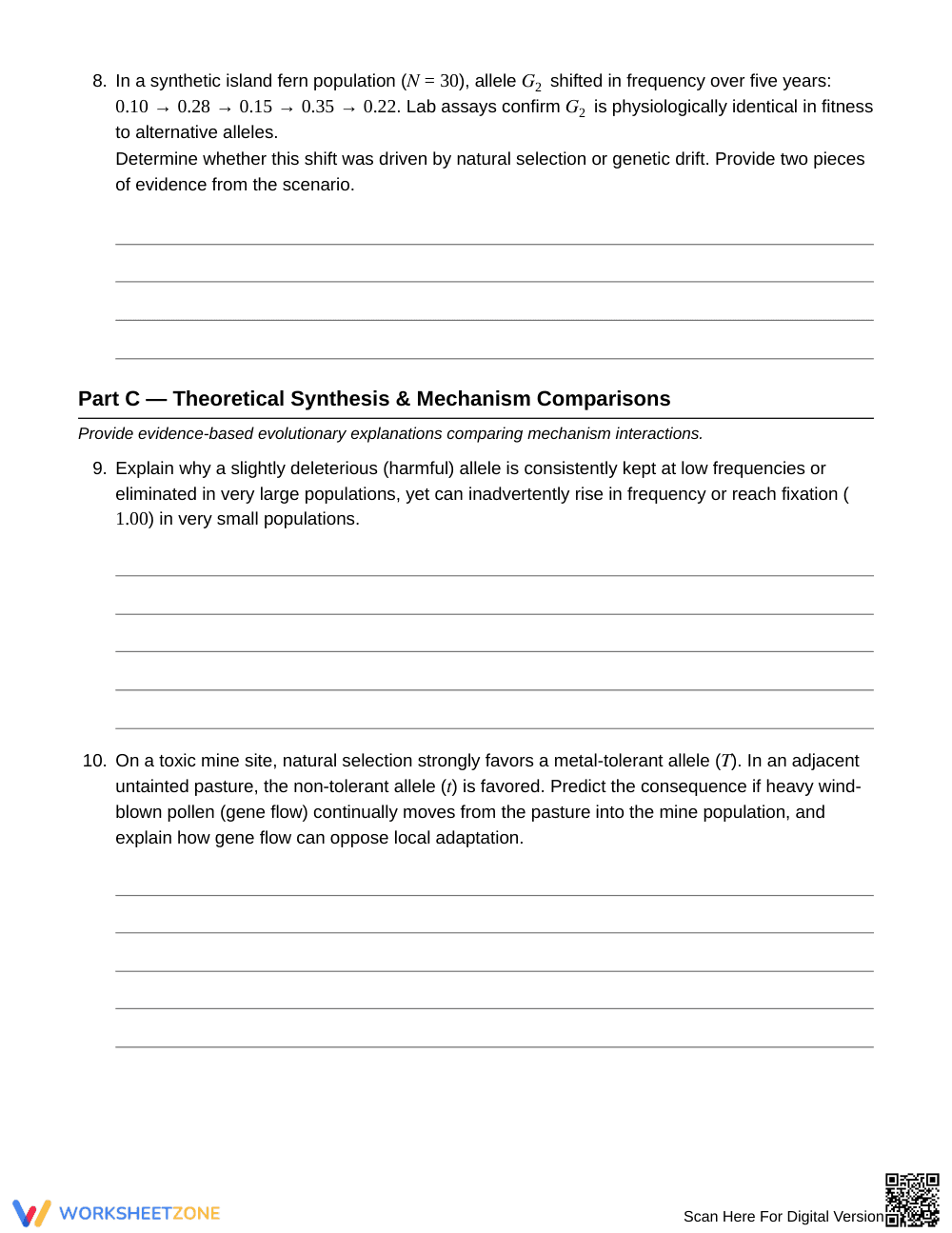
- Independent Practice (Part C, 2 tasks): Students write evidence-based biological explanations contrasting deleterious allele fixation risks in small populations with gene flow counteracting local adaptation.
This structured sequence uses the gradual-release model to advance student competency from direct mathematical calculation to sophisticated theoretical evaluation.
Standards Alignment
This resource aligns with high school life science standards for natural selection and population evolution. Students construct evidence-based explanations for how genetic variation, environmental selective pressures, and random events alter allele frequencies in populations over time. Both standard descriptions can be copied directly into lesson plans, IEP goals, or district curriculum mapping tools.
How to Use It
Deploy this worksheet after introducing Hardy-Weinberg equilibrium principles and evolutionary forces. For direct instruction, work through the introductory model cases as a whole group, then release students to complete the scenario tables in collaborative pairs. During independent completion, circulate to check student calculations in Part A; if learners struggle to distinguish genetic drift from directional selection, prompt them to compare population sizes and selective pressures. Expect this activity to take 45 to 60 minutes.
Who It's For
This activity is designed for Grade 10 General Biology, Honors Biology, or introductory AP Biology classrooms. It provides embedded formulas and scaffolded tables for standard learners while delivering rigorous quantitative reasoning for advanced students. Pair this worksheet directly with a population genetics simulation or an allele-frequency graphing lab.
Grounded in structured scaffolding frameworks outlined by Fisher & Frey (2014), this population genetics resource systematically builds quantitative fluency and scientific reasoning. By transitioning high school biology students from guided tabular calculations to independent mechanism synthesis, the 10 scaffolded tasks help learners master the distinction between adaptive natural selection and stochastic genetic drift across varied population sizes. The complete 6-page packet delivers high-rigor, standards-aligned instruction that reinforces essential evolutionary biology concepts, builds data literacy, and supports classroom formative assessment needs.


