


























Views
Downloads
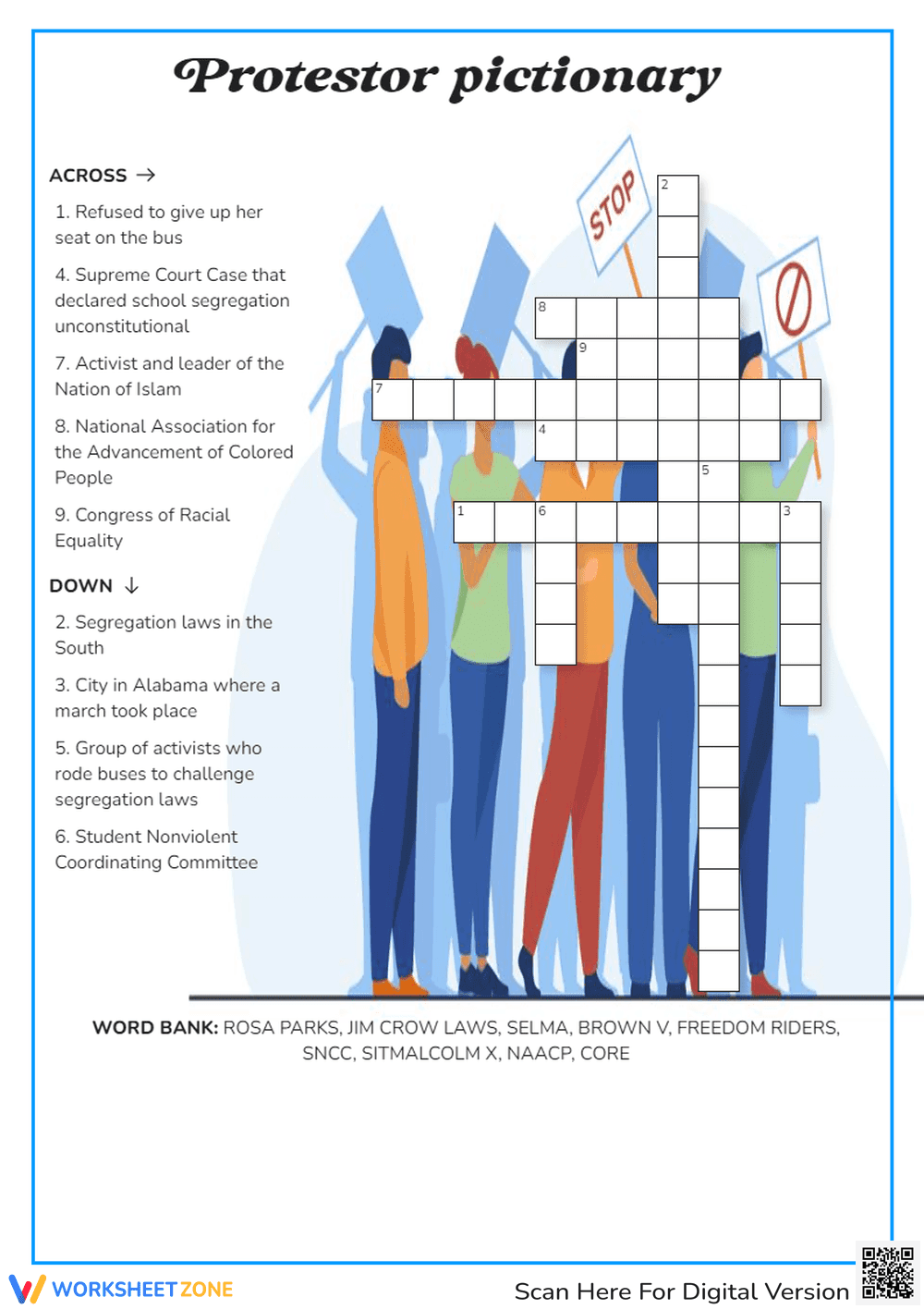

Printable Civil Rights Crossword | Grade 3
Paste this activity's link or code into your existing LMS (Google Classroom, Canvas, Teams, Schoology, Moodle, etc.).
Students can open and work on the activity right away, with no student login required.
You'll still be able to track student progress and results from your teacher account.
This Grade 3 social studies crossword puzzle helps students master essential civil rights vocabulary. By matching historical clues to key figures and events, learners build domain-specific knowledge while practicing reading comprehension. The activity reinforces understanding of the Civil Rights Movement through an engaging, puzzle-based format.
At a Glance
- Grade: 3 · Subject: Social Studies
- Standard:
CCSS.ELA-LITERACY.RI.3.4— Determine the meaning of domain-specific words- Skill Focus: Civil Rights Vocabulary
- Format: 1 page · 9 problems · Answer key included · PDF
- Best For: Independent practice
- Time: 15–20 minutes
This single-page resource features a nine-clue crossword puzzle focused on pivotal moments and leaders of the Civil Rights Movement. Students use a provided word bank containing terms like Rosa Parks, NAACP, and Freedom Riders to solve the across and down clues. A complete answer key is included in the download for quick grading and student self-correction.
Zero-Prep Workflow
This worksheet is designed for immediate classroom implementation with minimal teacher setup.
- Print (1 minute): Generate copies of the single-page puzzle and the separate answer key.
- Distribute (1 minute): Hand out the worksheets to students during your social studies block.
- Review (3 minutes): Briefly read the instructions and point out the word bank at the bottom of the page.
With under two minutes of total teacher prep time, this activity is highly suitable for emergency sub plans or quick transitions.
Standards Alignment
This activity aligns with CCSS.ELA-LITERACY.RI.3.4, requiring students to determine the meaning of general academic and domain-specific words and phrases in a text relevant to a grade 3 topic or subject area. It also supports historical comprehension by connecting specific vocabulary terms to their real-world definitions. Both standard codes can be copied directly into lesson plans, IEP goals, or district curriculum mapping tools.
How to Use It
Deploy this crossword puzzle after direct instruction on the Civil Rights Movement to solidify new vocabulary. It serves as an excellent independent practice activity while the teacher works with small groups. Alternatively, use it as a morning work assignment during Black History Month. As a formative assessment observation tip, monitor which clues students struggle to answer even with the word bank; this indicates which historical events may need a quick reteach. Expected completion time ranges from 15 to 20 minutes.
Who It's For
This resource is primarily designed for third-grade students, though it functions well for second and fourth graders studying American history. The inclusion of a word bank provides built-in differentiation, supporting English Language Learners and students who need spelling assistance. Pair this puzzle with a reading passage about Rosa Parks or the March on Washington to give students the contextual background needed to solve the clues.
Mastering historical terminology is a critical component of elementary social studies education. When students engage with domain-specific vocabulary through structured activities, their overall reading comprehension improves. This worksheet targets CCSS.ELA-LITERACY.RI.3.4, challenging learners to determine the meaning of domain-specific words. According to Fisher & Frey (2014), explicit vocabulary instruction combined with multiple exposures to new terms significantly increases student retention and academic achievement. Crossword puzzles offer a low-stakes, highly engaging method for this repeated exposure, requiring students to actively recall definitions rather than passively reading them. By connecting clues to terms like the NAACP and the Freedom Riders, learners build a stronger mental framework for understanding complex historical narratives. This targeted practice ensures that foundational concepts are firmly established before moving on to higher-order historical analysis.


