


























Views
Plays

Protestant Reformation Worksheet | Grade 8 Printable
Paste this activity's link or code into your existing LMS (Google Classroom, Canvas, Teams, Schoology, Moodle, etc.).
Students can open and work on the activity right away, with no student login required.
You'll still be able to track student progress and results from your teacher account.
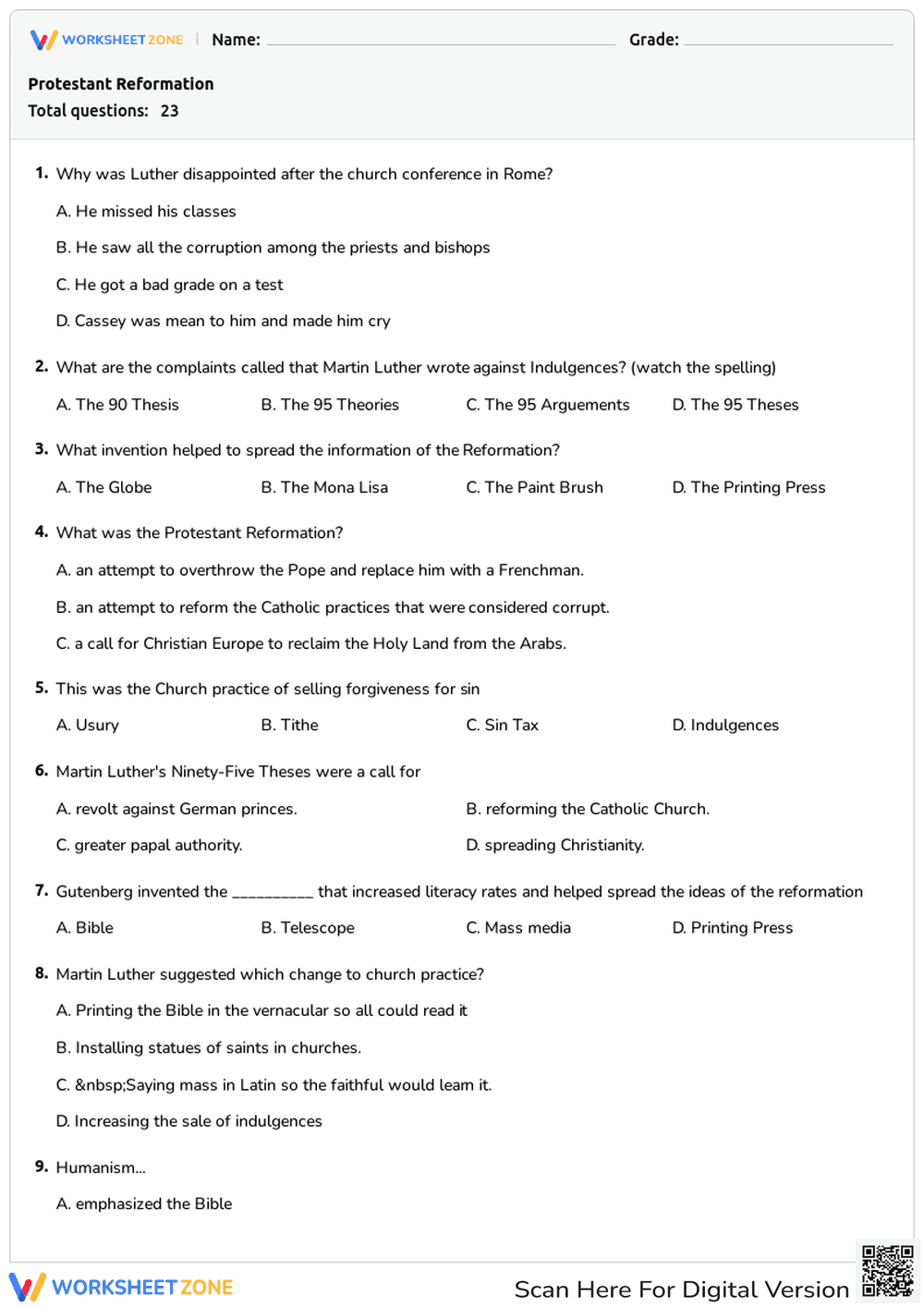
This Grade 8 history worksheet gives students a comprehensive assessment of the Protestant Reformation, focusing on key figures, vocabulary, and historical impacts. By answering these targeted questions, students demonstrate their understanding of Martin Luther, the printing press, and the cultural shifts that transformed European society.
At a Glance
- Grade: 8 · Subject: History
- Standard:
CCSS.ELA-LITERACY.RH.6-8.4— Determine the meaning of historical vocabulary- Skill Focus: Protestant Reformation concepts
- Format: 3 pages · 23 problems · Answer key included · PDF
- Best For: Formative assessment or review
- Time: 25–35 minutes
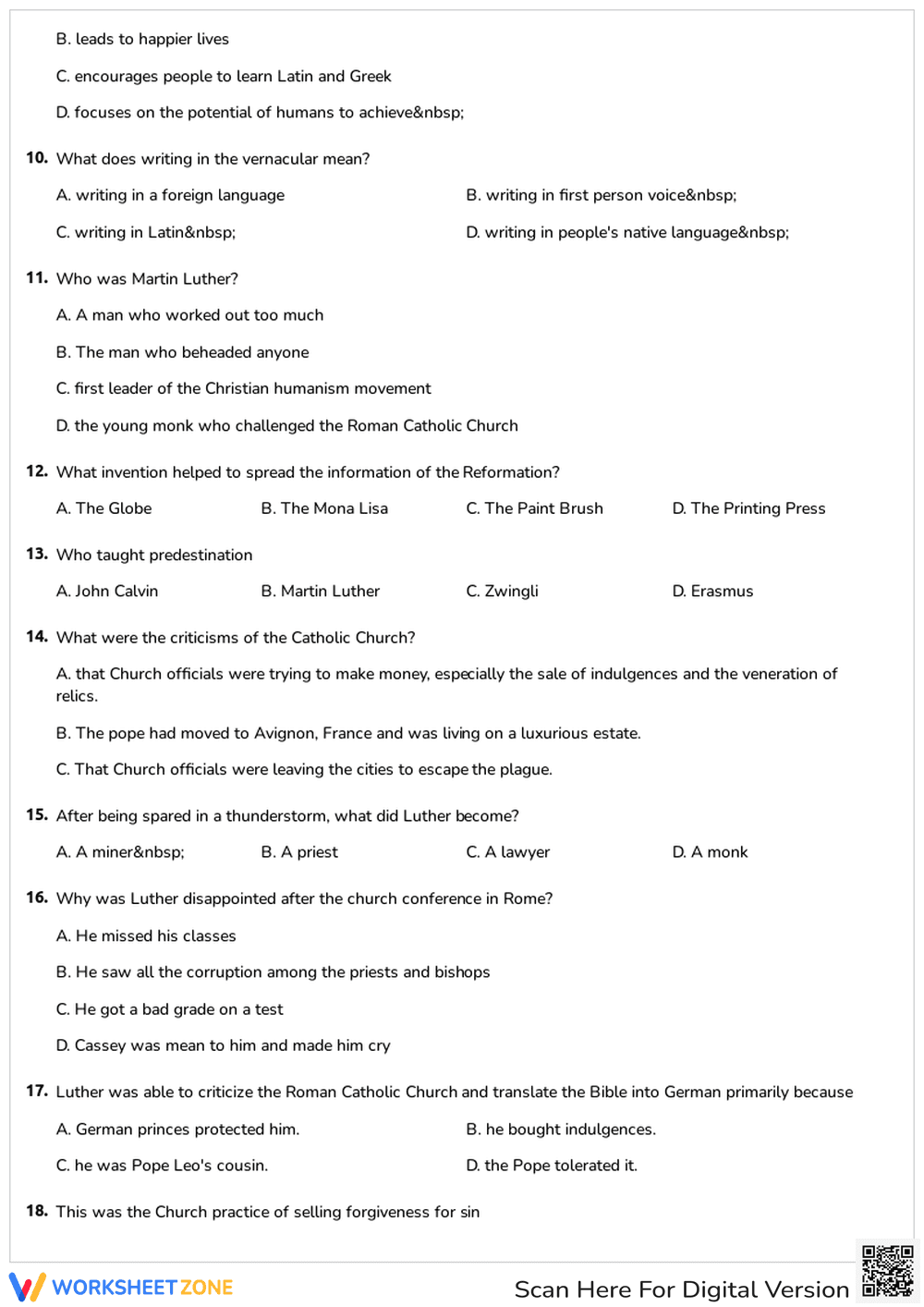
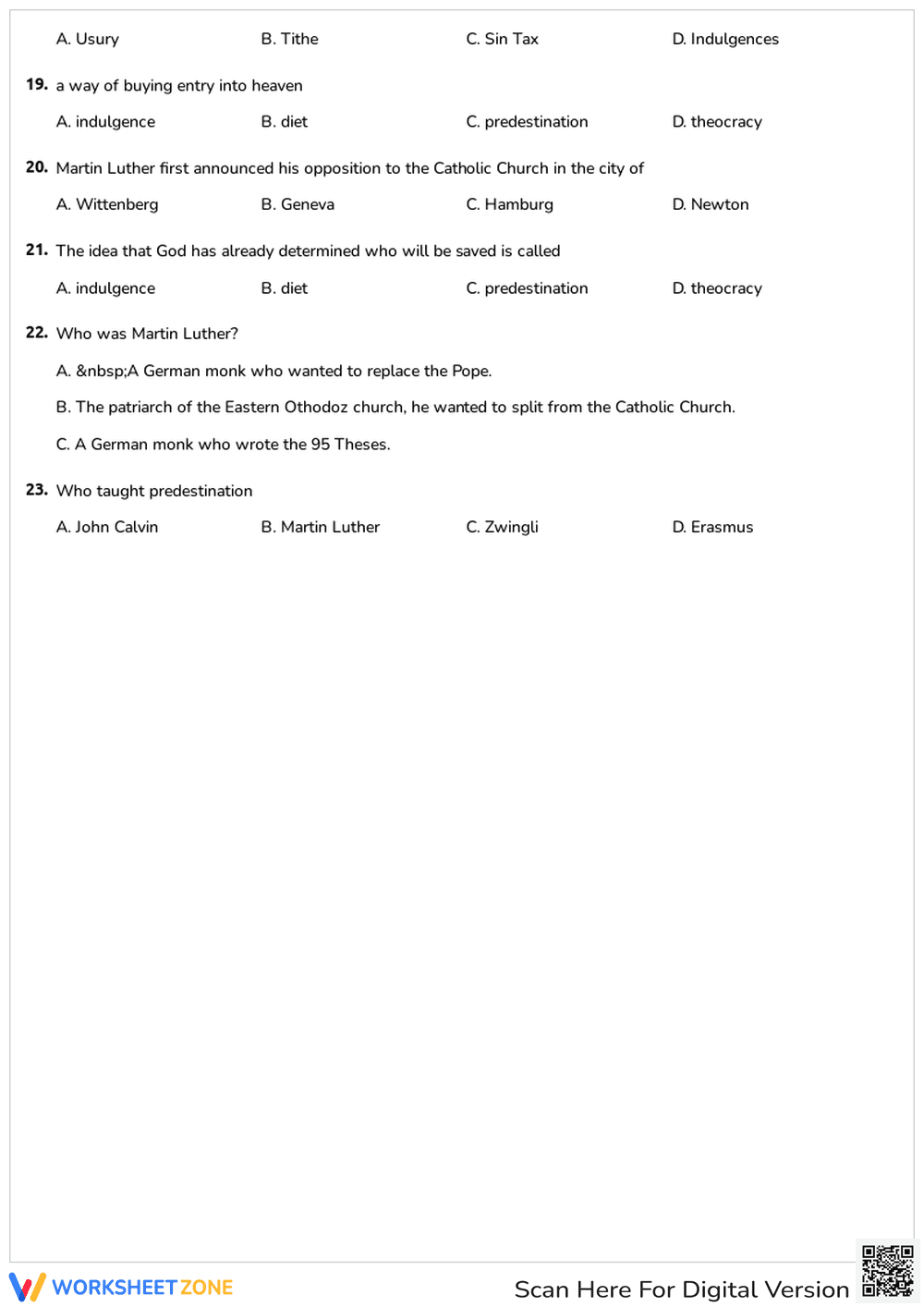
This resource features a robust 23-question multiple-choice quiz spanning three pages. The questions cover essential historical vocabulary such as indulgences, predestination, and vernacular, alongside critical figures like Martin Luther and John Calvin. The straightforward format allows students to quickly process information and select the most accurate historical facts, while the included answer key ensures grading is fast and objective.
Designed for immediate classroom implementation, this worksheet follows a simple zero-prep workflow.
- Print (1 minute): Simply download the PDF and print the three-page assessment for your class.
- Distribute (1 minute): Hand out the copies at the beginning of the period or leave them in a highly visible spot for a substitute teacher.
- Review (5 minutes): Use the provided answer key to quickly grade the 23 multiple-choice questions or review them together as a class.
Total teacher prep time is under two minutes, making this an ideal, reliable option for emergency sub plans or quick unit reviews.
This worksheet is aligned to primary standard CCSS.ELA-LITERACY.RH.6-8.4: Determine the meaning of words and phrases as they are used in a text, including vocabulary specific to domains related to history/social studies. It also supports general historical comprehension by reinforcing key events and figures of the 16th century. Both standard codes can be copied directly into lesson plans, IEP goals, or district curriculum mapping tools.
This assessment works perfectly as an end-of-unit quiz after direct instruction on the Renaissance and Reformation. Alternatively, use it as a pre-assessment to gauge prior knowledge before starting the unit. As a formative assessment observation tip, monitor which specific vocabulary terms (like "humanism" or "theocracy") students struggle with most, and use that data to drive your next review session. Expected completion time is 25 to 35 minutes.
This resource is primarily designed for middle school history students in grades 7 through 10. The multiple-choice format provides built-in differentiation by offering clear options, which supports English Language Learners and students needing structured recall cues. It pairs excellently with a primary source reading of Martin Luther's 95 Theses or a direct instruction lesson on the impact of the Gutenberg printing press.
Integrating structured vocabulary and fact-recall assessments is a proven method for solidifying historical knowledge. Aligned with CCSS.ELA-LITERACY.RH.6-8.4, this resource helps students determine the meaning of historical vocabulary in context. According to Fisher & Frey (2014), frequent, low-stakes formative assessments significantly improve long-term retention of domain-specific terminology and complex historical narratives. By repeatedly exposing students to terms like indulgences and predestination through targeted multiple-choice questions, educators can effectively measure comprehension and adjust instruction. This Protestant Reformation worksheet provides the exact repetition and clear formatting required to build student confidence. The straightforward design minimizes cognitive overload, allowing learners to focus entirely on recalling and applying their historical knowledge. Utilizing this type of targeted practice ensures that foundational concepts are mastered before moving on to more complex historical analysis.


