




























Views
Downloads



Essential 3D Figures Properties Worksheet | Grade 2 Math

Paste this activity's link or code into your existing LMS (Google Classroom, Canvas, Teams, Schoology, Moodle, etc.).
Students can open and work on the activity right away, with no student login required.
You'll still be able to track student progress and results from your teacher account.
Mastering the geometry of our three-dimensional world begins with understanding shape attributes. This comprehensive worksheet packet guides students through identifying the faces, edges, and vertices of common 3D figures. By analyzing spheres, cubes, and prisms, learners develop the spatial reasoning skills necessary for advanced geometric concepts and architectural applications.
At a Glance
- Grade: 2 · Subject: Math
- Standard:
CCSS.MATH.CONTENT.2.G.A.1— Recognize and describe 3D shapes by their number of faces, edges, and vertices.- Skill Focus: 3D Shape Property Identification
- Format: 4 pages · 26 problems · Answer key included · PDF
- Best For: Independent geometry practice and formative assessment
- Time: 30–45 minutes
What's Inside
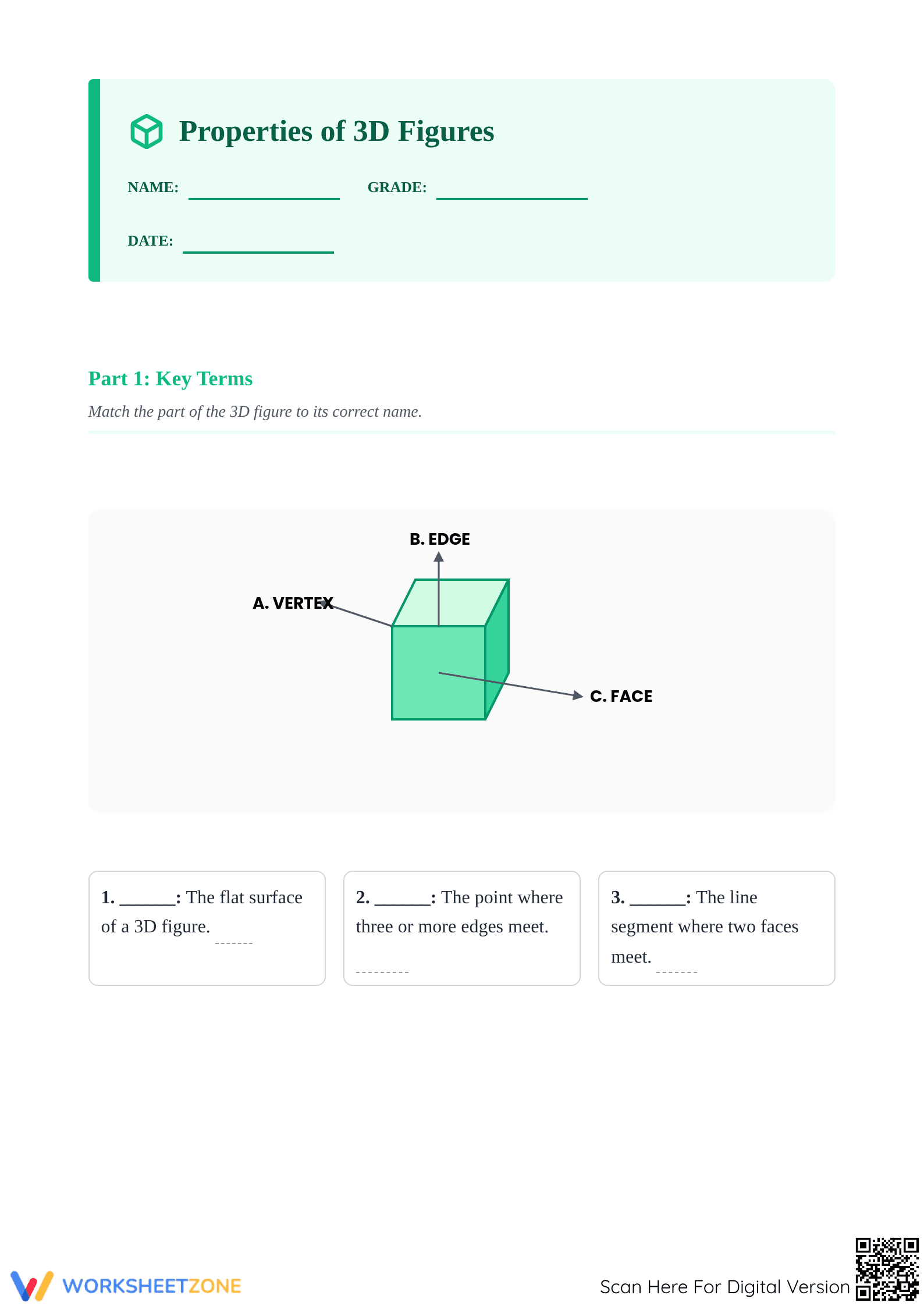
This four-page instructional resource provides a robust exploration of solid geometry. Pages one and two feature detailed illustrations of figures from cones to hexagonal prisms, with space for recording faces, edges, and vertices. Page three offers a matching activity to solidify vocabulary, while the final page categorizes shapes by properties. A full four-page answer key ensures rapid grading or student self-check.
Zero-Prep Workflow
This classroom-ready resource is designed for immediate use. Teachers can follow a three-step process: Print the four-page packet (1 minute), Distribute to individuals (1 minute), and Review using the provided answer key (5 minutes). Total preparation time is under two minutes, making this an ideal solution for emergency sub plans or homework assignments where clarity and student independence are paramount.
Standards Alignment
This worksheet aligns with CCSS.MATH.CONTENT.2.G.A.1: "Recognize and draw shapes having specified attributes, such as a given number of equal faces." By requiring students to decompose 3D figures into constituent parts—faces, edges, and vertices—the activity supports mastery of geometric attributes. This standard code can be copied directly into lesson plans or district curriculum mapping tools to ensure instructional compliance. Supporting standards include 1.G.A.1 for basic identification and 3.G.A.1 for categorization.
How to Use It
Deploy this packet during independent practice after an initial lesson on solid figures. It serves as a bridge between concrete manipulatives and abstract diagrams. For a formative assessment tip, observe students analyzing prisms; those struggling with "hidden" edges may need physical 3D models for support. The packet typically requires 30 to 45 minutes for completion. It works effectively as a post-lesson assessment or a comprehensive review before a geometry unit test.
Who It's For
This resource is tailored for second and third-grade students working on foundational geometry standards. It is effective for visual learners who benefit from clear, high-contrast diagrams of complex shapes. Differentiation is naturally supported as the packet moves from familiar cubes to challenging pentagonal prisms. Pair this worksheet with a set of geometric solids or an anchor chart displaying key vocabulary.
Effective geometry instruction requires a shift from simple recognition to the analysis of attributes, a transition supported by this worksheet's focus on faces, edges, and vertices. According to the RAND AIRS 2024 analysis of mathematics curricula, providing students with structured practice in identifying discrete geometric properties is essential for developing the mental rotation skills required for higher-order mathematical reasoning. This Grade 2 worksheet on 3D figure properties utilizes 26 targeted problems to bridge the gap between perceptual observation and conceptual categorization. By systematically guiding learners through the naming and analysis of ten different 3D solids, the resource ensures that students move beyond surface-level identification toward a deep, attribute-based understanding of the CCSS.MATH.CONTENT.2.G.A.1 standard. This data-driven approach allows for precise monitoring of student progress and provides clear evidence of mastery for geometry-focused learning objectives, making it an essential component of any primary geometry curriculum.


